Patrick Stewart Biography: The Incredible Journey of a Hollywood Icon
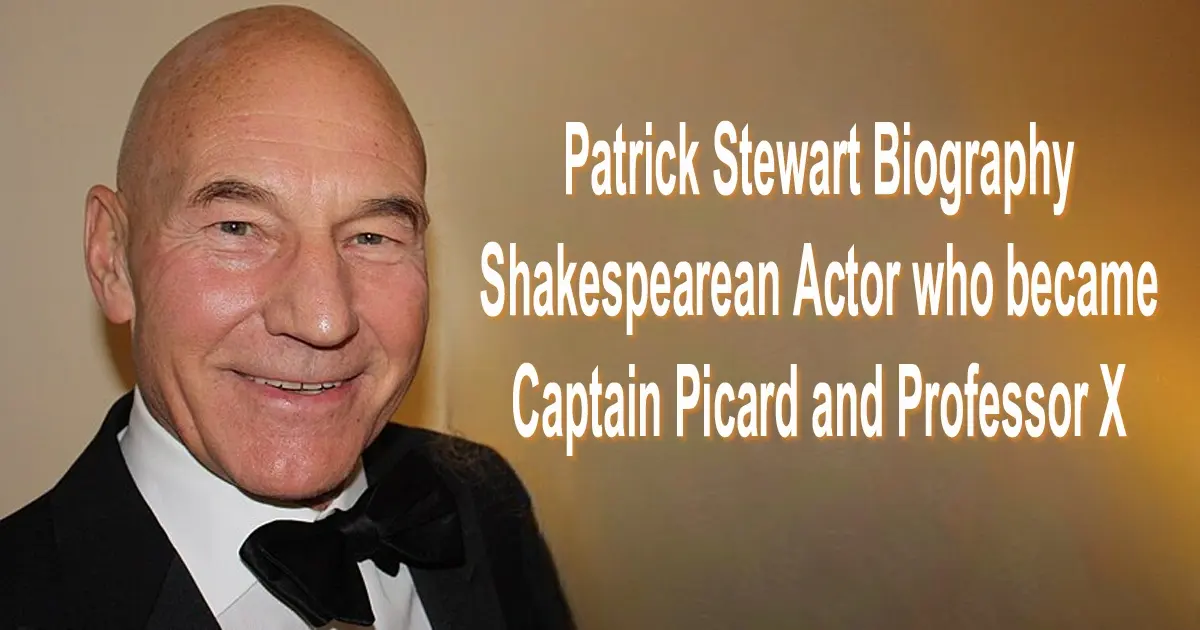
Sir Patrick Stewart was one of the most celebrated actors of his generation, a classically trained Shakespearean performer who became a global icon of science fiction and superhero cinema. Rising from a poor working class childhood in Yorkshire, he spent decades as a respected stage actor in Britain before, in his late forties, landing the role that would make him a household name around the world. His career spanned nearly seven decades, from provincial theaters in 1959 to the blockbuster screens and Broadway stages of the twenty first century.
Sir Patrick Stewart (July 13, 1940, to October 28, 2026) was an English stage and screen actor whose career spanned nearly seven decades. A longtime member of the Royal Shakespeare Company, he became an international star as Captain Jean-Luc Picard in Star Trek: The Next Generation (1987 to 1994), four feature films, and Star Trek: Picard (2020 to 2023). He also played Professor Charles Xavier in the X-Men film series, including Logan (2017). Stewart won Olivier Awards and a Grammy Award, was knighted in 2010, and was a prominent advocate for survivors of domestic violence, veterans, and refugees.
As a performer, Stewart was defined by his commanding voice, his precision, and his ability to bring dignity, intelligence, and deep humanity to every role. Whether playing kings and tragic heroes for the Royal Shakespeare Company or leaders of starships and mutants, he invested his characters with moral authority and emotional depth, elevating material that in lesser hands might have seemed fantastical into something profound.
Publicly, Stewart became beloved not only for his roles but for his warmth, wit, and humility. He spoke openly about the domestic violence he witnessed as a child and devoted much of his life to helping survivors, veterans, refugees, and rescue animals. His transformation from the reserved, serious stage actor into a playful, self deprecating public figure endeared him to millions, and his endurance came from his talent, his conscience, and his generosity of spirit.
In “The Inner Light,” the Next Generation episode in which Picard lives an entire lifetime on a vanished alien world in a matter of minutes, he raises a family and grows old as a man named Kamin. The young actor who played Kamin’s son, Batai, was Stewart’s real son, Daniel Stewart. One of the most beloved episodes in Star Trek history quietly featured a father and son sharing the screen.
👶 Early Life
Summary: Born in Mirfield, Yorkshire, in 1940, Stewart grew up poor in a violent household before an inspiring teacher and a grant to the Bristol Old Vic Theatre School set him on his path.
🏡 Birth in Mirfield
Patrick Stewart was born on July 13, 1940, in Mirfield, in the West Riding of Yorkshire, England. He was the youngest of three sons of Gladys Stewart (née Barrowclough), a weaver and textile worker, and Alfred Stewart, a regimental sergeant major in the British Army’s Parachute Regiment during World War II who later worked as a general laborer and postman. His older brothers were Geoffrey and Trevor.
💔 A Difficult Childhood
Stewart grew up in poverty in a working class home in Mirfield, in a house that had no bathroom. His childhood was marked by fear. His father, who had served during the Dunkirk evacuation and suffered from what was then called combat fatigue, now understood as post traumatic stress disorder, was prone to violent outbursts against Stewart’s mother. Stewart later described feeling, as a child, that he was somehow responsible for the pain and misery he witnessed, experiences that shaped his character, his art, and his lifelong activism.
📖 A Teacher Who Changed Everything
Stewart attended Crowlees Junior and Infant School, a Church of England school in Mirfield, and later entered Mirfield Secondary Modern School in 1951. He credited his English teacher, Cecil Dormand, with launching his acting career by putting a copy of Shakespeare in his hands and telling him to stand up and perform. From around the age of twelve, he joined local amateur drama groups, and as a teenager he memorized Shakespeare for pleasure. Around this time, on a drama course, he met and befriended the future actor Brian Blessed.
📰 Reporter and Salesman
At fifteen, Stewart left school. He worked as a reporter and obituary writer for a local newspaper while continuing to act in local theater, but he frequently skipped work to attend rehearsals. After a year his editor gave him an ultimatum to choose between journalism and acting, and he chose acting. He then took a job as a furniture salesman, saving money for drama school while discovering that tailoring his sales pitch to each customer was its own kind of performance. He also trained as a boxer.
🎓 Bristol Old Vic Theatre School
In 1957, at seventeen, Stewart received a grant from the West Riding Council to attend the Bristol Old Vic Theatre School, one of Britain’s most respected drama schools. Brian Blessed received a grant as well. Stewart spent two years there, including intensive vocal training that helped him master the classical diction that would become his trademark.
Explore the Biographies of Iconic Celebrities
🎭 Shakespeare and the Stage
Summary: A Royal Shakespeare Company member from 1966 to 1982, Stewart won Olivier Awards and triumphed in Macbeth, Hamlet, A Christmas Carol, and Waiting for Godot.
🎬 Professional Debut
Stewart made his first professional stage appearance on May 19, 1959, at the Theatre Royal in Bristol with the Bristol Old Vic Company, playing a small role in Cyrano de Bergerac. He went on to work in repertory theater across England, including a period with Manchester’s Library Theatre, and toured Australia, New Zealand, and South America with the Old Vic Company opposite Vivien Leigh.
👑 The Royal Shakespeare Company
In 1966, Stewart joined the Royal Shakespeare Company, beginning one of the most important associations of his life. He became an associate artist in 1967 and remained a core member of the company until 1982, appearing in more than sixty productions and taking on three or four major roles each season alongside actors such as Ben Kingsley and Ian Richardson. He made his Broadway debut as Snout in Peter Brook’s landmark 1970 production of A Midsummer Night’s Dream, and in the early 1980s he moved to the Royal National Theatre.
🏆 Antony and Cleopatra
In 1979, Stewart won the Laurence Olivier Award for Best Actor in a Supporting Role for his performance in Antony and Cleopatra in the West End, confirming his status as one of Britain’s leading classical actors.
🎄 A Christmas Carol
During his years in Hollywood, Stewart missed the stage and began creating one man shows. The most famous was his adaptation of Charles Dickens’s A Christmas Carol, in which he played all of the more than forty characters himself. He brought it to Broadway in 1991 and returned with it in 1992, 1994, and 2001, when all proceeds went to charity, as well as to London and Los Angeles. He won the Drama Desk Award for Best Solo Performance in 1992 and an Olivier Award for the show in London. He co-produced it through his company, Camm Lane Productions, named for the street where he was born.
🌊 The Tempest and Othello
Stewart played Prospero in The Tempest on Broadway in 1995 and again for the Royal Shakespeare Company in 2006. In 1997, he played the title role in a groundbreaking “photo negative” production of Othello at the Shakespeare Theatre Company in Washington, D.C., in which a white Othello was surrounded by an otherwise all Black cast, turning the play into a commentary on a white man entering a Black society. He had dreamed of playing Othello since he was fourteen.
🗡️ Macbeth (2007 to 2008)
Stewart triumphed as Macbeth in Rupert Goold’s acclaimed production, set in a Soviet style dictatorship, which played at the Chichester Festival Theatre, in London’s West End, at the Brooklyn Academy of Music, and on Broadway in 2008. Critics who had wondered whether he was too old for the role hailed him as one of the finest Shakespearean actors of his time, and he received a Tony Award nomination for Best Actor in a Play.
👻 Hamlet (2008)
In 2008, Stewart played Claudius and the Ghost opposite David Tennant‘s Hamlet in a celebrated Royal Shakespeare Company production. He won his second competitive Olivier Award for Best Supporting Actor, dedicating it in part to Tennant, whose back injury had forced him to miss weeks of performances.
🎩 Waiting for Godot and No Man’s Land
In 2009, Stewart starred with his close friend Ian McKellen in Samuel Beckett’s Waiting for Godot in London, fulfilling a fifty year ambition that began when he saw Peter O’Toole in the play at the Bristol Old Vic as a seventeen year old student. In 2013 and 2014, the two friends brought Godot to Broadway in repertory with Harold Pinter’s No Man’s Land, earning wide acclaim.
🎬 Film and TV Career
Summary: From I, Claudius and Dune to Moby Dick, Extras, American Dad!, and Green Room, Stewart built a remarkably varied screen career.
📺 Early British Television
Stewart made his television debut in January 1967 as a fire officer on Coronation Street. He went on to play Vladimir Lenin in Fall of Eagles (1974), the romantic lead in the BBC’s North and South (1975), and the ruthless Sejanus in the acclaimed BBC drama I, Claudius (1976). He played the Soviet spymaster Karla, a nearly silent but unforgettable role, opposite Alec Guinness in Tinker Tailor Soldier Spy (1979) and Smiley’s People (1982), and he played Claudius in the BBC’s 1980 Hamlet.
⚔️ Excalibur (1981) and Dune (1984)
Stewart played King Leondegrance in John Boorman’s Arthurian epic Excalibur (1981). In David Lynch‘s science fiction epic Dune (1984), he played Gurney Halleck, the loyal warrior troubadour of House Atreides, charging into battle with a pug dog under his arm. He also appeared in Tobe Hooper‘s science fiction horror film Lifeforce (1985) and as Henry Grey, Duke of Suffolk, in Trevor Nunn’s Lady Jane (1986).
🎭 Comedy in the 1990s
Between his Star Trek commitments, Stewart showed his comic gifts. He played an imperious restaurant maître d’ in Steve Martin‘s L.A. Story (1991) and King Richard the Lionheart in Mel Brooks‘s parody Robin Hood: Men in Tights (1993). In Jeffrey (1995), he won praise as Sterling, a flamboyant gay interior decorator, and he played a sinister psychiatrist in Conspiracy Theory (1997) opposite Mel Gibson and Julia Roberts.
🐋 Moby Dick (1998)
Stewart starred as the obsessed Captain Ahab in the USA network miniseries Moby Dick (1998), an adaptation of Herman Melville’s novel. His intense performance earned him Emmy and Golden Globe nominations.
👻 A Christmas Carol (1999)
Stewart brought his celebrated Scrooge to the screen in the TNT television film A Christmas Carol (1999), a darker, more psychologically rich version of the Dickens classic. He received a Screen Actors Guild Award nomination for his performance.
👑 The Lion in Winter (2003)
Stewart played King Henry II of England opposite Glenn Close‘s Eleanor of Aquitaine in Andrei Konchalovsky’s Showtime film The Lion in Winter (2003). He received a Golden Globe nomination for his performance and an Emmy nomination as an executive producer of the film.
😂 Frasier (2003) and Extras (2005)
Stewart received Emmy nominations for two hilarious guest roles. On Frasier, he played Alistair Burke, a Seattle opera director who mistakes Kelsey Grammer’s Frasier for a romantic prospect. On Ricky Gervais and Stephen Merchant’s Extras, he played an outrageous, nudity obsessed caricature of himself pitching an absurd screenplay.
🎙️ American Dad and Family Guy
Beginning in 2005, Stewart provided the voice and likeness of CIA Deputy Director Avery Bullock on Seth MacFarlane‘s animated comedy American Dad!, a role he played for nearly two decades. He also made guest appearances on MacFarlane’s Family Guy and served as the narrator of MacFarlane’s comedy film Ted (2012).
📺 Blunt Talk (2015 to 2016)
Stewart starred as Walter Blunt, a British news anchor in Los Angeles struggling with his personal demons, in the Starz comedy Blunt Talk (2015 to 2016), produced by Seth MacFarlane.
🎸 Green Room (2015)
Stewart delivered a chilling performance against type as Darcy Banker, the calm, calculating owner of a neo Nazi bar who orders the killing of a young punk band, in Jeremy Saulnier’s thriller Green Room (2015). Critics praised him for his quiet, terrifying menace.
🎥 Later Films
Stewart played the wizard Merlin in Joe Cornish’s family adventure The Kid Who Would Be King (2019) and John Bosley in Elizabeth Banks’s Charlie’s Angels (2019). He also lent his voice to animated films including The Pagemaster (1994), The Prince of Egypt (1998), Jimmy Neutron: Boy Genius (2001), Chicken Little (2005), and Gnomeo & Juliet (2011).
🎙️ A Voice for Generations
Stewart’s rich, resonant voice made him one of the most sought after narrators of his era. He narrated recordings of Prokofiev’s Peter and the Wolf, for which he won a Grammy Award, as well as C. S. Lewis’s The Last Battle, nature and astronomy documentaries, video games, and countless commercials.
🖖 Captain Jean-Luc Picard
Summary: As Captain Picard in Star Trek: The Next Generation, four films, and Star Trek: Picard, Stewart created one of television’s most admired leaders.
📚 A Fateful Reading at UCLA
In 1987, Robert H. Justman, a producer of Gene Roddenberry‘s new Star Trek revival, saw Stewart give a literary reading at UCLA and was struck by his commanding presence. Stewart knew almost nothing about Star Trek or its place in American culture. He reluctantly signed a standard six year contract, convinced, as were his agent and friends, that the show would quickly fail and he would soon return to the London stage. His friend Ian McKellen even urged him not to throw away his theater career for television.
🚀 Star Trek: The Next Generation (1987 to 1994)
Stewart was cast as Captain Jean-Luc Picard, commander of the USS Enterprise D, in Star Trek: The Next Generation (1987 to 1994). The Los Angeles Times described him as an unknown British Shakespearean actor. Picard was a new kind of starship captain: a cultured, thoughtful diplomat who preferred negotiation to fighting, quoted Shakespeare, loved archaeology and classical music, and led by moral example. Stewart played him with gravity, warmth, and quiet authority, and the series became a phenomenon, running for seven seasons and 178 episodes.
⭐ A Captain Like No Other
Picard’s most memorable moments became television classics. In the two part episode “The Best of Both Worlds,” he was captured and assimilated by the Borg, becoming the terrifying Locutus. In “The Inner Light,” he lived an entire lifetime in a few minutes on a vanished planet. In “Chain of Command,” he endured torture by a Cardassian interrogator while defiantly insisting on the truth. His orders “Make it so” and “Engage” became catchphrases recognized around the world.
🤝 Leader On and Off the Set
Stewart’s professionalism set the tone for the entire cast. Fellow actors credited him with much of the show’s success, saying that his meticulous preparation raised everyone’s standards. Over time he relaxed into the role and became a close friend and advocate for his castmates, a bond that lasted the rest of his life.
🎬 The Next Generation Films
Stewart played Picard in four feature films. In David Carson’s Star Trek Generations (1994), Picard joined forces with William Shatner‘s Captain Kirk. In Star Trek: First Contact (1996), directed by co-star Jonathan Frakes, Picard confronted the Borg and his own trauma in what many fans consider the finest of the Next Generation films. Frakes also directed Star Trek: Insurrection (1998), and the crew’s final voyage came in Star Trek: Nemesis (2002), in which Picard faced Shinzon, a clone of himself played by a young Tom Hardy.
🍇 Star Trek: Picard (2020 to 2023)
In 2018, Stewart announced that he would return to the role, and Star Trek: Picard (2020 to 2023) followed an aging, retired Picard drawn back into adventure. The series ran for three seasons, and its final season, which reunited the cast of The Next Generation, was hailed by fans and critics as a triumphant farewell to the beloved crew.
🎬 Read more about Walter Koenig in our exclusive bio.
🧠 Professor Charles Xavier
Summary: Stewart’s wise and compassionate Professor X helped launch the modern superhero era and culminated in his acclaimed performance in Logan.
🦸 X-Men (2000)
Although wary of joining another franchise, Stewart was persuaded by director Bryan Singer to play Professor Charles Xavier, the telepathic founder of a school for gifted young mutants, in X-Men (2000). His old friend Ian McKellen co-starred as Xavier’s friend turned adversary, Magneto. The film launched a new era of superhero cinema, and Stewart’s wise, compassionate Xavier became as iconic as his Picard.
🎬 The X-Men Series
Stewart played Xavier in X2 (2003), X-Men: The Last Stand (2006), and X-Men: Days of Future Past (2014), and made brief appearances in X-Men Origins: Wolverine (2009) and The Wolverine (2013). Alongside Hugh Jackman‘s Wolverine, his Xavier became the moral heart of one of the most successful film franchises of the era.
🌵 Logan (2017)
Stewart gave one of the most moving performances of his career in James Mangold’s Logan (2017), playing a frail, elderly Charles Xavier suffering from a degenerative brain disease that causes devastating psychic seizures, cared for by a weary Logan in a bleak near future. Critics hailed his performance as heartbreaking and among the finest work of his film career.
🌀 The Marvel Cinematic Universe
Stewart returned to the role in Sam Raimi‘s Doctor Strange in the Multiverse of Madness (2022), playing an alternate universe Charles Xavier, and he filmed scenes reprising the role for Avengers: Doomsday, scheduled for release in December 2026.
In 1992, the readers of TV Guide named Stewart television’s “most bodacious” man, alongside supermodel Cindy Crawford as the most bodacious woman. The classically trained actor admitted he had never heard of her.
❤️ Personal Life
Summary: Married three times and the father of two, Stewart championed survivors of domestic violence, veterans, refugees, and rescue dogs, and shared a famous friendship with Ian McKellen.
💍 Marriage to Sheila Falconer (1966 to 1990)
In 1966, Stewart married Sheila Falconer, a choreographer. They had two children, a son, Daniel, who became an actor, and a daughter, Sophie. The marriage ended in divorce in 1990. Stewart later admitted that his greatest regrets were the failures of his marriages.
💍 Marriage to Wendy Neuss (2000 to 2003)
Stewart became engaged in 1997 to Wendy Neuss, one of the producers of Star Trek: The Next Generation. They married on August 25, 2000, and divorced three years later.
💍 Marriage to Sunny Ozell (2013 to 2026)
In 2008, Stewart began dating the American singer and songwriter Sunny Ozell, whom he met while performing Macbeth at the Brooklyn Academy of Music. They lived together in Brooklyn’s Park Slope neighborhood and married in September 2013, with Ian McKellen officiating. Ozell remained his wife for the rest of his life.
Stewart’s famous 2013 wedding to Sunny Ozell, officiated by Ian McKellen in Nevada, was not actually legally binding because McKellen’s credentials were not valid there. Knowing this in advance, the couple had secretly held an official ceremony with McKellen a couple of weeks earlier at a Mexican restaurant in Los Angeles.
🤝 Friendship with Ian McKellen
Stewart’s friendship with Ian McKellen became one of the most beloved in show business. Their bond deepened during the long waits on the X-Men film sets and flourished in their stage collaborations. Their playful public appearances together endeared them to fans around the world and revealed Stewart’s sense of humor to a new audience.
💜 Fighting Domestic Violence
Drawing on his own childhood, Stewart became a powerful advocate against domestic violence. He made a 2006 video for Amnesty International describing his father’s attacks on his mother, became a patron of Refuge, the British charity for women and children experiencing domestic violence, and founded a scholarship at the University of Huddersfield to fund postgraduate research on domestic violence. He repeatedly emphasized that violence is a choice and that survivors can heal.
🎖️ Supporting Veterans
While researching his family history for the documentary series Who Do You Think You Are?, Stewart learned that his father had suffered from post traumatic stress after his wartime service. The discovery transformed his understanding of his father, and he became a supporter of Combat Stress, a British charity for veterans with mental health conditions.
🌍 Human Rights and Refugees
Stewart was a patron of the United Nations Association UK and served as a spokesperson for the International Rescue Committee on behalf of global refugees. He was also a lifelong supporter of the Labour Party, a humanist, and a patron of Dignity in Dying, which campaigns for the right to assisted dying.
🐶 Champion of Pit Bulls
In his later years, Stewart became a passionate advocate for pit bulls, fostering dogs through the Los Angeles rescue organization Wags and Walks. In 2021 the ASPCA honored him with its Pit Bull Advocate and Protector Award.
⚽ Huddersfield Town
Stewart was a lifelong supporter of his local football club, Huddersfield Town, and served as president of the club’s academy for young players beginning in 2010. He was at Wembley Stadium in 2017 when the club won promotion to England’s top division for the first time since 1972.
📖 Making It So (2023)
In 2023, Stewart published his memoir, Making It So, a candid and moving account of his difficult childhood, his life in the theater, his unlikely rise to Hollywood stardom, and his marriages and friendships. The book was widely praised for its warmth and honesty.
When Stewart arrived in Hollywood, an American actor had already registered the name “Patrick Stewart” with the Screen Actors Guild. For about 18 months, the future Captain Picard worked under the name “Patrick Hewes Stewart” while he negotiated the rights to his own name.
🕊️ Later Years and Death
Summary: Knighted in 2010, Stewart died at his Los Angeles home on October 28, 2026, at 86, after a brief battle with Alzheimer’s disease and Lewy body dementia.
🏆 Honors and Recognition
Stewart received a star on the Hollywood Walk of Fame on December 16, 1996. He was appointed an Officer of the Order of the British Empire in 2001 and was made a Knight Bachelor in the 2010 New Year Honours for services to drama, receiving the honor from Queen Elizabeth II at Buckingham Palace on June 2, 2010.
Over his career he received Olivier Awards, a Grammy Award, and nominations for a Tony Award, three Golden Globe Awards, four Emmy Awards, and three Screen Actors Guild Awards. He served as chancellor of the University of Huddersfield from 2004 to 2015, and a university building was renamed in his honor in 2016. He received numerous honorary degrees and carried the Olympic torch in the 2012 relay for the London Summer Olympics.
🎭 A Late Career Renaissance
In his seventies and eighties, Stewart enjoyed a remarkable creative renaissance, returning to Picard, revisiting Xavier, publishing his memoir, and embracing a joyful public persona through social media, where he shared readings of Shakespeare’s sonnets and photographs of his foster dogs with millions of followers.
⚰️ Death
Sir Patrick Stewart died on October 28, 2026, at the age of 86, at his home in Los Angeles, California. According to his longtime spokesperson, Kelly Bush Novak, he died in the loving care of his wife, Sunny, following a brief and poignant journey with Alzheimer’s disease and Lewy body dementia, diagnoses that had not been previously disclosed. He was survived by his wife, Sunny Ozell, his son, Daniel, and his daughter, Sophie. His death came just days after that of Walter Koenig, another member of the Star Trek family. Tributes poured in from around the world, including from Hugh Jackman, Seth MacFarlane, Marvel Studios, and the Royal Shakespeare Company, which called him a colossus of stage and screen.
🏆 Legacy
🌟 The Captain of a Generation
For millions of viewers, Jean-Luc Picard represented the ideal leader: thoughtful, principled, compassionate, and courageous. Stewart’s portrayal helped transform Star Trek into a vehicle for serious moral and philosophical storytelling, and his captain inspired countless people to pursue careers in science, diplomacy, and public service.
🎭 Bridging High Art and Popular Culture
Stewart’s career demolished the line between classical theater and popular entertainment. He proved that a Shakespearean actor could become a science fiction and superhero icon without sacrificing artistic integrity, and that genre roles could be performed with the same seriousness as Shakespeare. He once observed that all his years playing kings and tragic heroes had been preparation for sitting in the captain’s chair.
💪 From Trauma to Advocacy
Perhaps Stewart’s most profound legacy lies in how he transformed childhood pain into compassion. By speaking openly about domestic violence and his father’s wartime trauma, he gave a voice to survivors and veterans and showed that cycles of violence can be broken.
😄 A Joyful Public Presence
In his later years, Stewart revealed a playful, self deprecating side that delighted audiences. His comedy roles, his friendship with Ian McKellen, and his warm, witty presence on social media made him not only respected but genuinely loved by people of every generation.
🏆 Patrick Stewart’s Place in American Entertainment
Though he was proudly a son of Yorkshire, Sir Patrick Stewart became one of the defining figures of American popular culture, a Shakespearean actor who took command of the starship Enterprise, led the X-Men, and reshaped what audiences expected from science fiction and superhero storytelling. His legacy is ultimately one of dignity and compassion, of a boy from a home without a bathroom who rose to the heights of stage and screen, used his fame to protect the vulnerable, and left behind characters whose wisdom and humanity will continue to inspire people to boldly go where no one has gone before.
🗣️ Why He Still Matters
Patrick Stewart still matters because he showed the world what principled leadership looks like. His Captain Picard and Professor Xavier taught generations of viewers that wisdom, empathy, and moral courage are stronger than force, and those characters continue to inspire new fans through streaming, films, and conventions. On stage, he proved that Shakespeare belongs to everyone, and off stage he turned the pain of his childhood into a lifelong fight against domestic violence and for veterans and refugees. In an age that often prizes cynicism, his legacy remains a reminder to lead with decency, speak for the vulnerable, and, as Picard would say, make it so.