🎬 Gregory Peck Biography: Timeless Strength and Moral Courage

Few actors carried moral authority on screen the way Gregory Peck did. Tall, composed, and unmistakably steady in his presence, he became the embodiment of conscience in mid-twentieth-century American cinema. Audiences did not merely watch him; they trusted him. In an era when Hollywood often celebrated charm or bravado, Peck stood for principle.
Gregory Peck was one of the most respected leading men of classic Hollywood, known for portraying principled, morally grounded characters. His Academy Award-winning performance as Atticus Finch in To Kill a Mockingbird (1962) cemented his place in American film history. Across decades, he balanced literary adaptations, war dramas, westerns, and thrillers with quiet authority. His career reflects discipline, integrity, and enduring cultural influence.
His performances shaped some of the most respected films of their time, none more enduring than his portrayal of Atticus Finch in To Kill a Mockingbird. That role did more than win awards. It fixed his image in the public mind as a symbol of quiet strength and moral clarity. He brought gravity without stiffness, compassion without sentimentality, and a measured dignity that elevated every scene he entered.
Beyond individual roles, Peck represented a certain standard of leading man that has grown rare. He favored characters who wrestled with duty, justice, and responsibility rather than simple heroics. Off screen, he carried himself with the same thoughtful reserve, reinforcing the impression that his screen persona was not an act but an extension of character. In the broad sweep of American film history, Gregory Peck stands as one of its most principled figures.
Atticus Finch was not just a role for Peck. It became a national symbol of justice and conscience, shaping how generations understood moral courage.
👶 Early Life
Summary: His early life built the discipline and independence that later shaped his composed screen presence.
Gregory Peck was born Eldred Gregory Peck on April 5, 1916, in San Diego, California. His early years were marked by change and adjustment after his parents separated, and he spent much of his childhood living with relatives. That sense of independence, shaped early, would later contribute to the quiet self-reliance that defined him both on and off screen.
He attended San Diego High School, where he first showed signs of confidence in public settings. Tall and athletic, he was active in school life, though acting was not yet a serious ambition. After high school, he enrolled at San Diego State College before transferring to the University of California, Berkeley. It was there, amid academic life and campus activities, that his interest in performance began to take clearer form.
At Berkeley, Peck became involved in theater productions, discovering a natural ease before an audience. The stage offered discipline as well as direction, and he approached it with steady commitment rather than theatrical flourish. By the time he completed his studies, the foundation for a professional acting career had quietly taken shape.
While at Berkeley, Peck became involved in theater productions, discovering a natural ease before an audience. Around that same period, he took on what he later described as his first professional stage work as a “grinder” at the 1939 New York World’s Fair. Stationed outside attractions, he delivered energetic pitches to persuade passersby to buy tickets and step inside. The job demanded projection, rhythm, and the ability to command attention in seconds, skills that would quietly serve him throughout his career.
Explore the Biographies of Iconic Celebrities
Gregory Peck insisted that newcomer Audrey Hepburn receive equal billing in Roman Holiday, helping launch her career.
🎬 Movie Career
Summary: Through iconic films and major collaborations, Peck established himself as one of Hollywood’s most principled leading men.
Gregory Peck’s rise in Hollywood was swift and decisive. After training at the Neighborhood Playhouse in New York, he transitioned to film in the mid-1940s and quickly established himself as a leading man of unusual depth. His early performances revealed a natural authority that set him apart from many of his contemporaries. Within just a few years, he was working alongside major directors and commanding top billing.
He earned his first Academy Award nomination for The Keys of the Kingdom (1944), portraying a compassionate missionary priest. The performance announced the arrival of a serious actor capable of carrying moral weight without melodrama. That same steadiness carried into Spellbound (1945), directed by Alfred Hitchcock, where he starred opposite Ingrid Bergman. Hitchcock’s psychological thriller gave Peck a chance to explore vulnerability beneath his composed exterior.
In Duel in the Sun (1946), he worked with producer David O. Selznick and co-starred with Jennifer Jones in a sweeping western melodrama. The film contrasted sharply with his more restrained roles, showing that he could inhabit darker, conflicted characters. That versatility continued in Gentleman’s Agreement (1947), directed by Elia Kazan, in which Peck confronted anti-Semitism in postwar America. The film won the Academy Award for Best Picture and strengthened his reputation as an actor drawn to socially conscious material.
The 1950s expanded his range further. In Twelve O’Clock High (1949), he portrayed a stern Air Force commander grappling with leadership under wartime strain. His performance was widely praised for its psychological realism. He then stepped into adventure with The Gunfighter (1950), a restrained western that subverted genre expectations, and later brought gravitas to literary adaptations such as Moby Dick (1956), directed by John Huston, in which he played Captain Ahab.
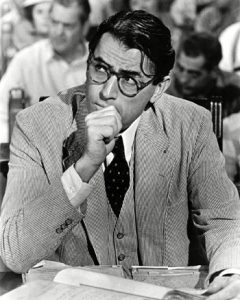
Peck’s most iconic role came with To Kill a Mockingbird (1962), directed by Robert Mulligan and adapted from Harper Lee’s novel. As Atticus Finch, he delivered a performance of quiet strength that earned him the Academy Award for Best Actor. Acting opposite young performers and a powerful supporting cast, he created a character that transcended the screen and entered American cultural memory.
He continued to take on varied roles throughout the 1960s and 1970s, including Cape Fear (1962), where he squared off against Robert Mitchum in a tense psychological thriller. In The Omen (1976), he confronted supernatural horror, proving that even later in his career he was willing to explore new territory. Across decades, Peck worked with leading actresses such as Audrey Hepburn in Roman Holiday (1953), a film that launched Hepburn to stardom and revealed Peck’s generosity as a co-star.
Throughout his film career, Gregory Peck balanced prestige dramas, literary adaptations, westerns, and thrillers. He collaborated with major directors, held his own opposite strong co-stars, and maintained a consistent screen identity built on integrity and restraint. His body of work reflects not only longevity but discernment, marking him as one of Hollywood’s most respected leading men.
Gentleman’s Agreement Blu-ray
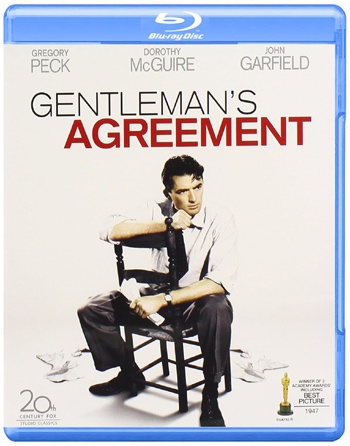
Product Description:
A powerful drama starring Gregory Peck as a magazine writer who poses as a Jew to expose anti-Semitism in postwar America. Directed by Elia Kazan, this Academy Award-winning film remains one of Hollywood’s most direct examinations of prejudice and moral responsibility.
Award Recognition:
• Academy Award for Best Picture
• Academy Award for Best Director – Elia Kazan
• Academy Award for Best Supporting Actress – Celeste Holm
Why This Film Matters:
Released in 1947, Gentleman’s Agreement confronted social intolerance at a time when few major studios were willing to do so. Gregory Peck’s restrained performance anchors the film with quiet conviction, while the supporting cast delivers sharp, realistic portrayals of casual discrimination. The film stands as one of the earliest mainstream Hollywood works to tackle anti-Semitism head-on, cementing its place in American film history.
❤️ Personal Life
Summary: His personal life reflected quiet strength, civic involvement, and deep commitment to family and values.
Gregory Peck’s personal life reflected the same steadiness that characterized his screen presence. He married Finnish-born Greta Kukkonen in 1942, and the couple had three sons before divorcing in 1955. Later, he married French journalist Veronique Passani in 1955, and the couple had two children, remaining together for the rest of his life. Those close to him often described him as private but warm, a man who valued loyalty and family above publicity.
Tragedy touched his life with the loss of his eldest son, Jonathan, an event that deeply affected him and reinforced his natural reserve. Yet Peck rarely allowed personal sorrow to become public spectacle. He maintained dignity in the face of hardship, choosing composure over display. That quiet resilience strengthened the respect many already held for him.
Beyond family, Peck was active in civic and cultural life. He served in leadership roles within the film community and supported humanitarian and political causes that reflected his long-held beliefs. Unlike some contemporaries who separated public persona from private conviction, Peck’s values appeared consistent across both arenas. His personal life, though guarded, revealed a man guided by principle rather than celebrity.
Gregory Peck was originally hesitant to accept the role of Atticus Finch, unsure he could live up to the character’s moral stature. That performance would later become the defining role of his career.
🕊️ Later Years
Summary: In later years, Peck embraced reflection and recognition, securing his place in cinematic history.
In his later years, Peck stepped back from the demanding pace of film production but never disappeared from public life. He became more selective with screen roles, choosing projects that reflected maturity and substance rather than box-office appeal. Appearances in films such as The Boys from Brazil (1978) showed he could still command the screen, even when cast against type. Yet increasingly, he preferred the stage and special presentations to the grind of major studio productions.
Peck also embraced retrospectives and speaking engagements that celebrated the golden age of Hollywood. He toured with presentations that included clips from his most famous films, offering audiences thoughtful reflections on craft, responsibility, and storytelling. These events revealed a reflective man aware of his place in film history but never boastful about it. His manner remained measured, his voice unmistakably steady.
Recognition continued to follow him. He received lifetime achievement honors and industry tributes that acknowledged both his artistic contributions and his integrity. As younger generations rediscovered his work, particularly To Kill a Mockingbird (1962), Peck’s image as a moral compass of American cinema only deepened.
Gregory Peck died on June 12, 2003, at his home in Los Angeles at the age of 87. His passing marked the end of one of Hollywood’s most distinguished careers, but his legacy endures through performances that continue to define courage, conscience, and quiet strength in American film.
He was awarded the Presidential Medal of Freedom in 1969 for his humanitarian efforts.
🏆 Legacy
Gregory Peck’s legacy rests on more than a list of celebrated films. He came to represent a particular kind of screen presence that is increasingly rare: principled, thoughtful, and grounded in moral conviction. At a time when Hollywood often rewarded spectacle, Peck built his reputation on restraint. His performances suggested strength without aggression and authority without arrogance.
His portrayal of Atticus Finch in To Kill a Mockingbird (1962) remains one of the most influential performances in American cinema. For many viewers, the character became inseparable from the man. Lawyers, teachers, and public servants have cited that role as formative, proof that film can shape cultural ideals. Peck’s image as a moral center extended beyond entertainment and into the broader national imagination.
Within the industry, he is remembered as a steady collaborator who elevated the material and supported his co-stars. He worked across genres without losing his identity, from literary adaptations to westerns and thrillers. Few actors have maintained such consistency over decades while avoiding self-parody or excess.
Today, Gregory Peck stands as a benchmark for dignity in film. His body of work reflects discipline, intelligence, and quiet power. Long after trends have shifted and styles have changed, his performances continue to resonate, reminding audiences that integrity, when convincingly portrayed, never goes out of fashion.
🗣️ Why They Still Matter
Gregory Peck’s performances continue to resonate because they reflect enduring values. In an era of shifting trends and rapid fame, his work stands as a reminder that integrity, restraint, and moral clarity never lose their power.
Further Reading & Resources
📖 Read: Gregory Peck | Biography, Movies, & Facts | Britannica
🔍 Explore: Gregory Peck - Biography