🎃 Burnt Offerings Review: The Terrifying House That Feeds on Its Guests
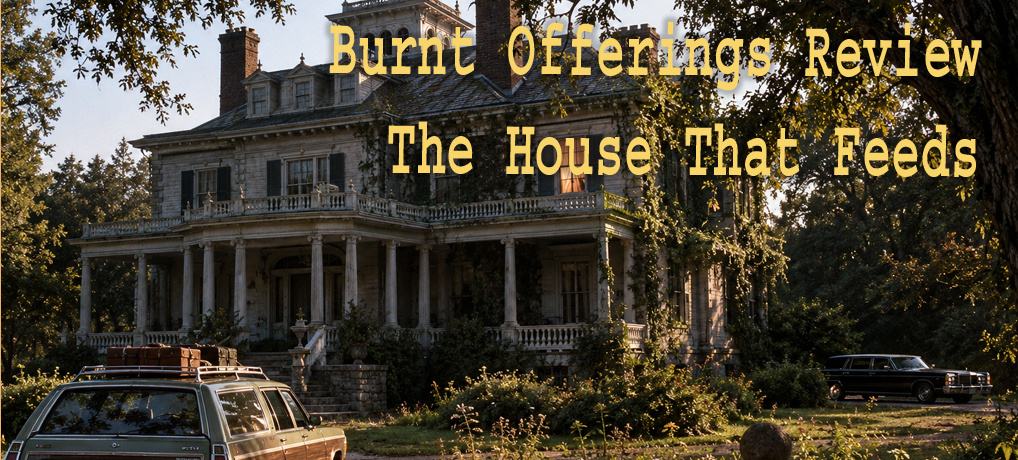
The Burnt Offerings review returns to Dan Curtis's 1976 nightmare about a summer rental that demands far more than rent.
My Rating: ⭐ ⭐ ⭐ ⭐ ⭐ 4.7 / 5
This Burnt Offerings review looks back at a 1976 haunted house film that still unsettles audiences decades later. Directed by Dan Curtis and based on Robert Marasco's 1973 novel, the film brought a slow, dread filled style of horror to movie screens. It arrived the same year as The Omen and rode a wave of occult interest sweeping through theaters. Nearly fifty years later, this Burnt Offerings review argues the film still earns its reputation as one of the genre's quiet classics.
Burnt Offerings Review
The project had a long road to the screen. Trade papers reported as early as December 1969 that director Bob Fosse had originally signed on for the adaptation. Turman Films and Lawrence Turman were attached as producers at that time. That version never came together. By the time filming finally began in 1975, Marasco's manuscript had already been published as a novel. Dan Curtis had taken over by then, serving as director, producer, and co-writer alongside William F. Nolan. Marasco was a former playwright best known for the Broadway hit Child's Play. He brought a stage writer's patience to a story that unfolds through accumulation rather than shock.
The premise sounds almost too good to pass up. A struggling family finds a massive Victorian summer estate available for rent at an impossibly low price. Ben and Marian Rolf, along with their young son Davey, tour the grand old mansion and assume they cannot possibly afford it. The catch, once revealed, seems small enough to accept without much thought. That single decision sets the entire film in motion, and Burnt Offerings never lets the audience forget it.
The $900 Summer Rental That Should Have Been a Warning
The house belongs to an odd brother and sister pair, Arnold and Roz Allardyce, played by Burgess Meredith and Eileen Heckart. Their rent for the entire summer comes to just 900 dollars, a price so low it should have raised immediate alarm. The only condition attached is that the Rolfs must care for the Allardyces' elderly mother, who lives alone on the third floor.
Mrs. Allardyce never leaves her room, and the family never actually meets her face to face. A tray of food must be left outside her door three times a day, with no exceptions. At first, the untouched trays suggest an empty gesture more than a real obligation. As the summer wears on, the food begins disappearing, and Marian grows steadily more absorbed in caring for a woman she has never once seen.
The House Is the Monster
Burnt Offerings breaks from typical ghost story conventions in a deliberate way. There are no spirits wandering the halls and no shadowy figures jumping out of closets. Instead, the mansion itself functions as the antagonist, a detail critics have often described as closer to a psychic vampire story than a traditional haunting.
The house appears to feed on conflict and misfortune inside its walls. Small accidents on the property, a near drowning, a minor fall, seem to trigger subtle physical changes in the structure itself. Cracked paint smooths over. Dead grass turns green again. Nothing is ever explained through dialogue, which forces the audience to notice these details the way the family eventually does.
This approach gives the film a novelty that still holds up. Removing a visible monster forces every ounce of tension into atmosphere, pacing, and the slow unraveling of the people living inside the house. The mansion becomes a presence the audience can feel without ever fully understanding.
Karen Black and Oliver Reed
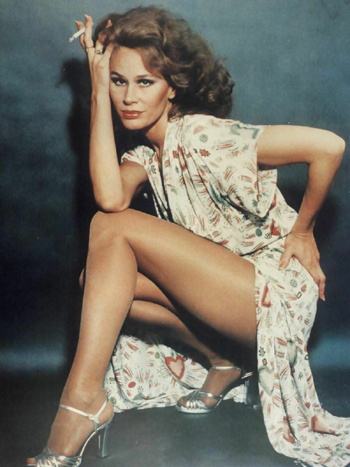
Karen Black Star of Burnt Offerings
Oliver Reed plays Ben Rolf as a man who starts the film relaxed and affectionate, then gradually shows flashes of real anger he cannot explain. Reed lets these outbursts build slowly rather than announcing them, which makes each one land harder than the last. His performance carries a physical unease that grows more pronounced as the story continues.
Karen Black plays Marian Rolf, and her transformation drives much of the film's tension. Marian begins as a warm, attentive mother and wife. Within weeks, she grows distant from her own family, drawn upstairs to the unseen Mrs. Allardyce with an intensity that unsettles everyone around her. Black won the Best Actress award at the 1977 Sitges Film Festival for the role, and it remains one of her more memorable genre performances.
Together, Reed and Black sell the film's central idea. A house does not need to throw furniture across a room to destroy a family. It only needs to quietly, patiently pull two people apart from the inside.
Bette Davis as Aunt Elizabeth
Bette Davis plays Aunt Elizabeth, Ben's elderly relative who moves into the house alongside the family. Davis brings warmth and humor to the role early on. This plays against the icy characters she had built a reputation on during earlier decades of her career. That warmth makes her later decline in the film difficult to watch.
Elizabeth grows tired, then withdrawn, then gravely ill in a matter of weeks, and Davis plays each stage with real restraint. The role earned her the Saturn Award for Best Supporting Actress at the 4th Saturn Awards ceremony, held in January 1977. Reports from the production describe friction on set, with Davis reportedly viewing her younger co-stars' approach to the work as unprofessional. Whatever tension existed off camera, none of it shows in her performance.
This was Davis's final role in a horror film. It closed out a stretch of genre work that had included What ever Happened to Baby Jane and Hush, Hush, Sweet Charlotte. Her presence in Burnt Offerings gives the cast a weight it might otherwise have lacked. She anchors the more theatrical elements of the story with screen craft.
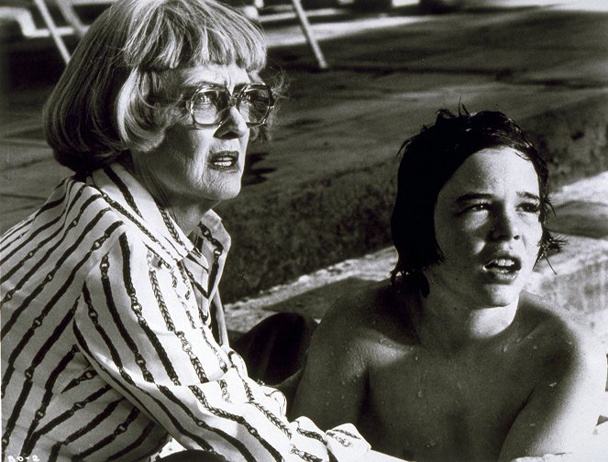
Bette Davis and Lee H. Montgomery in a promotional press photo
Burgess Meredith and the Allardyce Family
Burgess Meredith and Eileen Heckart play Arnold and Roz Allardyce, the siblings who rent out the mansion. Their brief appearance at the start of the film sets an uneasy tone that lingers for the rest of the runtime. Meredith in particular plays Arnold with a strange, clipped energy that feels rehearsed rather than natural.
The Allardyces answer questions about their mother with just enough detail to satisfy the Rolfs without ever fully explaining anything. Meredith earned recognition for the role at the 1977 Sitges Film Festival, where the film also picked up honors for direction. The siblings appear only briefly on screen, yet their strange behavior plants a seed of doubt that colors everything the family experiences afterward.
Dub Taylor rounds out the household as Walker, the property's groundskeeper. Walker functions as an outside observer who notices the house's strange behavior long before the family fully admits it to themselves. His scenes offer brief moments of plain spoken normalcy inside a story that otherwise keeps its characters increasingly isolated from anyone outside the estate.
The Chauffeur Nobody Forgets
One recurring image in Burnt Offerings has stuck with audiences longer than almost anything else in the film. A silent chauffeur, played by Anthony James in a role with no dialogue, appears at unexpected moments throughout the story. He is always connected to a black hearse.
James plays the part with an expression that critics have singled out for decades as one of the most unsettling in 1970s horror. He says nothing, and the film never explains exactly who he is or why he keeps appearing. That restraint is exactly what makes the character work. Without a single word, the chauffeur becomes a symbol the audience dreads seeing again, long before the story reveals what he actually represents.
Dan Curtis Brings Television Horror to the Big Screen
Dan Curtis came to Burnt Offerings with a résumé built almost entirely in television. He created Dark Shadows, the gothic soap opera that ran throughout the late 1960s and developed a devoted following. He also directed The Night Stalker, a television movie credited with helping launch the modern made for TV horror format. His other credits included Trilogy of Terror and a 1974 television adaptation of Dracula.
Burnt Offerings marked one of Curtis's few theatrical directing efforts, and he brought his television instincts with him. The pacing favors atmosphere over shock, and the film leans on mood the same way his small screen work did. Regular Curtis composer Bob Cobert supplied the score, adding an eerie musical layer that runs underneath nearly every scene in the house.
Production itself was not without real difficulty. Filming took place at Dunsmuir House in Oakland, California during the late summer of 1975. A cinematographer was let go partway through the shoot after two weeks of footage came back improperly lit. Production also paused for two weeks following the death of Curtis's daughter, a loss that struck the crew during an already demanding shoot.
The Mansion That Slowly Comes Back to Life
The mansion used for filming carries its own unsettling history. Dunsmuir House was built in 1899 as a wedding gift from Alexander Dunsmuir to his new wife. Dunsmuir never lived to see it finished, dying on his honeymoon before the house was complete. His wife died in the house herself just eighteen months later. The city of Oakland purchased the property in 1962, and it remains open to the public as a park today.
For filming, many of the mansion's 37 rooms were repapered in darker patterns to create a more oppressive mood than the house's real interior offered. The production also filled and used the estate's original swimming pool, despite damage the pool had suffered during the 1906 San Francisco earthquake decades earlier. After filming wrapped, most of the house was restored to its original condition.
As the Rolf family settles further into the house, small physical changes begin appearing throughout the mansion. Flowers that were withered when the family arrived bloom again without explanation. Broken windows repair themselves. Faded wallpaper regains its original color in patches too specific to be simple coincidence.
These changes never arrive with dramatic music cues or obvious camera tricks. The film trusts its audience to notice, which fits the slow burn approach Curtis brought from his television work. Each small repair suggests the house is drawing strength from something happening inside it, without ever spelling that connection out directly.
By the film's final stretch, the mansion looks noticeably different from the neglected property the family first toured. That visual transformation carries real weight precisely because of how gradually it unfolds across the runtime.
House on Haunted Hill: The Terrifying Movie That Flew a Skeleton Over the Audience
Why Burnt Offerings Still Works
Burnt Offerings received mixed reviews upon its original release. Many critics at the time faulted its slow pace compared to louder horror films of the same decade. The film opened in limited release in late August 1976, then expanded to wide release that October. It briefly topped the domestic box office for one weekend during that expansion. Despite that strong opening, the film's total domestic gross of roughly 1.56 million dollars fell short of its 2 million dollar production budget. It is generally remembered as a box office disappointment, even with its brief run at number one.
Retrospective opinion has warmed considerably since 1976. Modern genre critics have pointed to the film's patience as a strength rather than a weakness. It rewards viewers willing to sit with its slow accumulation of dread. The film went on to win Best Horror Film at the 4th Saturn Awards. Curtis won Best Director at the same ceremony, and Davis won Best Supporting Actress.
The novel that inspired the film has an even stronger legacy. Author Stephen King placed Burnt Offerings as his personal runner up to Shirley Jackson's The Haunting of Hill House in his nonfiction study Danse Macabre. King has separately acknowledged both Marasco's novel and Curtis's film adaptation as direct influences on his own novel The Shining, published just four years later. Readers and critics have long noted the parallel between the Rolfs' summer mansion and the Torrance family's Overlook Hotel.
What makes Burnt Offerings work today is exactly what frustrated some critics in 1976. The film refuses to rush. Ben's anger builds across the entire runtime rather than exploding in a single scene. Marian's obsession with the house develops in small, believable steps rather than a sudden dramatic shift. Audiences accustomed to faster modern horror pacing may need patience, but that patience pays off in a finale that lands with real weight.
Burnt Offerings DVD
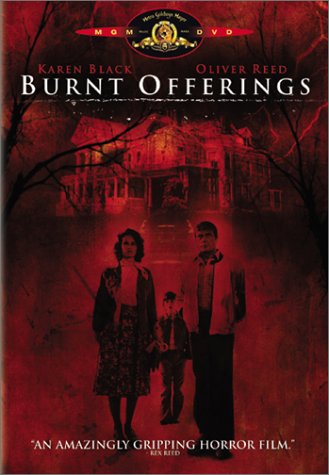
Burnt Offerings DVD featured in our Burnt Offerings Review
Product Description:
If our Burnt Offerings Review has you ready to visit the sinister old mansion for yourself, this DVD brings home the unsettling 1976 haunted-house classic. Karen Black and Oliver Reed star as Marian and Ben, who rent an enormous country mansion for the summer at a price that seems too good to be true. Along with their son and Ben's aunt, played by Bette Davis, they soon discover that something inside the estate has plans of its own.
Key Features:
• Classic 1976 supernatural horror film on DVD
• Stars Karen Black, Oliver Reed, Bette Davis, and Burgess Meredith
• Combines haunted-house horror with psychological and occult themes
• Centers on an isolated mansion with a mysterious supernatural presence
• Excellent addition for collectors of 1970s horror and classic haunted-house movies
Why This Works:
Our Burnt Offerings Review explores a haunted-house movie where the house itself becomes far more important than simply providing a creepy setting. The slow-building atmosphere, memorable cast, mysterious elderly woman upstairs, and increasingly disturbing changes to the mansion make this a perfect movie to revisit after learning more about how the film creates its sense of dread.
Buy on Amazon
Burnt Offerings Blu-ray and Home Video
Burnt Offerings has stayed in print on home video for decades, starting with early VHS releases and continuing through multiple DVD and Blu-ray editions. MGM released a DVD in 2003 featuring an anamorphic widescreen transfer. The print still reflects the heavy filtering and diffused lighting used throughout the original shoot.
More recent physical media releases have improved matters considerably. Kino Lorber issued a Region A Blu-ray and DVD in the United States. Arrow Video separately released a Region B Blu-ray and DVD in the United Kingdom. Both editions aim to preserve the film's deliberately soft, hazy visual style rather than sharpening it into something the original cinematography never intended.
Buyers should confirm region compatibility before ordering, particularly for the Arrow Video release, which was produced for UK players. Collectors interested in bonus material should compare special features across editions. Commentary tracks and extras have varied between the MGM, Kino Lorber, and Arrow releases over the years.
Final Rating
Burnt Offerings earns a strong recommendation for fans of patient, atmosphere driven horror. Kilroy rating, 4.7 out of 5. Viewers expecting fast scares or a visible monster may find the pace challenging at first. Anyone willing to settle into its slow, dread soaked atmosphere will find an effective haunted house film. The cast includes some of the era's finest character actors, all working at full strength.
ML Lamp is the owner of Kilroy Was Here. After his 20 years of working in Las Vegas in the entertainment promotions field, Mr. Lamp retired in 2002 from his job to pursue his passion for collectibles. Now as a guest speaker and author he’s living the dream, and sharing his warmth with You.