Jeanne Carmen
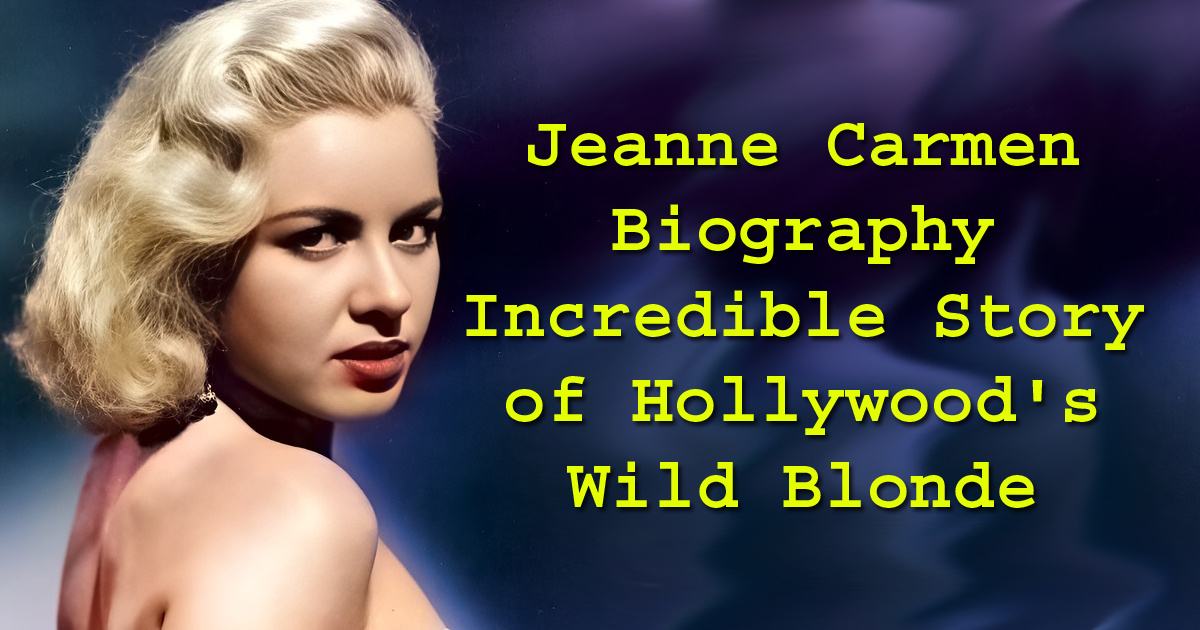
Jeanne Carmen occupied a distinctive corner of mid-century American popular culture, where Hollywood glamour, pin-up photography, nightclub celebrity, and exploitation cinema often overlapped. She never followed the conventional path of a major studio star, yet her striking image and unconventional public persona made her a memorable figure from an era crowded with carefully manufactured screen personalities.
Jeanne Carmen was an American actress, pin-up model, dancer and trick-shot golfer whose unusual career made her a distinctive figure in 1950s popular culture. Her best-known screen appearances include Untamed Youth, A Merry Mix Up with The Three Stooges, and the cult creature feature The Monster of Piedras Blancas. She also appeared in Westerns, crime films and television series including The Millionaire, 26 Men, Riverboat and Have Gun – Will Travel. Her combination of glamour photography, B movies and professional trick-shot golf gave her a career unlike most Hollywood performers of her generation.
Carmen became particularly associated with the glamorous, rebellious image that surrounded the 1950s pin-up world. Her platinum-blonde appearance invited comparisons with Marilyn Monroe, but Carmen developed a reputation of her own, combining sex appeal with humor, confidence, and an unusually independent streak. She moved comfortably between modeling, television appearances, publicity events, and films that ranged from mainstream entertainment to low-budget cult productions.
Her lasting appeal comes partly from how completely she represented the less polished side of Hollywood's golden-age mythology. Carmen belonged to the world beyond prestigious premieres and major studio contracts, a world of photographers, nightclubs, publicity stunts, B movies, and colorful personalities who helped shape American celebrity culture. Decades later, that mixture of glamour and eccentricity has kept her recognizable to collectors, classic-film enthusiasts, and fans of vintage Hollywood.
Jeanne Carmen spent years living several lives that seemed almost impossible to combine: Arkansas farm girl, New York dancer, pin-up model, trick-shot golfer, Hollywood actress and cult-movie personality. What makes her story remarkable is that no single one of those identities completely explains the woman she became.
👶 Early Life
Summary: Born Agnes Lavern Carmon near Paragould, Arkansas, Carmen grew up around cotton farming before leaving Arkansas while still young and pursuing a very different life.
Jeanne Carmen was born Agnes Lavern Carmon on August 4, 1930, in the rural Lafe community near Paragould, Arkansas, in Greene County. Her mother was Georgia Ellen Wright, and court records identified Dennis “D. B.” Carmon as her father. Carmen was born with a twin brother, Donald, into circumstances far removed from the glamour that would later surround her name.
Her childhood around Paragould, Arkansas, was rooted in agricultural life. The family picked cotton for a living, and Carmen worked in the cotton fields herself while still a child. It was demanding physical work and part of the everyday reality of growing up in a poor rural household during the years following the Great Depression.
Carmen later said that she first ran away from home at 13 years old. By age 16, records place her leaving Arkansas with her friend Mary Lou Ledbetter for St. Louis, Missouri, where Carmen had relatives and began supporting herself away from home.
Running Away and Finding New York
Leaving Arkansas began a remarkable transition for Carmen. Still in her teens, she made her way through places including St. Louis, where she reportedly worked as a waitress, before eventually reaching New York City. She had no established theatrical background, professional acting experience, or family connections waiting to open doors for her.
While still in her teens, Carmen followed aspiring opera singer Sandy Scott to New York City, where she auditioned for and found work in a revival of Burlesque starring comedian Bert Lahr, already famous for playing the Cowardly Lion in The Wizard of Oz. For a teenager who had been picking cotton in Arkansas only a few years earlier, the move placed her inside the professional entertainment world with extraordinary speed.
The experience gave Carmen her first real exposure to show business. Dancing required her to learn how to perform before an audience and present herself with the confidence expected of a professional entertainer. Rather than entering the business through formal dramatic training, Carmen learned by working, adapting to the stage and discovering that appearance, personality, and self-assurance could become valuable professional assets.
Explore the Biographies of Iconic Celebrities
Becoming a 1950s Pin-Up Model
By 1948, Carmen had begun moving from stage dancing into professional modeling. She posed for glamour photographers, including Irving Klaw, and entered the rapidly expanding world of pin-up and men's-magazine photography. Her photographs eventually appeared in publications including Wink, Titter, and Beauty Parade.
Modeling suited Carmen's increasingly recognizable image. Her looks, figure, and willingness to pose for the more daring glamour photography of the period distinguished her from conventional fashion models. She became part of the same postwar pin-up culture that produced figures such as Bettie Page, when inexpensive magazines and widely circulated photographs could turn a model into a nationally recognizable personality without the backing of a Hollywood studio.
By the beginning of the 1950s, Carmen had already traveled an extraordinary distance from the cotton fields around Paragould. Running away as a young teenager had taken her first to an uncertain life on her own, then to New York City, professional dancing, and finally the pin-up photography that established her public image. Hollywood had not yet become the center of her career, but the independent streak and ability to reinvent herself that would define Jeanne Carmen were already firmly established.
Jeanne Carmen was a twin. Her twin brother was named Donald, an easily overlooked detail from a life later dominated by stories of Hollywood, golf and glamorous pin-up photography.
⛳ The Trick-Shot Golfer Nobody Expected
Summary: Carmen developed genuine golfing ability and toured with trick-shot golfer Jack Redmond, adding an extraordinary second profession to her growing public image.
Jeanne Carmen developed one of the most unusual sidelines associated with any 1950s pin-up model when she became a skilled trick-shot golfer. Despite having no background that suggested a future in the sport, Carmen discovered that she had a natural ability with a golf club and learned to combine genuine golfing skill with the showmanship she had already developed as an entertainer.
Her abilities brought her into contact with professional trick-shot golfer Jack Redmond, who was known for exhibition performances built around difficult and unconventional shots. Carmen toured with Redmond, appearing in golf exhibitions in which accuracy was only part of the attraction. Trick-shot performers hit balls from unusual positions, used modified equipment, and attempted shots designed as much to entertain spectators as to demonstrate golfing ability.
Carmen became more than a glamorous assistant standing beside a professional golfer. She learned to perform difficult shots herself and developed an act that played on the audience's expectations. The sight of a glamorous blonde pin-up stepping onto a golf course and then successfully executing demanding trick shots gave the exhibitions an element of surprise that made Carmen particularly effective as a performer.
The work also reflected a trait that followed Carmen throughout her life. She was willing to move between occupations that normally had little connection with one another. Dancing, modeling, entertainment, and golf could all become part of the same career if she could turn them into opportunities.
🎰 Las Vegas, Golf Hustling and Johnny Roselli
Summary: Carmen later described using her golf skills in money matches and connected some of those adventures with Las Vegas and mob figure Johnny Roselli, although many details survive primarily through her own recollections.
Golf eventually took Carmen into a more colorful world than exhibition matches. She later described playing for money and participating in golf hustles in which opponents underestimated her ability. Her appearance could work to her advantage because a golfer who assumed the glamorous young woman could not seriously compete might be willing to make a wager before discovering otherwise.
Las Vegas provided a natural setting for that combination of golf and gambling. Carmen later told stories of substantial wagers surrounding matches and of using her underestimated golfing ability to win money. Some accounts became increasingly elaborate as she recounted them over the years, so the more dramatic episodes are best understood as Carmen's own recollections and claims rather than independently documented results from competitive golf.
During this period Carmen also became associated with Johnny Roselli, the organized-crime figure whose activities connected him with both Las Vegas and Hollywood. Roselli was a significant figure in the gambling and entertainment circles of the period, and Carmen said that he became involved in arranging or backing some of her money golf matches.
Carmen later claimed that Roselli recognized how effectively she could hustle male golfers who underestimated her. In her telling, the arrangement could be profitable because opponents were encouraged to believe they were wagering against an inexperienced woman rather than someone who had toured with a professional trick-shot golfer. These stories became an enduring part of Carmen's personal mythology, although the exact details and amounts of money she later described are difficult to verify independently.
What is clear is that Carmen's connection with golf was genuine and unusually important to her life outside modeling. Her work with Jack Redmond gave her legitimate trick-shot experience, while her later stories about Las Vegas, gambling, and Johnny Roselli added a much more colorful chapter. Together they created one of the strangest contrasts in her public image: a 1950s pin-up who could walk onto a golf course looking like part of the entertainment and then prove that she actually knew how to play.
🎬 Film and TV Career
Summary: Carmen built an eclectic screen career in Westerns, crime pictures, exploitation films, comedy, horror and television rather than following the conventional path of a major studio actress.
By the middle of the 1950s, Jeanne Carmen had made the transition from pin-up modeling and nightclub entertainment into motion pictures. Hollywood never turned her into a conventional studio leading lady, but that ultimately became part of her appeal. Carmen worked steadily in Westerns, crime pictures, juvenile-delinquent films, comedy shorts, television, and low-budget horror, building the varied screen résumé that eventually helped earn her the nickname “Queen of the B-Movies.”
One of her first substantial movie roles came in 1956 with The Three Outlaws. Carmen played Serelda in the Western, appearing alongside Neville Brand and Alan Hale Jr., years before Hale became famous as the Skipper on Gilligan's Island. The picture drew upon the legends surrounding Butch Cassidy and the Sundance Kid, placing Carmen in the kind of modestly budgeted genre filmmaking that would become an important part of her career.
Producer and director Howard W. Koch subsequently cast Carmen as Yellow Moon in the 1957 Western War Drums. The picture starred Lex Barker, the former screen Tarzan, along with Joan Taylor and Ben Johnson. Carmen's ability to change her appearance proved useful during these years. Although audiences increasingly knew her as a platinum blonde, she could return to her naturally darker appearance for roles requiring a completely different screen image.
Carmen also appeared as Paula in the 1957 crime picture Guns Don't Argue. The low-budget production dramatized the exploits of notorious American criminals and the federal agents pursuing them, touching on names including John Dillinger, Pretty Boy Floyd, Bonnie and Clyde, Ma Barker, Alvin Karpis, and Homer Van Meter. It was another example of Carmen moving easily into the inexpensive crime and exploitation pictures that filled theaters and drive-ins during the decade.
🎵 Untamed Youth and Lilibet
Summary: Her role as Lilibet in Untamed Youth placed Carmen inside one of the defining juvenile-delinquent exploitation pictures of the 1950s.
Carmen received one of her best-remembered 1957 assignments when Howard W. Koch cast her as Lilibet in Untamed Youth. The juvenile-delinquent exploitation picture starred Mamie Van Doren and Lori Nelson as sisters who wind up sentenced to work on a corrupt cotton farm. Carmen's supporting role placed her squarely inside one of the decade's most recognizable exploitation-film formulas, mixing rebellious youth, sex appeal, music, and sensational subject matter.
The cast also included John Russell, Lurene Tuttle, Yvonne Lime, Robert Foulk, and rockabilly star Eddie Cochran. Cochran's presence helped give the picture additional importance for rock-and-roll collectors, and Carmen later became associated with his recording of Jeannie, Jeannie, Jeannie. With Van Doren supplying the film's principal star power and Cochran representing the emerging rockabilly generation, Untamed Youth became exactly the kind of 1950s drive-in picture that later developed a strong cult following.
Lillibet was not a leading role, but the film became one of the titles most closely associated with Carmen's B-movie reputation. It also demonstrated how naturally her established pin-up image could be transferred to the screen. Rather than being reshaped into a traditional dramatic actress, Carmen was increasingly used for the qualities audiences already associated with her: glamour, attitude, sexuality, and a slightly dangerous edge.
😂 Jeanne Carmen Meets The Three Stooges
Summary: Carmen entered classic comedy history as Mary in the 1957 Three Stooges short A Merry Mix Up.
That same year brought Carmen into a completely different corner of American popular culture. She appeared as Mary in the 1957 Columbia short A Merry Mix Up with The Three Stooges. The lineup at the time consisted of Moe Howard, Larry Fine, and Joe Besser, who had replaced Shemp Howard following Shemp's death.
A Merry Mix Up used an unusually elaborate mistaken-identity premise in which the Stooges portray three separate sets of identical triplets. Carmen's Mary is connected with Joe Besser's character, giving her a small but memorable place in the enormous screen history of the comedy team. For Carmen's later admirers, the short also links her to a form of classic Hollywood entertainment far removed from the pin-up and exploitation pictures with which she is usually identified.
🚨 Portland Exposé and More 1950s Films
Summary: Crime films, Westerns and supporting appearances kept Carmen working throughout the decade alongside performers including Frank Gorshin, Errol Flynn, Mamie Van Doren and Jeff Richards.
Carmen continued her busy 1957 with Portland Exposé, a crime film directed by Harold D. Schuster. She played Iris in a cast that included Edward Binns, Carolyn Craig, Virginia Gregg, and Frank Gorshin, who would later become famous as the Riddler on the Batman television series. The picture drew upon contemporary concerns about organized crime, corruption, gambling, and racketeering in Portland, Oregon.
Her film work continued during 1958. Carmen appeared as a camera girl in I Married a Woman, starring George Gobel and British bombshell Diana Dors. She also had an uncredited appearance as Tassles in Too Much, Too Soon, the screen biography of Diana Barrymore, starring Dorothy Malone and Errol Flynn.
Carmen was also seen as a rodeo girl in the 1958 picture Born Reckless. The film starred Mamie Van Doren and Jeff Richards, bringing Carmen once again into the orbit of the blonde bombshell and exploitation-film culture that flourished alongside mainstream Hollywood during the period.
👹 The Monster of Piedras Blancas
Summary: Carmen's role as Lucille Sturges in The Monster of Piedras Blancas became her strongest connection to the enduring world of 1950s creature features.
For horror fans, Carmen's most important screen appearance came as Lucille Sturges in 1959's The Monster of Piedras Blancas. The independently produced creature feature gave Carmen one of her strongest connections to classic monster cinema and eventually became one of the most enduring films in her résumé.
The story takes place around the isolated lighthouse at Piedras Blancas, where a mysterious sea creature begins terrorizing the surrounding California coastline. Carmen's Lucille Sturges is the daughter of lighthouse keeper Sturges, played by John Harmon. The cast also included Don Sullivan as Fred, Les Tremayne as Dr. Sam Jorgenson, and Forrest Lewis as Constable George Matson.
The monster itself is a wonderful piece of late-1950s creature-feature history. The suit was assembled in part from existing Universal monster materials, including pieces associated with This Island Earth and the Mole People. The result was a strange, bug-eyed sea monster perfectly suited to the final years of the original drive-in creature boom.
Carmen's Lucille is far more central to the story than many of the decorative roles available to pin-up models who crossed into low-budget filmmaking. Her relationship with her father and her presence near the creature's hunting ground place her directly inside the film's main narrative. That makes The Monster of Piedras Blancas particularly important when looking beyond Carmen's publicity photographs and glamour image to the films that preserved her on screen.
The picture has survived as a cult favorite among collectors of 1950s science-fiction and horror, alongside the seemingly endless parade of giant insects, radioactive mutations, aliens, prehistoric survivors, and amphibious monsters that populated theaters and drive-ins during the decade.
The Monster of Piedras Blancas Blu-ray
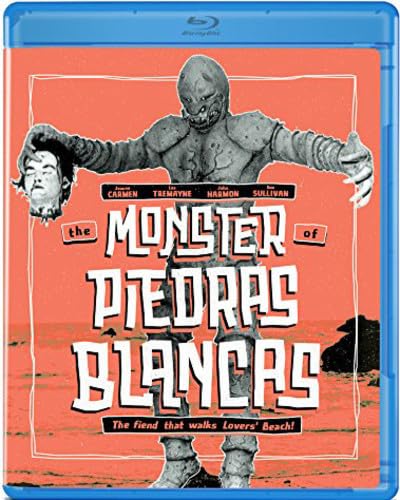
Product Description:
For anyone discovering Jeanne Carmen and her unusual Hollywood career, The Monster of Piedras Blancas is one of the films that helped secure her place in 1950s cult-movie history. Carmen plays Lucy, the lighthouse keeper's independent daughter, whose seaside community suddenly finds itself terrorized by a mysterious prehistoric creature lurking near a secluded coastal cave.
Key Features:
• Classic black-and-white 1950s creature feature on Blu-ray
• Features Jeanne Carmen as lighthouse keeper's daughter Lucy
• Stars John Harmon, Don Sullivan, Les Tremayne, and Jeanne Carmen
• Combines a remote lighthouse, mysterious murders, seaside caves, and a prehistoric monster
• Great addition for collectors of vintage monster movies, drive-in horror, and 1950s science-fiction cinema
Why This Works:
If you've been reading our Jeanne Carmen biography, The Monster of Piedras Blancas offers a chance to see her in one of the movies most closely associated with her cult-film legacy. Between the isolated lighthouse, foggy coastline, mysterious cave, gruesome discoveries, and classic rubber-suit monster, the movie has nearly everything you could want from a late-1950s drive-in creature feature.
Buy on Amazon
📺 Television Career
Summary: Carmen expanded her screen work through guest appearances on prominent television programs including The Millionaire, 26 Men, Riverboat and Have Gun Will Travel.
Carmen's career was not confined to movie theaters. As television became increasingly important to Hollywood performers during the late 1950s, she began appearing in some of the era's familiar anthology, Western, and adventure programs. Her television work allowed her to move between character parts and glamorous guest appearances while reaching an audience considerably larger than many of her low-budget films could command.
In 1958, Carmen appeared on The Millionaire as Mary Evans in “The Wally Bannister Story.” The popular CBS anthology starred Marvin Miller as Michael Anthony, the representative of unseen multimillionaire John Beresford Tipton, whose anonymous gifts of one million dollars provided the premise for each week's story.
Also in 1958, Carmen appeared as Lili Mae Turner in “The Last Rebellion,” an episode of the Western series 26 Men. The program starred Tristram Coffin and Kelo Henderson and drew its premise from the Arizona Rangers, giving Carmen another connection with the Western genre she had already explored in pictures such as The Three Outlaws and War Drums.
In 1959, she appeared as Janine in the Riverboat episode “A Night at Trapper's Landing.” The adventure series starred Darren McGavin as riverboat captain Grey Holden and, during its early run, Burt Reynolds as Ben Frazer. Carmen's appearance placed her within another popular television genre built around the mythology and adventure of nineteenth-century America.
Carmen also appeared in 1959 on Have Gun Will Travel, one of television's most successful adult Westerns. Starring Richard Boone as the sophisticated gunfighter Paladin, the series was considerably darker and more psychologically complex than many earlier television Westerns. Carmen appeared in the episode “Tiger” as a glamorous blonde associated with Paladin.
Her television credits continued into the new decade. In 1960, she played Francie Verlaine on Tightrope!, the crime series starring Mike Connors as an undercover police officer. In 1961, she appeared as Nikki on The Dick Powell Show, adding another major television name to a résumé that already crossed several of the dominant genres of the period.
🎥 The Later B-Movie Years
Summary: Horror and exploitation pictures continued to define Carmen's later screen work and strengthened her eventual reputation as a memorable B-movie personality.
Carmen returned to low-budget horror territory with The Devil's Hand, produced around 1961 and widely released in the early 1960s. The supernatural picture starred Robert Alda, Linda Christian, and Neil Hamilton, the future Commissioner Gordon of television's Batman. Carmen appeared as a blonde member of the mysterious cult at the center of the story and was credited under the spelling Jeannie Carman.
She also appeared as an inmate in 1962's House of Women, another entry in the women-in-prison cycle that had become a dependable exploitation genre. By this point, Carmen's screen credits formed an unusually broad catalogue of the kinds of pictures that existed around the edges of prestige Hollywood: Westerns, gangster stories, juvenile-delinquent films, exploitation pictures, prison dramas, comedy shorts, and monster movies.
That range explains why the “Queen of the B-Movies” description followed Carmen so effectively. She was never defined by one famous starring vehicle. Instead, her film career became a tour through the less respectable but often more colorful side of 1950s and early-1960s American entertainment. Her screen partners and colleagues ranged from The Three Stooges, Eddie Cochran, Mamie Van Doren, and Lex Barker to Frank Gorshin, Errol Flynn, Richard Boone, Darren McGavin, and Mike Connors. For later cult-film audiences, those connections helped turn a modest Hollywood filmography into an unusually entertaining piece of B-movie history.
Carmen's birth name was Agnes Lavern Carmon. The name recognized by generations of pin-up and cult-film collectors was therefore itself part of her transformation from rural Arkansas teenager to Hollywood personality.
🕊️ Later Years
Summary: Carmen spent much of her later life away from regular acting but returned to public attention as interest in vintage pin-ups, cult movies and classic Hollywood grew.
After stepping away from regular film and television work, Jeanne Carmen moved to Scottsdale, Arizona, in 1962. There she married stockbroker Ben Campo and raised three children while living largely outside the Hollywood spotlight. In 1978, Carmen relocated to Orange County, California, where she would spend the remainder of her life.
Carmen raised three children and spent much of the following decades outside the Hollywood spotlight. As interest in 1950s pin-up culture and low-budget genre films grew, however, a new generation began discovering her photographs and movies. Titles such as Untamed Youth and The Monster of Piedras Blancas helped introduce her to cult-film audiences who had not seen the pictures during their original theatrical runs.
During her later years, Carmen returned to the public eye through autograph conventions, memorabilia events, interviews, and appearances connected with classic Hollywood. She readily discussed her years as a pin-up model, actress, dancer, and trick-shot golfer, and she became known for colorful stories about the people she had encountered. Her recollections included Marilyn Monroe, Frank Sinatra, Elvis Presley, and mob figure Johnny Roselli, although some of Carmen's more dramatic stories have remained difficult to independently verify.
Her friendship with Marilyn Monroe became an especially prominent part of Carmen's later public identity. Carmen gave numerous interviews describing their relationship and her memories of Monroe's private life. She also participated in documentaries and television programs devoted to Monroe and the Hollywood culture of the 1950s, becoming one of the personalities frequently called upon to recall that period.
Carmen's son, Brandon James, preserved her story in the 2006 biography Jeanne Carmen: My Wild, Wild Life as a New York Pin Up Queen, Trick Shot Golfer & Hollywood Actress, documenting her journey from the cotton fields of Arkansas to New York stages, pin-up photography, trick-shot golf, Hollywood movies, television, and the celebrity circles of mid-century America.
Jeanne Carmen died on December 20, 2007, at her home in Irvine, California. She was 77 years old. The cause of death was reported as lymphoma, bringing to a close a life that had stretched across several very different corners of twentieth-century American entertainment.
Her death prompted renewed attention to a career that had never fit comfortably into a single category. Carmen left behind pin-up photographs, Westerns, crime pictures, television appearances, comedy with The Three Stooges, and one wonderfully strange monster movie. By the time of her death, the inexpensive entertainment that once placed her outside Hollywood's prestigious ranks had become an important part of the popular culture of the 1950s, preserving Jeanne Carmen as one of its most unusual personalities.
Before Jeanne Carmen became associated with Hollywood B movies, she reportedly worked as a model for golf clothing advertisements. Her ability with a golf club eventually became much more than a prop, leading to professional trick-shot exhibitions.
🏆 Legacy
Jeanne Carmen's legacy rests on a career that crossed several distinct corners of 1950s American popular culture. She was a pin-up model, dancer, actress, television performer, and accomplished trick-shot golfer at a time when entertainers were usually promoted within much narrower boundaries. That unusual combination made her difficult to categorize during her career and considerably more interesting in retrospect.
Her photographs remain part of the golden age of American pin-up art, placing Carmen among the glamour models who helped define the visual style of the 1950s. Although comparisons with Marilyn Monroe followed her because of her platinum-blonde image, Carmen developed a personality that was distinctly her own. She projected humor, independence, sexuality, and a willingness to take chances that separated her from the carefully controlled glamour associated with the major Hollywood studios.
Her films gave that image a permanent home. Untamed Youth became a durable piece of juvenile-delinquent and rock-and-roll exploitation history, while her appearance with The Three Stooges in A Merry Mix Up connected her with one of America's most enduring comedy teams. Her Westerns, crime pictures, prison films, and television appearances further preserved the breadth of a career built largely outside prestige Hollywood.
For horror and science-fiction fans, The Monster of Piedras Blancas remains especially important. Carmen's performance as Lucille Sturges tied her permanently to the great wave of 1950s creature features. The film's strange monster, isolated lighthouse setting, and unapologetic B-movie atmosphere helped it survive long after many similarly inexpensive productions disappeared from public memory.
Carmen's trick-shot golf career adds another dimension to that legacy. Her work with Jack Redmond was more than a publicity gimmick and demonstrated an athletic ability few people expected from a woman primarily known as a pin-up model. Her later stories about golf hustling, Las Vegas, and Johnny Roselli added to the colorful mythology surrounding her, even when individual details depended heavily upon Carmen's own recollections.
She also became part of the continuing fascination with Marilyn Monroe. Carmen's accounts of their friendship have been repeated in books, interviews, documentaries, and discussions of Monroe's life. Some of those stories remain disputed or impossible to confirm, but they ensured that Carmen's name continued to surface whenever historians and fans explored the personalities surrounding Hollywood's most famous blonde.
Collectors have played an important role in keeping Carmen's work visible. Original pin-up photographs, lobby cards, movie posters, autographs, magazines, and other memorabilia preserve an entertainer whose career once existed largely on the margins of mainstream Hollywood. The growth of interest in exploitation films, drive-in movies, vintage glamour photography, and forgotten television has given much of her work a cultural afterlife that would have been difficult to predict when it was originally produced.
Jeanne Carmen ultimately represents something larger than a list of movie credits. Her life connected rural America, burlesque, pin-up photography, Hollywood B movies, television Westerns, golf exhibitions, Las Vegas gambling culture, and classic monster cinema. Few performers traveled through so many different pieces of mid-century American entertainment, and that improbable mixture remains the defining feature of her legacy.
🗣️ Why She Still Matters
Jeanne Carmen remains worth remembering because her career preserves parts of 1950s entertainment that traditional Hollywood histories often pass over. Pin-up magazines, B movies, television Westerns, exploitation pictures, trick-shot exhibitions and drive-in creature features all belonged to the popular culture of their time, and Carmen moved through nearly all of them. Her surviving photographs and films now document a colorful entertainment world that existed alongside the major studios and famous stars, giving her an enduring place in the history of mid-century American popular culture.
ML Lamp is the owner of Kilroy Was Here. After his 20 years of working in Las Vegas in the entertainment promotions field, Mr. Lamp retired in 2002 from his job to pursue his passion for collectibles. Now as a guest speaker and author he’s living the dream, and sharing his warmth with You.