May 2002 Review: A Disturbing Horror Sleeper You Shouldn't Overlook
Some horror movies announce exactly what they are within the first few minutes. This one does not. This May 2002 review covers Lucky McKee's strange, sad, and eventually gruesome debut about a lonely young woman who wants a friend more than anything in the world. It starts out awkward and almost sweet. Then it slowly becomes something much darker, and very hard to forget.
May 2002 Review: One Strange Little Horror Movie
May premiered at the Sundance Film Festival on January 13, 2002. Lions Gate picked it up, then held it for a year. It finally reached a handful of American theaters on February 7, 2003.
Lucky McKee's film begins with an awkward young woman trying to connect with other people. Over its running time, it gradually becomes something much darker. It is funny, uncomfortable, sad, creepy, and eventually gruesome.
McKee has said audiences at that first Sundance midnight screening were laughing, squirming, and feeling a little emotional all at once. That mix of reactions is still the best description of the film.
Here is the most important advice in this May 2002 review. The less you know about where May's story is heading, the better. Do not read a full plot summary. Do not ask a friend to explain the ending. Let the movie unfold the way McKee intended.
Everything below stays spoiler free. You will learn about the characters, the cast, and the mood. The final act stays a surprise.
Meet May Canady
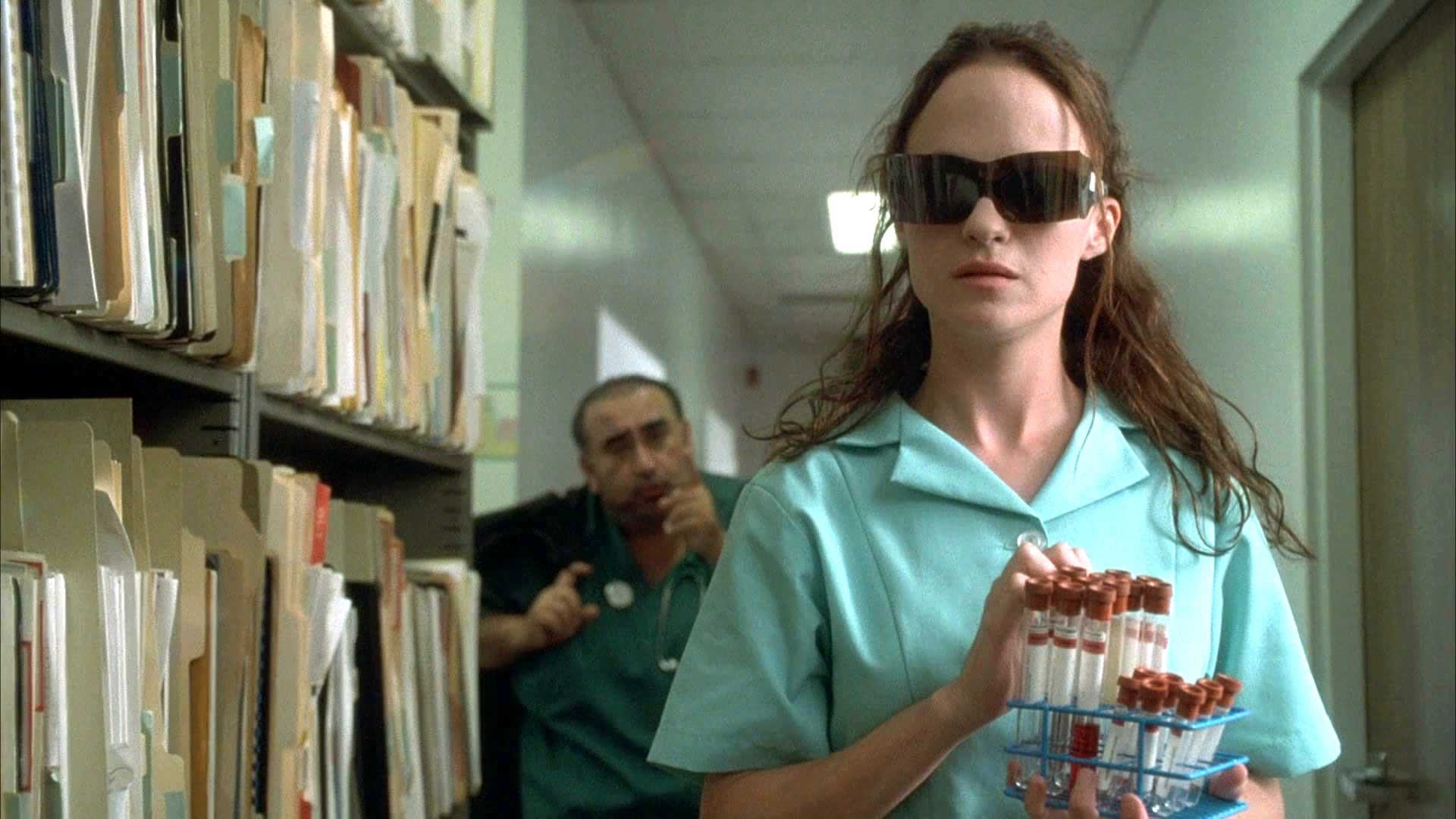
May Dove Canady is played by Angela Bettis. She is a quiet, painfully shy young woman who has never quite learned how to be around other people.
Her trouble started in childhood. May grew up with a lazy eye, and other kids treated her as an outsider. Her mother was demanding and particular, more interested in appearances than comfort. May learned early that she did not fit in.
As an adult, May works as an assistant at a veterinary clinic. She is skilled and calm with the animals, and she is not bothered by the surgical side of the job. With people, though, she is a mess. She stares, blurts out odd remarks, and misreads simple social cues.
Her closest companion has always been a strange childhood gift. It is a handmade doll named Suzie, kept inside a glass case. May's mother made the doll herself and told May never to take it out.
May talks to Suzie the way most people talk to a best friend. That doll should tell you fairly quickly that this probably is not going to become a conventional romantic comedy.
Angela Bettis Makes May Impossible to Ignore
Angela Bettis is the reason the movie works. Lucky McKee reportedly auditioned many actresses for the part, but he felt Bettis understood May and wanted the role more than anyone else.
Horror fans may know Bettis from the 2002 television version of Carrie, where she played Stephen King's troubled title character. She had also appeared in Girl, Interrupted. Even so, May is her signature role.
Bettis makes May awkward, sympathetic, funny, unsettling, and occasionally frightening, sometimes all in one scene. She never turns May into a simple horror caricature. You understand why May behaves the way she does, even when you wish she would stop.
Her physical choices are remarkable. May holds herself stiffly, fidgets with her hands, and stares a beat too long. Her attempts at conversation are painfully uncomfortable. Even ordinary scenes, like ordering coffee or chatting at work, feel slightly wrong.
As May's emotional state begins changing, Bettis takes the audience along with her. The shift is gradual and believable. By the time you realize how far May has drifted, Bettis has already made you care about her.
Festivals took notice. Bettis won best actress honors at several genre festivals, including Sitges in Spain and the Brussels International Fantastic Film Festival.
Then May Meets Adam
Jeremy Sisto plays Adam Stubbs, a handsome local mechanic who also makes his own movies. May notices him in a coffee shop and becomes instantly fascinated.
There is one particular feature about Adam that captivates her. It would be easy to explain exactly what it is, but that would spoil some of the fun. May's attraction to individual physical features becomes more and more important as the story moves forward.
Adam is a fan of strange movies and odd people. When May admits she is weird, he tells her he likes weird. For a moment, it seems like May might have found someone who understands her.
Their relationship gives the movie some of its strangest moments. It mixes romance, humor, and discomfort in ways that are hard to predict. There are sweet scenes, funny scenes, and scenes that make you want to look away.
Sisto is excellent. He brings natural charm and charisma to Adam, which makes it easy to see why May falls for him. Fans may also know Sisto from Clueless and from his role on the HBO series Six Feet Under.
Horror buffs will enjoy one detail about Adam. He is clearly a fan of Italian director Dario Argento. His apartment features a poster for Argento's Tenebrae, a sly nod from McKee to one of his influences.
Anna Faris Is Definitely Not Playing Cindy Campbell
Anna Faris appears as Polly, May's confident and flirtatious co-worker at the veterinary clinic. Polly works the front desk and loves to talk.
For viewers who mostly remember Faris as Cindy Campbell from the Scary Movie series, seeing her in this peculiar little horror film can be a real surprise. Here she plays a much more grounded, playful, and complicated character.
Polly is everything May is not. She is outgoing, self assured, and completely comfortable flirting with anyone. She takes a teasing interest in May and seems to find her quirks charming.
Their relationship adds another layer to May's fragile understanding of friendship, attraction, and rejection. Polly offers May attention at a moment when she desperately needs it. Whether that attention is what May thinks it is becomes a key question.
Faris is wonderful in the part. She is funny, warm, and a little careless in a way that feels very real. Nichole Hiltz also appears as Ambrosia, a woman in Polly's orbit who adds yet another complication.
Don’t Forget James Duval
Horror and cult film fans will also recognize James Duval, who plays a punk named Blank.
Duval was already a familiar face in offbeat cinema. He had appeared in Gregg Araki films such as The Doom Generation and in the blockbuster Independence Day. He also played Frank in the cult classic Donnie Darko.
May meets Blank by chance. Like several people she encounters, he initially seems to offer another possibility for connection. He is rough around the edges, but he is curious about her.
Duval's role is smaller than Sisto's or Faris's, but it matters. Blank represents one more chance for May to find a friend.
Things rarely remain simple around May.
Suzie May Be the Creepiest Doll That Barely Does Anything
Horror movies are full of evil dolls. Chucky stabs, Annabelle haunts, and countless others creep across floors at night. May's childhood doll, Suzie, does none of that.
Suzie spends much of the movie standing silently inside her glass case, watching. She does not need to run around the room or attack anybody to be creepy. Her stillness is enough.
The doll represents something much more important to May. It is a link to her mother and to a lesson May took to heart as a little girl. Her mother told her:
"If you can't find a friend, make one."
It sounds like gentle advice from a parent who wants her daughter to be creative. In May's world, it becomes something else entirely.
Without revealing what eventually happens, that idea grows more and more important. Keep it in mind as you watch. It is the key to the whole film.
Lucky McKee Makes Loneliness Uncomfortable
Writer and director Lucky McKee wrote the first draft of May while he was still a student at the University of Southern California. It became his solo feature directing debut. McKee has said the character owes a debt to Amanda Plummer's role in Terry Gilliam's The Fisher King.
McKee does not treat May merely as a collection of horror scenes. Much of the movie is about isolation, rejection, attraction, jealousy, and May's inability to form normal relationships. It plays like a character study first and a horror film second.
That approach makes the horror much more effective. The audience spends considerable time understanding May before discovering exactly how far her thinking can go. By the time the story turns dark, we know her well enough to feel uneasy rather than simply shocked.
The behind the scenes team is full of surprises. Cinematographer Steve Yedlin shot the film, and Rian Johnson was one of its editors. The two later worked together on Brick, Looper, Star Wars: The Last Jedi, and Knives Out. It is fun to see their names on such a small, strange horror film.
McKee also slips himself into the movie in a brief, uncredited cameo. Eagle eyed viewers can spot him as a man in an elevator.
The Movie Is Funnier Than You Might Expect
May contains a surprisingly strong streak of black comedy.
Some scenes are funny because May has almost no idea how uncomfortable she makes other people. She says exactly the wrong thing at exactly the wrong moment, and the reactions on everyone's faces are priceless.
Others deliberately push situations until laughing feels slightly inappropriate. You find yourself chuckling, then wondering whether you should be.
That strange humor keeps the movie from becoming relentlessly bleak. It also makes May feel more human. Her awkwardness is something many viewers will recognize, at least in small doses, from their own lives.
The comedy also sets a trap. Because you have been laughing, you are not quite ready when the film stops being funny.
Things Start Going Very Wrong
This is where a spoiler free review needs to become careful.
May experiences rejection and disappointment from several directions. People who seemed interested in her pull away. Moments of hope end in embarrassment or hurt. Even Suzie cannot provide the comfort May needs.
With each blow, her already unusual view of relationships begins to deteriorate. Her thinking grows stranger and more fixed. She starts to see the people around her in a very different way.
The movie that started as an uncomfortable character study gradually reveals what kind of horror story it has been building toward. The shift is slow, then sudden.
What May decides to do is not explained here. That discovery belongs to the viewer.
When May Finally Gets Bloody, It Earns It
May is not a nonstop gore movie. That actually works in its favor.
McKee saves most of the bloodshed for the final act. Because he spends so much time developing May and the people around her, the violence has considerably more impact when the movie finally crosses that line.
When it comes, it is shocking, grisly, and genuinely upsetting. Yet it never feels random. Every disturbing moment connects back to May's loneliness, her past, and her mother's advice.
The blood is not the entire attraction. It is the destination of a character story that has been getting stranger from the very beginning. That is why the ending stays with people long after the credits roll.
How Did May Become Such a Sleeper?
May received only a limited theatrical release. After test screenings in a few cities, Lions Gate opened it in just a handful of theaters across North America. It earned only a small fraction of its modest budget at the box office.
Critics were kinder than ticket buyers. Many reviews praised Bettis and McKee. Over time, the film found its audience on DVD and developed a devoted cult following. In 2006, the Chicago Film Critics Association even named it one of the 100 scariest films ever made.
That makes it exactly the kind of horror movie worth digging back up. It has recognizable actors, an unusual central character, a memorable visual style, and a premise that is hard to mistake for any other horror film.
More than two decades later, plenty of casual horror viewers have still never seen it. McKee has said people tell him the film helped them through hard times. That kind of personal connection is rare for any horror movie.
Does May Still Work Today?
Yes, largely because the movie depends more on character than on horror trends.
The early 2000s setting is certainly visible. The clothes, phones, and music all place it firmly in its time. Yet Angela Bettis's performance and the film's peculiar personality remain its real strengths, and those have not aged a day.
The themes have arguably become even more relevant. Loneliness, social anxiety, and the struggle to connect are things many people talk about more openly now than in 2002. May's isolation feels painfully familiar.
Some viewers may find the first half slow if they expect immediate bloodshed. Anyone willing to let May's personality and relationships develop gets a much stranger and more rewarding payoff.
Who Should Watch May?
May is worth seeing for viewers who enjoy psychological horror, black comedy, strange character studies, and cult movies. It suits anyone who likes horror that gradually moves from uncomfortable to disturbing.
Fans of Angela Bettis should consider it essential. It is the performance that defines her career in the genre.
Anna Faris fans who only know her mainstream comedy work may also get a surprise. Jeremy Sisto and James Duval fans will enjoy seeing them in such an unusual project.
If you want monsters, jump scares, or a conventional slasher, this is not really that movie. It is also rated R, and its final act is strictly for adults.
Final Thoughts 4.6/5
This one earns a 4.6 out of 5 from Kilroy. Closing out this May 2002 review, the film succeeds because Angela Bettis makes it impossible to dismiss its central character as simply another movie psycho.
May is lonely, awkward, sometimes funny, sometimes sympathetic, and increasingly alarming. Bettis plays every side of her with total commitment, and the supporting cast gives her plenty to react to.
Lucky McKee lets us spend enough time with May that when the movie finally reveals just how literally she has interpreted an old piece of childhood advice, it lands with real force.
If you've never met May, don't ask anyone to explain the ending. Just remember the advice her mother gave her: If you can't find a friend, make one.