🎞️ Murders in the Rue Morgue 1932 Review: Bela Lugosi’s Twisted Pre-Code Horror Classic
My Rating: ⭐ ⭐ ⭐ ⭐ ☆ 4.6/5
This Murders in the Rue Morgue 1932 review heads back to the year after Dracula made Bela Lugosi a star. Universal handed him a new villain with no cape, no castle, and no fangs. He plays Dr. Mirakle, a carnival showman with a lab, a theory, and a very large ape. The result is one of the strangest, darkest pictures of the early Universal horror years.
Murders in the Rue Morgue 1932 Review: Universal Horror at Its Darkest
One year after Dracula turned Bela Lugosi into a horror icon, Universal put him back into the shadows.
This time there was no cape.
No castle.
No Count Dracula.
Instead, Lugosi became the wonderfully named Dr. Mirakle, a sinister carnival showman conducting experiments in the dark streets of 19th-century Paris.
And somehow Bela manages to be even creepier without the cape.
Universal Pictures released the film in 1932. It opened at New York’s RKO Mayfair Theatre on February 10 and went into wide release on February 21. It runs about 61 minutes. Today you can find it on digital retailers and on a Blu-ray set in the UK.
This Murders in the Rue Morgue 1932 review stays spoiler free.
Edgar Allan Poe Started This Nightmare
Murders in the Rue Morgue was inspired by Edgar Allan Poe’s famous 1841 story.
The story first ran in Graham’s Magazine in April 1841.
Poe’s original tale is often credited as one of the earliest detective stories. It features the brilliant C. Auguste Dupin investigating a seemingly impossible double murder in Paris.
Universal took Poe’s basic idea and did what horror movies often do best.
They made it stranger.
Universal Changed Poe’s Story a Lot
Don’t expect a faithful page-to-screen adaptation.
The movie keeps Poe’s Paris setting, Dupin, the mysterious murders, and one particularly important element from the original story.
Then it builds an entirely different horror movie around them.
Florey’s first draft actually stayed close to Poe’s mystery. Universal wanted a horror vehicle for Lugosi instead, so the story was reshaped.
The new version borrowed ideas from Frankenstein, Dracula, and the German silent classic The Cabinet of Dr. Caligari.
The biggest addition is Dr. Mirakle.
And once Bela Lugosi walks onto the screen, it’s pretty obvious why they invented him.
Bela Lugosi Becomes Dr. Mirakle
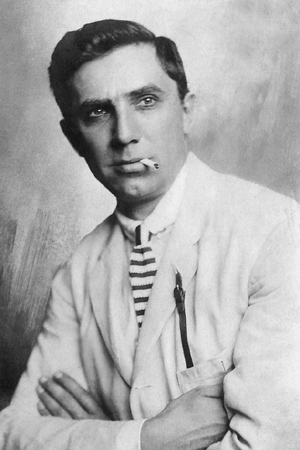
Lugosi had already created one of cinema’s most famous monsters with Dracula.
Dr. Mirakle gave him something completely different to play.
He’s a carnival attraction operator.
He’s a scientist.
He’s obsessed with proving his theories about evolution.
And his methods would definitely have caused problems with the university ethics committee.
Lugosi gets to deliver speeches, glare at people, conduct horrifying experiments, and generally make everyone around him uncomfortable.
Exactly what you want from Bela Lugosi.
Not every critic in 1932 loved the big performance. Photoplay warned that fans of restrained acting might get annoyed. The magazine still called him the perfect type for this kind of film.
Welcome to the Carnival
The carnival setting is one of the best things in the movie.
Crowds gather.
Barkers call for customers.
Strange attractions promise sights people have never seen before.
And among those attractions is Dr. Mirakle and his ape, Erik.
For Kilroy, this is where the movie becomes especially interesting.
Old carnivals and sideshows were perfect places for horror because audiences willingly paid money to walk toward things they didn’t understand.
Sometimes curiosity isn’t healthy.
Keep an eye on the sideshow crowd. A young Iron Eyes Cody turns up there in an uncredited bit.
Meet Erik
Dr. Mirakle’s attraction centers around Erik, a large ape presented to the carnival crowd as evidence supporting Mirakle’s theories about humanity and evolution.
But Erik isn’t simply decoration for the show.
The relationship between Mirakle and the animal becomes increasingly important as the story moves deeper into the dark streets of Paris.
Erik is played by Charles Gemora, a Philippine-born performer who built a long Hollywood career inside ape suits.
If you’ve read Poe’s original story, you’ll already recognize why an ape belongs in Murders in the Rue Morgue.
If you haven’t, don’t look it up yet.
Sidney Fox Is Camille L’Espanaye
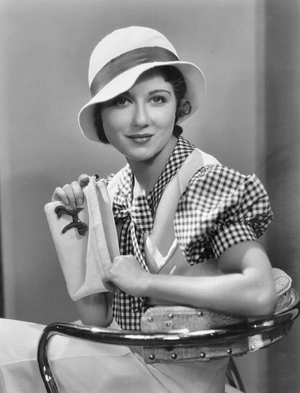
Sidney Fox plays Camille L’Espanaye, the young woman who attracts some very unwanted attention.
Fox was a young Universal contract player, and she actually received top billing over Lugosi.
Camille gives the movie its connection between the everyday world of Paris and the increasingly bizarre experiments being conducted by Mirakle.
She’s also at the center of several of the movie’s most memorable sequences.
Betty Ross Clarke plays her mother, Madame L’Espanaye.
Leon Ames Appears as Pierre Dupin
Leon Ames plays Pierre Dupin, the medical student who becomes suspicious about the strange deaths occurring around Paris.
On screen in 1932, he was billed as Leon Waycoff. He switched to Ames a short time later.
Classic-movie fans may recognize Ames from the long career that followed. It eventually included Meet Me in St. Louis, The Postman Always Rings Twice, and many other films and television appearances.
Here he’s considerably younger and trying to understand a mystery that keeps getting stranger.
Bert Roach plays Paul, Pierre’s roommate and comic relief. Edna Marion plays Paul’s girlfriend, Mignette.
Brandon Hurst plays the Prefect of Police. D’Arcy Corrigan plays the Morgue Keeper. Noble Johnson plays Janos, Mirakle’s silent servant.
Watch for a young Arlene Francis as a woman of the streets. TV fans later knew her as a longtime panelist on What’s My Line?
Dr. Mirakle Has a Very Disturbing Theory
Mirakle isn’t killing people simply because the movie needs a villain.
He believes he’s conducting important scientific work.
That’s what makes him more disturbing.
In his mind, the horrible things he’s doing have a purpose.
Mad scientists are always more interesting when they don’t think they’re mad.
Mirakle thinks he’s right.
Everybody else has the unfortunate job of discovering exactly what that means.
This Is Pre-Code Horror
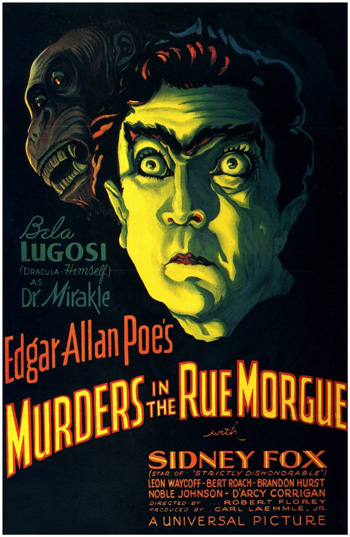
Murders in the Rue Morgue arrived in 1932, before Hollywood began strictly enforcing the Production Code in 1934.
That matters.
Pre-Code horror movies could sometimes go places that later Universal monster films had to approach more carefully.
There are disturbing implications, violent ideas, experiments, and imagery here that can still feel surprisingly nasty for a movie made in the early 1930s.
Even then, it pushed too far for some people. The Hays Office objected to what it saw as an improper use of horror in one early scene.
Florey and Freund toned that scene down. Several local censor boards still cut parts of it anyway.
This isn’t simply spooky castles and cobwebs.
There is some genuinely dark material underneath it.
The Movie Looks Like a Nightmare
One of the biggest reasons Murders in the Rue Morgue still deserves attention is its visual style.
Paris isn’t presented as a bright romantic city.
It’s filled with shadows, crooked streets, fog, rooftops, laboratories, carnival tents, and expressionistic sets.
Art director Charles D. Hall built those crooked streets on the Universal lot.
Here’s a fun budget trick. Florey set the story in 1845 partly because costumes from MGM’s La Bohème sat at Western Costume. Universal only had to pay the rental.
At times the movie feels closer to a nightmare version of Europe than an actual place.
That’s exactly what it needs.
Karl Freund Was Behind the Camera
The cinematography came from Karl Freund, one of the most important names in early horror filmmaking.
Before coming to Hollywood, Freund worked on major German films including Metropolis.
He photographed Dracula for Universal and would soon direct The Mummy.
That background helps explain why Murders in the Rue Morgue looks so unusual.
German Expressionism is all over these shadows.
Low light, misty exteriors, and a moving camera give the film a look far richer than its budget.
Robert Florey Finally Got His Universal Horror Movie
Director Robert Florey has an interesting place in Universal horror history.
Florey had originally been involved with Universal’s plans for Frankenstein before James Whale ultimately directed that film.
Florey was a Paris native, born in 1900. That makes him a fitting choice to build a nightmare version of his hometown.
Instead, Florey was given Murders in the Rue Morgue.
That makes this more than another early Universal horror picture.
It’s also a glimpse at what another filmmaker working inside Universal’s monster factory could create.
He also had help from a young staff writer named John Huston, who is credited with additional dialogue. Huston would later direct The Maltese Falcon.
Lugosi Almost Became Frankenstein’s Monster
There’s another interesting connection.
Before Boris Karloff became forever associated with Frankenstein’s Monster, Bela Lugosi had been considered for the role.
That didn’t happen.
Universal’s own pressbook spun the story. It claimed Lugosi turned the part down over the heavy makeup and the monster’s lack of dialogue.
Instead, Dracula belonged to Lugosi.
Frankenstein belonged to Karloff.
And Murders in the Rue Morgue gave Lugosi another chance to establish himself as one of Universal’s essential horror stars.
Not a bad consolation prize.
Dr. Mirakle’s Laboratory Is Pure Mad-Scientist Horror
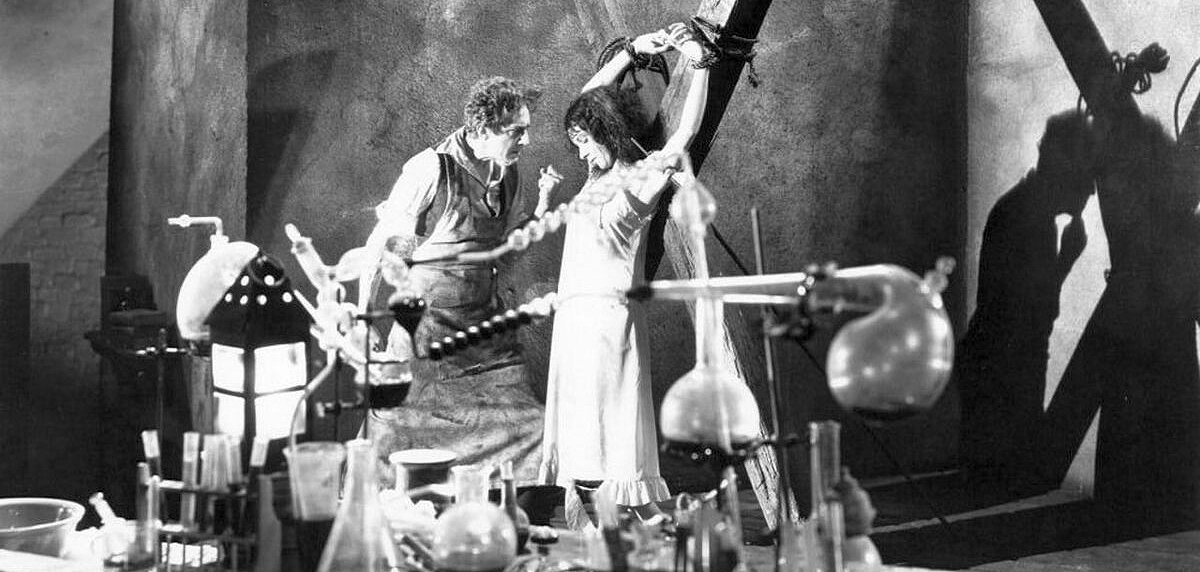
Forget clean white laboratories.
Mirakle works in the kind of place where you immediately know nothing good is happening.
Strange equipment.
Dark corners.
Experimentation.
Victims who definitely didn’t sign consent forms.
It’s exactly the sort of laboratory that helped establish the visual language of mad-scientist movies for generations.
The Movie Doesn’t Waste Much Time
One advantage of horror films from this period is their running time.
Murders in the Rue Morgue doesn’t need two hours to tell its story.
The whole thing runs about an hour. A few listings claim 75 minutes, but the AFI Catalog found no evidence it ever ran that long.
It gets into Paris, introduces the carnival, establishes Mirakle’s experiments, and starts moving.
Modern movies could occasionally learn something from 1932.
Not every nightmare needs a three-hour director’s cut.
The Rue Morgue Mystery Still Matters
Poe’s original story helped establish the idea of a detective solving an apparently impossible crime through observation and logic.
The movie doesn’t follow that structure exactly, but the mystery remains underneath the horror.
Bodies are appearing.
Something strange is happening.
The explanation doesn’t seem to make sense.
And somebody has to put the pieces together.
That combination of mystery and horror gives the movie a different flavor from Universal’s better-known monster films.
The Ape Effects Are Definitely From 1932
There’s no reason to pretend every effect has aged perfectly.
It hasn’t.
You’re watching a movie made more than ninety years ago.
Some techniques involving Erik are obvious to modern eyes, and occasionally the illusion works better than others.
The film cuts between Gemora in his ape suit and shots of a real chimpanzee. The two do not exactly match.
But that’s also part of watching early horror.
You’re seeing filmmakers invent solutions decades before CGI could fix everything with a computer.
Sometimes the seams are part of the fun.
Bela Lugosi Is the Reason to Watch
There are plenty of interesting things surrounding Murders in the Rue Morgue.
Poe.
Pre-Code horror.
Karl Freund’s cinematography.
The carnival.
The laboratory.
The early Universal atmosphere.
But Bela Lugosi is still the center of the show.
Dr. Mirakle lets him be theatrical, sinister, obsessive, and completely committed to every bizarre word coming out of his mouth.
Nobody could stare at another human being quite like Bela.
Why Isn’t Murders in the Rue Morgue Better Remembered?
Mention Universal horror from the 1930s and everyone knows the giants.
Dracula.
Frankenstein.
Bride of Frankenstein.
Murders in the Rue Morgue tends to live one shelf below them.
That doesn’t mean it belongs there.
It simply never produced the instantly recognizable monster that could be printed on lunchboxes, Halloween masks, model kits, and T-shirts for the next ninety years.
It also disappointed at the box office. Florey’s deal was for one picture, and Universal did not bring him back for more horror.
Still, the film kicked off Lugosi’s Poe cycle at Universal. The Black Cat followed in 1934 and The Raven in 1935.
Hollywood kept returning to the story too. Warner Bros. remade it as Phantom of the Rue Morgue in 1954, with more versions in 1971 and 1986.
Dr. Mirakle isn’t Dracula.
But he’s absolutely worth meeting.
This Is Universal Horror Before the Formula Settled
That’s another reason the movie is interesting today.
Universal horror was still being invented.
The studio hadn’t completely established what a Universal monster movie was supposed to look like.
Filmmakers were borrowing from Gothic literature, German Expressionism, mad-scientist stories, stage productions, detective fiction, and whatever else might scare an audience.
There’s a roughness to these early movies that later productions sometimes lost.
Even the end credits show the studio still playing around. The cast list repeats under the heading “A Good Cast Is Worth Repeating.”
Does Murders in the Rue Morgue Still Work Today?
You have to watch a 1932 horror movie on its own terms.
The acting style is different.
The pacing is different.
The effects are different.
But atmosphere doesn’t have an expiration date.
Neither does Bela Lugosi.
The shadows, carnival setting, mad science, strange murders, and grotesque imagery still give Murders in the Rue Morgue a personality completely its own.
That is the honest bottom line of this Murders in the Rue Morgue 1932 review. The film works because it commits to its own odd mood.
Who Should Watch Murders in the Rue Morgue?
Watch it if you enjoy Bela Lugosi, Edgar Allan Poe, Universal Monsters, Pre-Code movies, old carnivals, mad scientists, Gothic mysteries, German Expressionism, and horror history.
It’s especially worth seeing if you’ve already watched Universal’s famous monster movies and want to explore the darker corners surrounding them.
This is where some of the really interesting stuff is hiding.
Final Thoughts 4.6/5
This one earns a 4.6 out of 5 from Kilroy. Wrapping up this Murders in the Rue Morgue 1932 review, the film stands as a shadowy, daring piece of early Universal horror. It is anchored by one of Bela Lugosi’s most gleefully sinister performances.
“Bela Lugosi is magnificently sinister in this shadowy, startling Pre-Code horror treasure.”
ML Lamp, Kilroy Was Here Shop
Murders in the Rue Morgue may never have achieved the legendary status of Dracula or Frankenstein, but that’s exactly why it’s worth rediscovering.
Bela Lugosi is wonderfully sinister as Dr. Mirakle, and the carnival setting gives the movie an old-world sideshow atmosphere. Karl Freund’s photography turns Paris into a maze of shadows.
It’s strange.
It’s dark.
It’s unmistakably Pre-Code.
And it comes from a period when Universal was still figuring out exactly what movie horror could become.
More than ninety years later, Dr. Mirakle is still waiting inside that carnival tent.
If you see Bela Lugosi standing outside a carnival tent promising to demonstrate his latest scientific discovery, spend your nickel somewhere else.