💡 NOMA Bubble Lights: The Amazing Christmas Lights That Actually Moved
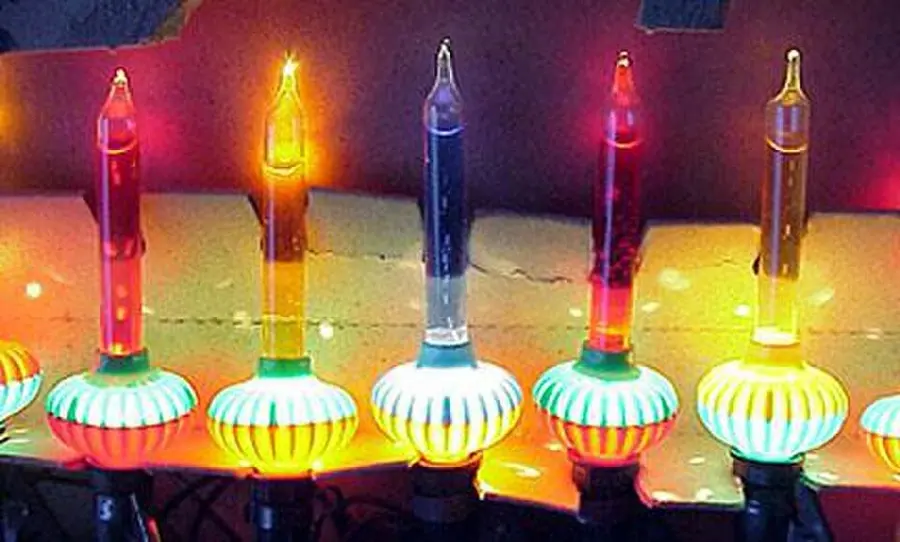
Most Christmas lights just sit there and glow. NOMA Bubble Lights did something more. Plug them in, wait a few minutes and the colored tubes started to bubble like tiny soda bottles hanging from the branches. For a generation of postwar families, that little stream of rising bubbles was pure Christmas magic.
The Christmas Lights That Put on a Show
Picture a 1950s living room in December. The tree stands in the corner, heavy with tinsel and glass ornaments. Tucked among the branches are slim candle shaped tubes, each one glowing red, green, blue or amber. Inside every tube, a column of bubbles races upward without stopping.
Kids would sit on the floor and stare at them. Grown ups did too, though they might not admit it. Nothing else on the tree moved like that. Ornaments sparkled and tinsel shimmered, but bubble lights put on an actual show.
That show had a surprising backstory. It involved an accountant with an inventive streak, a giant lighting company, a world war and a courtroom fight. It also produced one of the best selling Christmas lights of the twentieth century.
Department Store Santa: The Amazing Tradition We Loved
Carl Otis Has a Strange Christmas Idea
The man most often credited with the bubble light was Carl Otis. By day, he worked as an accountant at Montgomery Ward. In his spare time, he tinkered with ideas that had nothing to do with ledgers.
His first patent application, filed in November 1935, was for a bubbling tabletop sign. He simply called it a “Display.” Other inventors were also experimenting with bubbling signs at the time. Otis had his own clever method for creating even, steady bubbles.
Even before that sign patent was granted, Otis was thinking about Christmas trees. He imagined a small light that would bubble on a branch, using the heat of an ordinary bulb. He called it an “Ornamental Illuminating Device.” It was not a catchy name, but it was a brilliant idea.
Collectors believe Otis drew inspiration from existing products. One was the Glo Lite candle, a glass candle shaped decoration. Another was the bubbling tube found on jukeboxes of the era. Otis combined those ideas into something new for the Christmas tree.
NOMA Takes a Chance
An idea needs a manufacturer, and Otis went looking for one. He contacted companies in hopes of bringing his light to market. The one that jumped at it was NOMA Electric Corporation.
NOMA was already a giant in Christmas lighting. It began in 1925 as the National Outfit Manufacturer’s Association, a trade group of about 15 small lighting makers. In 1926, the members merged into a single company called NOMA Electric Corporation. For decades, NOMA dominated the American Christmas light market.
On July 4, 1944, Otis was granted a patent for his bubble light. NOMA bought the rights late that year and hired Otis to keep developing the idea. Under the deal, he agreed to a royalty of three cents for every light produced. At the time, that seemed like a modest arrangement. It would soon add up to real money.
There was one big problem. The country was still at war. Wartime restrictions and material shortages meant NOMA could not put the new light into production. The bubble light would have to wait for peace.
Bubble-Lites Arrive in 1946
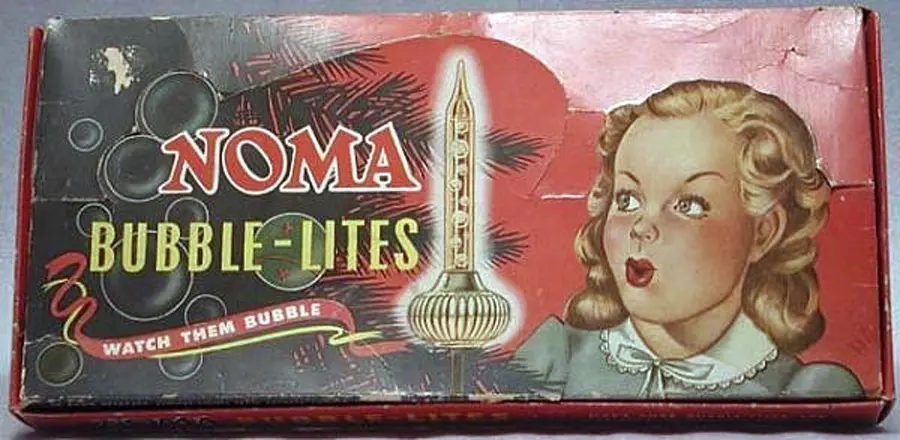
The wait ended in 1946. NOMA introduced its new lights for Christmas that year under the name Bubble-Lites. The company was smart enough to drop the “Ornamental Illuminating Device” label for something families could actually say.
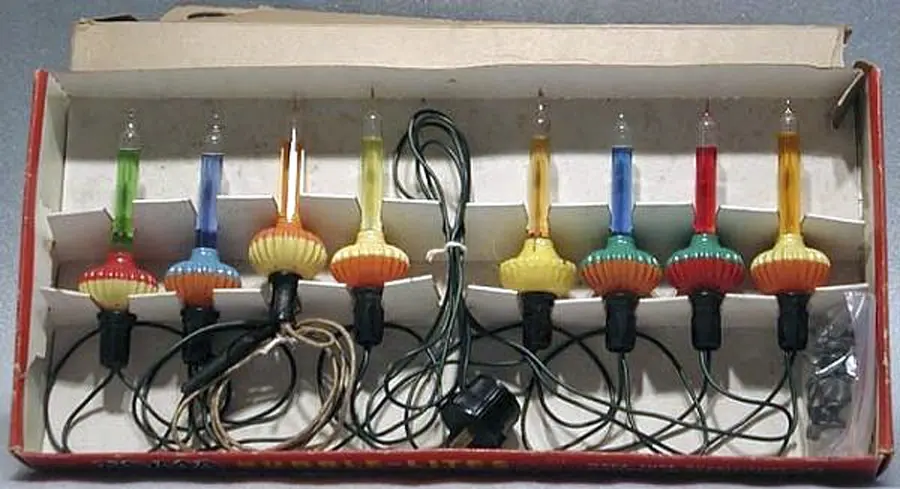
The first sets came in a book style box with the NOMA girl pictured on the inside flap. Each set held nine bubble lights, a nine socket cord and metal clips for attaching the lights to branches. Collectors call those early lights “biscuits” because of the shape of their plastic bases.
The timing could not have been better. A war weary public was tired of making do with old Christmas lights. People snapped up nearly every lighting set NOMA could make in 1946 and 1947. Bubble-Lites were heavily advertised and quickly became the thing to have on a properly decorated tree.
NOMA also sold replacement Bubble-Lites in their own boxes. Advertising encouraged families to swap out their ordinary bulbs and add NOMA Bubble Lights to the strings they already owned. A tree did not need an all new set to join the fun.
According to one collector history, NOMA made and sold nearly one million Bubble-Lites in December 1946 alone. Some sources suggest bubble lights may have been available as early as 1945. Surviving boxes from 1946, however, confirm the big national launch.
How Does a Bubble Light Actually Work?
The secret is a liquid with a very low boiling point. Each bubble light has a sealed glass tube sitting on top of a small plastic base. Inside the base is a tiny incandescent bulb, placed in close contact with the bottom of the tube.
The tube is filled with a liquid called methylene chloride. It boils at around 104 degrees Fahrenheit, far lower than water. When the bulb warms up, the liquid at the bottom of the tube begins to boil. Bubbles form and rise up through the colored liquid, lit from below by the bulb.
The liquid is so sensitive that it can bubble from the warmth of a hand or sunlight through a window. In a cold room, the lights may take several minutes to get going. A warm room and a little patience usually get the bubbles moving.
Some early bubble lights used a different recipe. A few companies tried a lightweight oil or camphor instead of methylene chloride. Those versions produced finer, slower bubbles, but most makers eventually switched to the standard liquid.
One word of caution is worth sharing. Methylene chloride is a toxic chemical. As long as the glass tube stays sealed, there is no exposure. If a tube breaks, keep children and pets away, air out the room and clean up carefully.
Sears Wish Book: The Amazing Christmas Catalog Kids Loved
When Bubble Lights Took Over the Christmas Tree
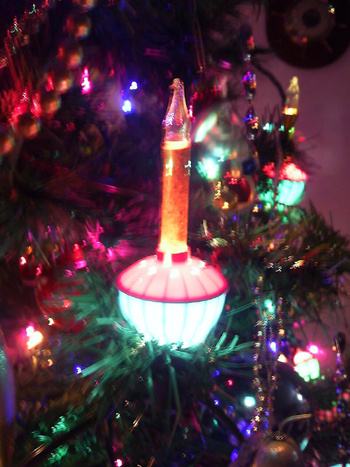
NOMA Bubble Lights were a smash. They quickly became the best selling and most profitable Christmas lights of their day. NOMA made more than 25 million Bubble-Lites in the first two years of production alone.
NOMA’s overall lighting business was booming too. By the late 1940s, the company was ordering more than 85 million lamps a year from General Electric. After years of wartime shortages, families were eager for new Christmas lights of every kind.
Success attracted competition. Other companies quickly brought out bubble lights of their own. Raylite sold its Paramount brand lights. Royal Electric of Pawtucket, Rhode Island, offered Sparkling Bubble Lights. Peerless, Renown, USAlite and others joined in too.
That competition led to a legal fight. NOMA warned rivals they were infringing on the Otis patents. Raylite fought back by pointing to an earlier patent by inventor Phillip Rosenblatt, granted in 1942. The court sided with Raylite and invalidated the last Otis patent. Suddenly the bubble light market was wide open for everyone.
Even so, NOMA kept making bubble lights for years. Prelit Christmas trees with bubble lights also hit the market after the war. Bubble lights stayed popular from the 1940s into the 1970s, when tiny miniature lights finally took over.
Biscuit Bases, Flats and Flying Saucers
For collectors, the shape of the plastic base tells much of the story. NOMA produced several distinct styles over the years, and each one has its own nickname.
Biscuits. The original NOMA biscuit is the most common bubble light of all. It has a rounded, bulbous base, rather like a small biscuit. The very first biscuits from 1946 can be spotted by small metal clips holding the base halves together at the ventilation holes. Those early clip versions are now very hard to find.
Flats and saucers. In 1948, NOMA changed its design, perhaps to look more modern. The new lights had a flatter, saucer shaped base. Collectors call them flats or saucers. The flat style was sold only in 1948 and 1949. Heat from the bulb was too intense for the smaller base, and many warped or melted. In 1949, NOMA went back to its trusty biscuits.
Tulips, snap ons and rockets. NOMA also made Tulip bubble lights from 1948 to 1960. Its Snap-On bubblers fit right over a standard Christmas bulb. In 1961 and 1962, NOMA tried a Rocket Ship style to tap into the space race. It was designed by Frank Pettit, a former Lionel train company employee. The rockets did not last, but collectors love them now.
15 Vintage Christmas Collectibles: Shocking Prices Revealed
The Christmas Light Kids Could Actually Watch
Ordinary Christmas bulbs were bright and cheerful. But a kid could only stare at a still bulb for so long. Bubble lights were different. They gave children something to watch.
Each light had its own personality. Some bubbled furiously. Others started slowly and then picked up speed. A few refused to bubble at all until someone gave them a nudge. Kids would pick a favorite and check on it all evening.
There was a little science lesson hiding in every tube too. Parents could explain how heat made the liquid boil. Curious kids wondered why water needed a stove but this liquid needed only a tiny bulb. The bubble light turned the Christmas tree into a small, glowing experiment.
Mostly, though, it was about wonder. On a quiet night with the room lights off, the tree seemed alive. The movement made the whole room feel warmer. That feeling is exactly what people remember decades later.
Why Old NOMA Bubble Lights Became Collectibles
Bubble lights were made by the millions, yet good vintage sets are getting harder to find. Many were used until they broke. Others were thrown out when miniature lights took over. Survivors in their original boxes have become prized pieces of Christmas history.
Boxes matter a great deal. The original 1946 book style box with the NOMA girl inside the flap is a key piece. In 1949, NOMA switched to a lid style box with the NOMA girl printed on the cover. A complete set with its box, cord and clips tells a much fuller story than loose lights.
Colors matter too. Purple liquid is considered the rarest, since it was only sold during the first three years of production. Some base colors are also scarce. Pink, royal blue, white and deep blood red NOMA biscuit halves are all hard to find.
Condition is the next thing to check. Some lights from around 1949 used a fire retardant chemical that later caused the plastic to break down. Lights with this damage look shrunken and distorted. Look for clear tubes, intact bases and liquid that still bubbles.
Identification takes a careful eye. Not every biscuit shaped bubbler is a NOMA. Royal, Paramount, Renown and USAlite all made similar shapes. Many genuine NOMA Bubble Lights carry patent numbers molded into the base parts, which can help separate them from look alikes.
A few practical tips help when you find old sets. Check the bottom of early bases for markings like “Matchless,” which can point to early production. Inspect cords carefully, since old wiring may be brittle. It is wise to display fragile vintage sets with care and never leave them running unattended.
Bubble Lights Are Coming Back
Here is the fun twist. Bubble lights never fully disappeared, and now they are enjoying a real comeback. Nostalgic and retro Christmas decor is a major theme in decorating coverage heading into the 2026 season.
Design writers have described 2026 as a year for embracing nostalgia and the small details that made childhood holidays special. Holiday decor guides list bubble lights alongside mercury glass ornaments and retro tree toppers as vintage must haves. Apartment Therapy has also named bubble lights among the retro decorations that are cool again.
Modern reproduction sets are easy to find. Many still use the same basic design, with a small bulb heating the liquid in a sealed glass tube. Some newer versions use different technology for a similar look. For families who want the bubbling effect without risking a fragile vintage set, reproductions are a practical choice.
Many decorators mix both. They hang a few treasured vintage NOMA Bubble Lights in a place of honor and fill in with modern strings. It is a nice way to bring a little 1950s magic to a modern tree.
Why Bubble Lights Still Feel Like Christmas
In a practical sense, bubble lights make no sense at all. They take a while to warm up. They use more power than modern LEDs. They are fragile, and they cannot do anything a regular bulb cannot do. Except, of course, bubble.
That wonderfully unnecessary movement is the whole point. Today’s tiny LED strings can blink, fade and change colors with the touch of a phone. Yet none of them quite match the simple charm of bubbles rising through a glowing tube.
NOMA Bubble Lights capture a hopeful moment in American life. The war was over, families were growing and Christmas felt bigger and brighter than ever. A little light that bubbled seemed like the perfect symbol of that new optimism.
So if you have a few old bubble lights in a box somewhere, bring them out this year. Find them a spot on the tree, plug them in and wait. When those first bubbles start to rise, you will understand exactly why they still feel like Christmas.