Thanksgiving Day Parade History: When America Gathered Around the TV
For millions of American families, Thanksgiving did not begin with the turkey. It began with the television. Somewhere between the first cup of coffee and the first whiff of stuffing, someone turned the dial, and the parade filled the living room. Thanksgiving Day Parade history is really two stories woven together. One is about giant balloons, marching bands and Santa Claus. The other is about the families at home who watched it all happen, year after year, from the couch.
Thanksgiving Morning When the Whole Family Gathered Around the Television
Before streaming, before cable and before anyone had a phone in their pocket, Thanksgiving morning had a rhythm. The house woke up early. The oven came on. The television came on too, and it usually stayed on until the football games ended late in the afternoon.
Pajamas, Breakfast, and the Television Already Turned On
Kids padded into the living room in pajamas and slippers. Somebody had already found the right channel. A bowl of cereal or a plate of toast balanced on a lap while the first marching band stepped off in New York.
There was no rush to get dressed. Company was still hours away. For a little while, the whole world seemed to slow down and watch the same thing. The announcers chatted, the cameras swung up toward a balloon, and the day officially began.
The Smell of Thanksgiving Dinner Coming From the Kitchen
Meanwhile, the kitchen was working overtime. The turkey went into the oven early, and its smell slowly drifted into every room. Onions and celery sizzled for the stuffing. Pies cooled on the counter, and someone always tried to sneak a taste.
Mom or Grandma might step into the doorway with a dish towel over her shoulder. She would watch a balloon or two, ask what she missed and head back to the stove. The parade was the soundtrack to all that cooking.
When Watching the Parade Was a Family Tradition
For many families, watching the parade was as fixed a ritual as carving the bird. Grandparents remembered watching it when the picture was black and white. Parents had watched it as kids. Now the youngest children were watching too.
The tradition passed down without anyone planning it. Nobody wrote a rule that said the parade must be on. It simply was, every year, from the late 1940s onward. That shared habit is one of the quiet threads that tied American Thanksgivings together.
DIY Ugly Christmas Sweater: 9 Hilarious No-Sew Ideas
Thanksgiving Day Parade History Before Television
Long before television cameras arrived, department stores had already discovered the magic of a holiday parade. A parade drew crowds downtown. It also delivered Santa Claus right to the store’s front door, just in time for Christmas shopping. That simple idea launched a tradition that still marches today.
The First Macy’s Thanksgiving Parade in 1924
Macy’s staged its first parade in 1924 to celebrate the expansion of its Herald Square flagship. The store promoted its building as the world’s largest store. Fittingly, the event was first called the Macy’s Christmas Parade.
Macy’s employees dressed as clowns, cowboys, knights and sheikhs. Floats and professional bands joined in. Twenty five live animals were borrowed from the Central Park Zoo. The route began far uptown at 145th Street and wound its way down to Herald Square.
Macy’s own history counts about 10,000 onlookers that first year. Other accounts give much larger numbers. Either way, the parade was a hit, and Macy’s declared it would return. At the end, Santa Claus was crowned King of the Kiddies and took his throne above the store’s new 34th Street entrance.
The live animals did not last. Their roars and growls frightened young spectators. Within a few years, they were replaced by something gentler and far more memorable, the giant balloons.
Philadelphia’s Thanksgiving Parade and Its Earlier Beginnings
Macy’s gets most of the attention, but Philadelphia got there first. On November 25, 1920, Gimbel Brothers department store staged a Thanksgiving Day parade. It is widely recognized as the oldest Thanksgiving parade in America.
That first procession was tiny. About 50 people, most of them Gimbels employees, rode in roughly 15 cars, many of them Ford Model Ts. Santa Claus rode in the last car, decorated with rolls of crepe paper. Some accounts say a fireman played Santa that day.
The finale became a Philadelphia legend. Santa climbed a fire department ladder up to the Gimbels toy department on the eighth floor. Thousands of spectators watched him make the climb. By the time the parade turned 50, it had grown to about 5,000 participants, more than 110 floats and 31 bands.
Gimbels sponsored the parade until the store closed in 1986. WPVI, the ABC station in Philadelphia known as 6abc, then took over. Sponsors have included Boscov’s, IKEA and Dunkin’. Today it is called the 6abc Dunkin’ Thanksgiving Day Parade.
Detroit’s Thanksgiving Parade Becomes a Holiday Tradition
Detroit launched its own parade in 1924, the same year as Macy’s. It was organized by the J.L. Hudson Company department store. Hudson’s display director, Charles Wendel, proposed the idea after seeing the success of Eaton’s Santa Claus Parade in Toronto.
The first Detroit parade marched down Woodward Avenue. Horses pulled ten nursery rhyme floats, led by one featuring Mother Goose. Four Hudson’s employees wore large papier mâché heads made in Italy. Seven high school bands played, and Santa Claus arrived at the end.
Those giant heads became the parade’s trademark. Wendel had seen similar heads on a trip to Viareggio, Italy. Detroit’s parade was first broadcast on radio station WWJ in 1931. Hudson’s sponsored it until 1979, when it passed to a nonprofit group. Today it is called America’s Thanksgiving Parade.
When Thanksgiving Parades Came Into America’s Living Rooms
Radio brought the parades to some listeners, but television changed everything. Suddenly a family in Ohio or Iowa could see the balloons float down Broadway. The parade was no longer a New York event. It became a national one.
Thanksgiving Day Parade History on Early Television
The Macy’s parade was first televised as an experimental local broadcast in New York in 1939. Very few people owned a television set at the time. No stations carried the parade in 1940 or 1941. Then World War II halted the parade itself.
When the parade returned in 1945, local television coverage returned with it. In 1946, Hollywood filmed parts of the parade for Miracle on 34th Street. Most of the crowd had no idea that the Santa Claus that year was actor Edmund Gwenn. The 1947 film helped make the parade famous across the country.
Network television followed. CBS carried the Macy’s parade nationally in 1948, the year regular network programming began. Some sources date the first national broadcast to 1947. Either way, the parade was now on its way into living rooms from coast to coast.
NBC Brings Macy’s Parade to a National Audience
NBC soon became the official home of the Macy’s parade. Sources give the start date as 1952 or 1953. Either way, NBC has carried it every year since, and that partnership is one of the longest in television history.
The early broadcasts were short, often just an hour. Color television arrived around the start of the 1960s. Over the following decade, the broadcast stretched to two hours and then three. By the end of the 1960s, viewers could watch the whole parade.
NBC also began tape delaying the broadcast so it airs from 9 a.m. to noon in each major time zone. A family in California could watch at the same breakfast hour as a family in New York.
CBS Offers America Another Thanksgiving Morning Tradition
CBS did not simply walk away. In 1959, the network launched its own Thanksgiving morning special, first called the CBS Thanksgiving Day Jubilee. Producer and director Mike Gargiulo built a broadcast around several department store parades at once.
The early lineup featured Gimbels in Philadelphia, Hudson’s in Detroit, Macy’s in New York and Eaton’s Santa Claus Parade in Toronto. The Toronto parade was always taped in advance. The show soon became known as the CBS All-American Thanksgiving Day Parade.
Because the Macy’s parade runs on public streets, CBS could cover it without official permission. NBC had the official partnership, but CBS kept cameras on the route anyway. That arrangement set up one of the friendliest rivalries on television.
The Thanksgiving Morning Television Rivalry Between NBC and CBS
For decades, American families faced a small Thanksgiving decision. Do we watch NBC or CBS? Both networks went head to head from about 9 a.m. to noon. Both promised balloons, bands and Santa. Yet they offered very different experiences.
NBC and the Macy’s Thanksgiving Day Parade
NBC focused entirely on one parade, the official Macy’s broadcast. Its hosts stood near Herald Square, where the big performances happened in front of the cameras. Broadway casts sang. Celebrities waved from floats. The Rockettes kicked.
NBC also used the parade to promote its own stars. In 1973, the hosts were Martin Milner and Kent McCord, the stars of NBC’s Adam-12. In 1976, Ed McMahon and Shari Lewis hosted the pre-parade show. Ed was then joined by Della Reese and McLean Stevenson for the parade itself.
CBS and the All-American Thanksgiving Day Parade
CBS went wide instead of deep. Its show jumped from city to city, spending a block of time at each parade. Each city had its own pair of celebrity hosts, usually stars of current CBS shows. A main anchor tied everything together from a studio.
In the 1970s, CBS covered parades in New York, Philadelphia, Detroit, Toronto and Honolulu. One viewer later recalled about thirty minutes for each parade. The Hawaii segment was pre recorded because of the time difference.
One Holiday Morning, Several Cities, and Two Networks
Picture a typical late 1970s Thanksgiving. NBC carried the Macy’s parade from 9 a.m. to noon with Ed McMahon. At the same time, CBS carried the All-American Thanksgiving Day Parade with parades from five cities. William Conrad was the host.
Newspaper listings from the era make the choice clear. Late 1970s listings promoted CBS coverage of parades from New York, Philadelphia, Toronto, Detroit and Hawaii. Viewers could tour half the continent without leaving the couch.
Changing Channels to See Different Parades
Plenty of families refused to choose. Dad worked the dial, flipping between channels during commercials. The kids lobbied for whichever network had Snoopy on screen. Grandma wanted to see the Rockettes.
Many viewers have said CBS was their home base, with a peek at NBC now and then. Others stuck faithfully with NBC and Macy’s. Either way, the channel flipping became part of the fun. In the days before remote controls, it also meant somebody had to get up off the couch.
The Famous Hosts of Thanksgiving Morning Television
The hosts were a big part of the appeal and a big part of Thanksgiving Day Parade history. They were familiar faces, often borrowed from the shows families watched every week. Seeing them on Thanksgiving morning felt like having a favorite TV friend drop by for the holiday.
NBC Hosts Through the Decades
Dave Garroway, the first host of NBC’s Today show, anchored the Macy’s broadcast through most of the 1950s. Buffalo Bob Smith of Howdy Doody fame also took a turn. In the 1960s, Lorne Greene of Bonanza teamed with Betty White, and the pair became a beloved fixture for years.
Ed McMahon, Johnny Carson’s sidekick on The Tonight Show, became the voice of the parade through the 1970s and into the early 1980s. Bryant Gumbel joined him at times. Pat Sajak of Wheel of Fortune followed in the mid 1980s.
Willard Scott, the cheerful Today show weatherman, took over in 1987 and stayed for about a decade. Katie Couric co-hosted from 1991 to 2005. Al Roker joined in 1995 and has been a fixture ever since. Matt Lauer, Meredith Vieira and Ann Curry each held the chair for a time.
Savannah Guthrie joined in 2012. Hoda Kotb later completed the trio with Guthrie and Roker. That team has become the modern face of NBC’s Thanksgiving morning.
CBS Hosts Through the Decades
CBS took a different approach. Instead of news anchors, it relied on stars from its own prime time lineup. Viewers might see a sitcom star in Philadelphia, a western hero in Detroit and a detective in New York, all in the same morning.
In 1971, the CBS hosts included Bob Crane of Hogan’s Heroes, Beverly Garland, Bob Barker and Gail Fisher of Mannix. The rotating cast made the show feel like a family reunion of the CBS schedule. Some names returned year after year, and one name in particular became the voice of the CBS broadcast.
William Conrad and the CBS All-American Thanksgiving Day Parade
For many viewers who grew up in the 1970s and early 1980s, Thanksgiving morning on CBS meant one man. William Conrad sat by a crackling fire and welcomed America to the parades. Any honest look at Thanksgiving Day Parade history on television has to give him a chair of his own.
Who Was William Conrad?
William Conrad was born in Louisville, Kentucky, in 1920. He served as a fighter pilot during World War II. After the war, he built a career on one of the richest voices in broadcasting.
On radio, he was the original Marshal Matt Dillon on Gunsmoke, starting in 1952. When the show moved to television, the role went to James Arness, partly because of how Conrad looked. Conrad kept working anyway, and audiences heard him everywhere.
He narrated The Adventures of Rocky and Bullwinkle and Friends. He was also the narrator of The Fugitive, the hit drama of the 1960s. He directed and produced as well. Long before he became a TV star on camera, millions of Americans knew his voice.
From Cannon to Thanksgiving Morning
In 1971, Conrad finally became a leading man on screen. He starred as the private detective Frank Cannon in the CBS series Cannon, which ran until 1976. Cannon was a large, tough, gourmet detective who drove a big Lincoln Continental. The show was a solid hit.
His success on Cannon made him a natural choice for CBS on Thanksgiving. He appeared in the 1973 CBS parade special, and he became the main host for a run of years that lasted into the early 1980s. Later, he returned to CBS in Nero Wolfe and then Jake and the Fatman. Conrad died in 1994.
The Fireside Setting Viewers Still Remember
Conrad did not stand on a cold street corner. CBS placed him on a cozy studio set built like a living room. There was a fireplace with a crackling fire, holiday decorations and a big wingback armchair. Conrad sat in the chair and introduced each city in that unmistakable baritone.
The effect was warm and personal. It felt as if a favorite uncle had invited the whole country into his den for the holiday. Many viewers who remember Conrad remember the fireplace first. The set matched exactly how families were watching at home, in their own living rooms.
Why Conrad Became Part of the Holiday Memory
Conrad was not flashy. He did not crack many jokes or chase celebrities around. He simply anchored the morning with calm authority. His voice told viewers that everything was in order and the holiday had begun.
That steadiness is why so many people still link him with Thanksgiving. TV Guide listings from the early 1970s name Conrad as host, with Sebastian Cabot as a co-host. The broadcast ran from 9 a.m. to noon. For a generation of viewers, his voice sounded like turkey and pumpkin pie.
New York, Philadelphia, Detroit, Toronto, and Hawaii
Under Conrad, the CBS broadcast was a grand tour. It visited the Macy’s parade in New York and the Gimbels parade in Philadelphia. It covered Hudson’s parade in Detroit and the Eaton’s Santa Claus Parade in Toronto.
Then it flew all the way to Honolulu. The Hawaii segment brought palm trees, flowers and sunshine into snowy Midwest living rooms. Jack Lord, the star of Hawaii Five-O, often hosted from Honolulu. Hawaii always came last, and it was always pre recorded.
Each city got its own celebrity hosts. One TV Guide cast list names Lucie Arnaz and Dick Clark in Toronto. Ed Asner and Gail Fisher worked Philadelphia. Bob Barker and Lee Meriwether covered New York. June Lockhart and sportscaster Jack Whitaker handled Detroit. Leslie Nielsen and Anita Gillette also appeared.
The CBS All-American Thanksgiving Day Parade Hosts
The CBS broadcast ran under one name or another for decades. Its hosts changed with the network’s lineup. Looking back at them is like flipping through a CBS yearbook.
Captain Kangaroo and the Early CBS Years
In the beginning, CBS turned to its morning children’s star. Captain Kangaroo, played by Bob Keeshan, hosted the early broadcasts. He was joined by Mr. Green Jeans and the puppets Mr. Moose and Bunny Rabbit.
The Captain watched the parades on a Magic Picture Window Screen. That touch made the coverage feel like an extension of his regular show. Children who watched him every weekday morning got to spend Thanksgiving with him too. His final parade was in 1965, when he co-hosted with puppeteer Shari Lewis.
Bob Barker, June Lockhart, and Sebastian Cabot
Bob Barker was a familiar face on the CBS parade for years. He was a game show host long before he took over The Price Is Right in 1972. On Thanksgiving, he often worked the New York segment.
June Lockhart was beloved from Lassie and Lost in Space. She brought warmth to the Detroit coverage. Sebastian Cabot, the distinguished Mr. French from Family Affair, served as a co-host alongside Conrad. Together they gave the broadcast a polished, friendly feel.
William Conrad Takes the Host Chair
Conrad’s run as main host covered the heart of the late 1970s and early 1980s. Listings from 1977 and 1980 confirm him in the chair. This was the classic era of the CBS broadcast, with five cities and a fireplace in the studio.
Ask people who grew up then, and many will describe the same scene. Conrad in his armchair, a band marching through Philadelphia, a giant balloon over Broadway and leis in Honolulu. It was three hours of comfort before the dinner table filled.
Larry Hagman and Linda Gray
By 1983, CBS had a new kind of star power. Larry Hagman and Linda Gray of Dallas took over as anchors. Dallas was one of the biggest shows on television. Fans who knew Hagman as the scheming J.R. Ewing now saw him wishing America a happy Thanksgiving.
The 1983 broadcast still covered New York, Philadelphia, Detroit, Toronto and Hawaii. City co-hosts included Catherine Bach, Robert Foxworth, Mary Frann, John Hillerman and Michele Lee. Hagman and Gray hosted again in later years, including 1986.
Patrick Duffy and Joan Van Ark
Dallas continued to shape the show. In 1988, Linda Gray hosted with Patrick Duffy. By 1990, Duffy was paired with Joan Van Ark of Knots Landing. That year the lineup included Toronto, the Aloha Festival in Honolulu and the Disneyland Star Parade.
CBS Parade Hosts in the 1990s and 2000s
Through the 1990s, CBS kept mixing cities and events. By 1998 and 1999, the lineup included Macy’s, the Aloha Floral Parade in Hawaii, Detroit and the Opryland Aqua Parade in Nashville. CBS ended its regular coverage of Detroit after 2002.
Over time, the multi city format faded. CBS narrowed its focus to New York. Its later broadcast was simply called The Thanksgiving Day Parade on CBS. Julie Chen and former NFL quarterback Boomer Esiason were among the hosts during this period.
The Final Years of CBS Thanksgiving Parade Coverage
Kevin Frazier of Entertainment Tonight became a lead host around 2011. Brooke Anderson, Thea Andrews and Keltie Knight joined him in different years. In 2020, CBS aired a CBS Thanksgiving Day Celebration special.
Then CBS quietly stepped away. The network did not air its unofficial parade broadcast in 2024 or 2025. For the first time in decades, NBC had Thanksgiving morning parade coverage largely to itself. A tradition that began with Captain Kangaroo had come to an end.
Other Thanksgiving Parades Families Watched on CBS
The CBS broadcast introduced millions of viewers to parades they would never see in person. For families in small towns, these segments were a window into other cities and a wider side of Thanksgiving Day Parade history. Each one had its own personality.
Philadelphia’s Thanksgiving Day Parade
Philadelphia brought history. Viewers saw the oldest Thanksgiving parade in the country roll through the streets of the city where the nation was founded. The Gimbels name stayed on the parade until 1986. In 1983 CBS still included the Gimbels parade in its coverage.
The Philadelphia segment often felt lively and local. Mummers, high school bands and hometown floats filled the screen. Today, the parade continues on 6abc and has been sponsored by Dunkin’ since 2011.
Detroit’s Thanksgiving Day Parade
Detroit brought the Big Heads. Those giant papier mâché heads bobbed down Woodward Avenue every year. They became one of the most recognizable sights of the CBS broadcast.
CBS covered Detroit beginning in 1960 and carried it for 25 straight parades. After a break in the mid 1980s, CBS returned and carried Detroit through 2002. In 1958, a helium shortage forced Detroit to fill its balloons with air and hang them from cranes. Captain Kangaroo hosted that year.
Toronto’s Santa Claus Parade
Toronto brought the oldest tradition of all. The Eaton’s Santa Claus Parade began on December 2, 1905, when Santa arrived at Union Station. It inspired the Detroit parade and helped spread the idea across North America.
Canadian television began covering the parade in 1952. CBS added it to its American broadcast, always as a taped segment. Eaton’s ended its sponsorship in 1982, but the parade continued under new organizers.
Hawaii’s Holiday Parade Coverage
Hawaii brought something nobody else could, warm weather. While New York crowds shivered in coats, Honolulu showed flowered floats and bright sunshine. Families in Iowa and Minnesota got a glimpse of a tropical holiday.
The segment featured Aloha Week events and later the Aloha Floral Parade. Jack Lord of Hawaii Five-O was a natural host. He hosted the Hawaii segment in several years, including 1977, 1979 and 1984. Because of the time difference, Hawaii was always taped and saved for last.
The Radio City Rockettes and Thanksgiving Morning
No Thanksgiving morning seemed complete without the Rockettes. Their precision kickline in front of Macy’s became one of the most anticipated moments of the broadcast. Families waited for it the way they waited for Santa.
When the Rockettes First Joined the Macy’s Parade
The Radio City Rockettes first performed in the Macy’s parade in 1957. They have performed every year since. Their appearance also gave New York a chance to promote the Radio City Christmas Spectacular.
The Rockettes themselves trace their history to 1925. That made 2025 their 100th anniversary year. Very few performers can claim such a long and steady place in American holiday traditions.
Why the Rockettes Became a Holiday Highlight
Their routine is pure precision. Dozens of dancers move as one, kicking in perfect unison. Even through a fuzzy black and white picture, viewers could feel the energy.
For many families, the Rockettes were the signal that Christmas season had arrived. Their outfits, often red and festive, matched the sparkle of the holiday. When they finished, the kids knew Santa was not far behind.
The Giant Balloons That Made the Parade Famous
If one thing defines the Macy’s parade, it is the balloons. These towering characters turned a store promotion into a national spectacle. They are also where Thanksgiving Day Parade history gets its most colorful, and sometimes most dangerous, stories.
Felix the Cat and the First Giant Balloon
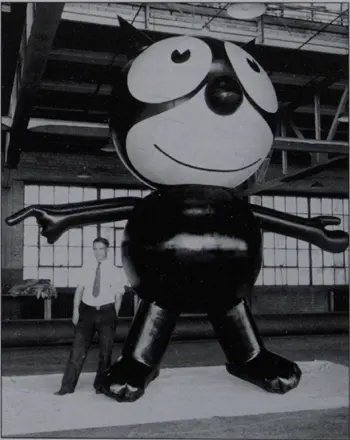
The balloons began in 1927. Puppeteer and illustrator Tony Sarg had already designed parade floats for Macy’s. He worked with the Goodyear Tire and Rubber Company to create giant rubber balloons. They replaced the live zoo animals that had frightened children.
Felix the Cat led the way. He was the most popular cartoon character of the day. A dragon and a toy soldier also appeared. In the earliest years, the balloons were filled with air and held up on sticks. Helium soon gave them their famous lift.
The Balloon Releases Nobody Forgot
Here is the balloon story many older Americans half remember. In 1928, Macy’s did not know what to do with the balloons after the parade. So handlers simply let them go. The giant characters floated off over New York and drifted for days.
The balloons had valves meant to let helium leak out slowly. They came down wherever the wind took them, sometimes miles away. Macy’s turned it into a contest. Each balloon carried a return address, and finders who sent it back could collect a reward.
Rewards ran from about $25 to $100. That was serious money in the Depression. People chased balloons across Long Island, through New Jersey and out over the water. Some landed on rooftops. Others came down in the water.
In 1931, Felix the Cat met an unhappy end. The balloon drifted into high voltage power lines and caught fire. He was destroyed, and the first great balloon star was gone.
The 1932 Airplane Encounter
The release contest ended because of a near tragedy in 1932. After the parade, a giant Tom Cat balloon was set free and drifted over Queens. A 22 year old student pilot named Annette Gibson was flying nearby with her instructor.
Gibson decided to try to catch the balloon with her plane. She flew straight into it. The balloon wrapped around a wing, and the aircraft went into a tailspin. Her instructor, Hugh Copeland, grabbed the controls and pulled out of the dive just above the rooftops.
Nobody was killed, but the near crash made the newspapers. Macy’s quickly realized that free flying balloons were a serious hazard. The release tradition ended. From then on, the balloons were deflated after the parade instead of sent sailing into the sky.
Mickey Mouse, Superman, and Early Characters
The 1930s brought new stars. Mickey Mouse joined the lineup in 1934, with help from Walt Disney himself. That same year, entertainer Eddie Cantor became the first balloon modeled on a real person.
Superman arrived around 1939 or 1940, soon after his 1938 comic book debut. He returned in new versions over the decades. The 1980 Superman was about 104 feet long, one of the biggest balloons ever flown. He flew until 1987.
Popeye, Underdog, and Television Favorites
Popeye made a memorable debut in 1957. The parade took place in the rain. His sailor hat filled with water and then tipped, dumping a cold shower on spectators below. Viewers at home laughed, though the crowd may not have.
Underdog arrived in 1965 and became a fan favorite. He flew in a horizontal, flying pose, a style that changed how balloons were designed. Bullwinkle, Kermit the Frog and other television characters followed. Kermit made his first appearance in 1977.
Snoopy and the Balloons Children Loved Most
Snoopy first flew in 1968, dressed as the World War I Flying Ace. He went on to become the most frequent balloon in parade history. Over the years he appeared as an astronaut, an ice skater and many other versions.
For many children, spotting Snoopy was the highlight of the morning. Families shouted when he appeared on screen. Woodstock eventually joined him, and the Peanuts gang became a parade staple.
How the Balloons Were Inflated Before the Parade
The balloons are designed and built at a Macy’s studio in New Jersey. They travel to Manhattan flat and folded. On the day before Thanksgiving, crews spread them out on the streets around the American Museum of Natural History.
Workers fill them with helium under large nets that keep them grounded overnight. The public began coming to watch, and the scene grew into a festival known as the Inflation Celebration. It has drawn huge crowds since the 1990s. Many New Yorkers say it is as much fun as the parade itself.
On parade morning, teams of handlers take over. A large balloon can need around 90 handlers, many of them Macy’s employees and volunteers. They train ahead of time and march holding guide ropes the whole route.
When the Giant Balloons Caused Trouble
Giant balloons and city wind do not always mix. Over the decades, gusts have caused some of the most frightening moments in Thanksgiving Day Parade history. Each incident pushed Macy’s and New York City toward stricter safety rules.
Popeye and the Early Balloon Mishaps
Popeye’s water spill in 1957 was more funny than dangerous. Other early mishaps were similar. Balloons snagged on trees, got tangled in streetlights or sagged into the crowd.
Weather has always been the main enemy. In 1971, strong winds kept every balloon on the ground for the only time in parade history. Television broadcasts filled in with footage from earlier years.
Sonic the Hedgehog and the 1993 Accident
In 1993, the Sonic the Hedgehog balloon was caught by high winds near Columbus Circle. It struck a lamppost. Falling debris injured an off duty police officer and a child.
The Sonic balloon was retired after that parade. A new Sonic would not fly until 2011. The accident was a warning sign of what high winds could do.
The Cat in the Hat Accident in 1997
The worst accident came in 1997. Winds gusted to around 43 miles per hour that morning. The Cat in the Hat balloon struck a lamppost near Central Park West.
A piece of the lamppost fell into the crowd. Kathleen Caronna, a spectator, suffered a fractured skull and spent nearly a month in a coma. Other balloons struggled too. Barney and the Pink Panther had to be punctured and brought down.
Mayor Rudy Giuliani formed a task force after the parade. New rules followed, including limits on balloon size. The 1997 parade changed how the event is run to this day.
The M&M Balloon Accident in 2005
In 2005, the M&M’s balloon hit a streetlight in Times Square. The light fell and injured two sisters. Once again, wind was to blame.
Macy’s responded by adding weather instruments along the route the following year. These measure wind speed in real time. Officials can now make decisions based on precise readings rather than guesses.
How Safety Rules Changed the Parade
Today, the rules are clear. Balloons do not fly if sustained winds top 23 miles per hour or gusts exceed about 34 miles per hour. Officials watch the readings closely on parade morning.
Handlers can lower balloons closer to the street when winds pick up. Balloons are tethered to vehicles for extra control. A police officer is assigned to supervise each balloon. These changes have made the parade much safer while keeping the giants in the sky.
Marching Bands, Floats, Performers, and Holiday Magic
The balloons get the headlines, but the parade is much more than that. Bands, floats and performers fill every block. They give the event its sound and its sparkle.
Marching Bands From Across America
Marching bands from across the country apply each year for a spot in the Macy’s parade. Being chosen is a huge honor. Small town high schools raise money for years to make the trip.
For families back home, seeing their local band on national television was unforgettable. Neighbors gathered around the set to watch. The announcer said the town’s name, and the whole living room cheered.
Floats That Brought Holiday Themes to Life
Floats bring storybooks, cartoons and holiday scenes to the streets. Early floats were pulled by horses. Later, they grew into elaborate rolling stages with lights, music and moving parts.
Many floats are built to fold down so they can pass through the Lincoln Tunnel from New Jersey. Then they expand again in Manhattan. It is a feat of engineering most viewers never think about.
Broadway Performances
Broadway shows often perform in front of Macy’s during the parade. It is a way to reach a giant national audience in just a few minutes. For families far from New York, it might be their only taste of a Broadway musical.
Those short numbers sometimes inspired lifelong love of theater. A child in a farmhouse might see a song from a hit show and remember it forever.
Clowns, Celebrities, and Television Stars
Clowns have marched since the very first parade. They still fill the streets, waving, juggling and joking with the crowd. Many are Macy’s employees who volunteer each year.
Celebrities ride on floats and wave to viewers at home. Singers lip sync or perform live. For the networks, the stars are a way to promote their shows. For families, they were part of the fun of spotting famous faces.
Santa Claus and the Official Start of Christmas
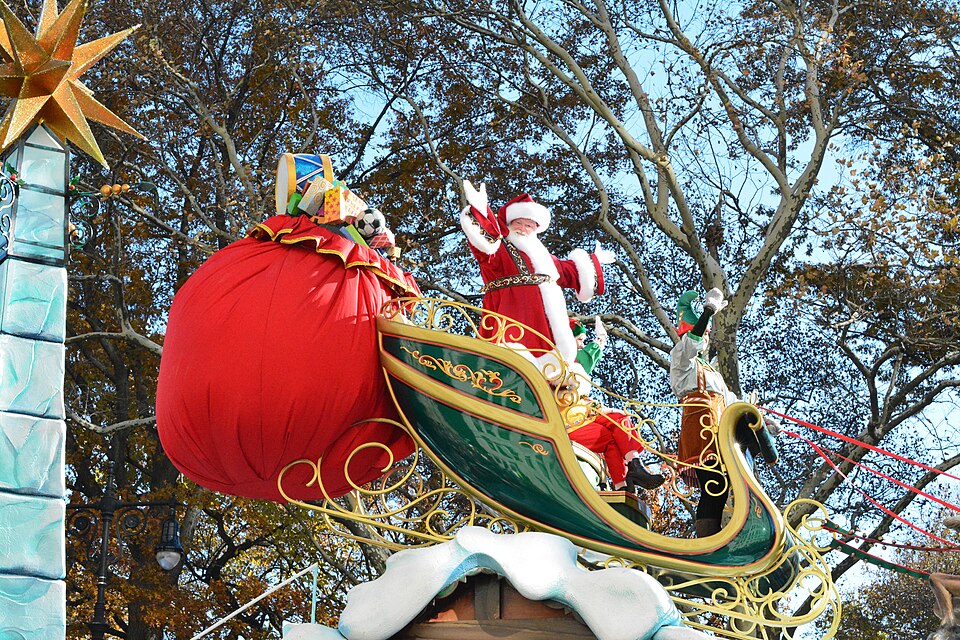
The parade always saves the best for last. Santa Claus arrives at the very end. His appearance has long marked the official start of the Christmas season in America.
Waiting for Santa at the End of the Parade
Kids at home knew the drill. They watched every balloon and every band, but they were really waiting for Santa. When his sleigh came into view, the room filled with excitement.
Santa has closed the Macy’s parade every year except 1933, when he appeared at the start instead. That consistency is one of the few constants in Thanksgiving Day Parade history, and it makes the moment feel magical.
Why Santa’s Arrival Meant Christmas Was Coming
Once Santa waved goodbye, the holiday calendar changed. Store windows filled with toys. Christmas music started on the radio. Wish lists were written and catalogs were circled.
That was always the plan. The department stores created these parades to bring shoppers downtown. Santa’s arrival told everyone the shopping season had begun.
The Holiday Season Begins After Thanksgiving
Today the day after Thanksgiving is known as Black Friday. Yet the idea is much older. For generations, the parade ended with Santa, and the next morning Christmas shopping began in earnest.
The parade stitched Thanksgiving and Christmas together. It gave families a clear handoff from one holiday to the next. That bridge is still part of American life.
Memorable Moments in Thanksgiving Parade History
Over a century, the parade has marched through war, tragedy, bad weather and a pandemic. Some years stand out more than others in Thanksgiving Day Parade history. These moments reveal how deeply the parade is woven into American life.
The Parade During World War II
The Macy’s parade was canceled from 1942 through 1944. Rubber and helium were needed for the war effort. Macy’s deflated its balloons and donated about 650 pounds of rubber to the government.
Detroit also canceled its parade in 1943 and 1944. When the parades returned after the war, they were bigger than ever. In 1945, the Macy’s parade drew huge crowds and was back on local television.
The 1963 Parade After President Kennedy’s Death
President John F. Kennedy was assassinated on November 22, 1963. Thanksgiving came just six days later. The nation was in mourning, and many wondered if the parade should go on.
Macy’s has said a call from the Kennedy family helped settle the question. The parade went forward. Flags were draped in black bunting. For a grieving nation, the parade offered a small sense of normal life.
Weather That Changed Parade Day
Weather has shaped many parades. The coldest on record was 2018, at about 19 degrees Fahrenheit. The warmest was 1933, at about 69 degrees. The wettest came in 2006, with heavy rain soaking marchers and spectators.
Snow, rain and wind have all made their mark. Through it all, the parade has almost always gone on. Viewers at home stayed warm and dry while watching others brave the weather.
The 2020 Parade and Changing Traditions
In 2020, the COVID-19 pandemic forced major changes. The parade was closed to the public. Most of the event was staged around Herald Square for television. The balloons were tethered to vehicles instead of carried by large teams of handlers.
There was no public balloon inflation event, and marching bands did not take part in person. Yet the parade still went on. For families stuck at home, the familiar broadcast was a comfort.
The 100th Macy’s Thanksgiving Day Parade in 2026
This year brings a milestone. The 100th Macy’s Thanksgiving Day Parade is scheduled for Thursday, November 26, 2026. It will air on NBC and stream on Peacock starting at 8:30 a.m. local time.
Savannah Guthrie, Hoda Kotb and Al Roker are set to host. Macy’s has announced a record lineup of balloons and inflatables. Telemundo will simulcast the parade in Spanish. NBC has also scheduled a documentary about the parade’s century of history.
The number 100 counts parades, not years. Since the first parade in 1924, three were lost to World War II. That is why the 100th parade falls in 2026.
How Television Changed the Thanksgiving Parade Experience
Television did not just broadcast the parade. It changed it, and it reshaped Thanksgiving Day Parade history for good. The event became a performance for the cameras as much as for the crowd on the street.
Watching the Parade in Black and White
Early viewers watched on small screens with grainy black and white pictures. The balloons were shades of gray. The bands were tiny figures. Still, it felt like magic to see New York from a living room in Kansas.
Many families crowded around one set, sometimes at a neighbor’s house. Television itself was still new and exciting. The parade gave them a reason to gather.
The Arrival of Color Television
Color arrived on the parade broadcasts around 1960. Suddenly the balloons were bright red, yellow and blue. Santa’s suit was red. The Rockettes sparkled.
Color televisions were expensive at first. Families who had one often invited others over. By the 1970s, most households could finally see the parade in full color.
The Difference Between NBC and CBS Coverage
NBC offered a single, polished Macy’s broadcast. It had the official access and the big performances in front of the store. CBS offered variety, with several cities and a cozy host like Conrad.
Some families liked the focus of NBC. Others loved the travelogue feel of CBS. Both helped make Thanksgiving morning a shared national experience.
From Rabbit Ears to Streaming
Early viewers adjusted rabbit ear antennas to get a clear picture. Later came rooftop antennas, then cable and satellite. Today the parade streams on phones, tablets and smart TVs.
The screens changed, but the experience stayed familiar. Families still gather. Children still wait for Santa. The parade remains appointment viewing in an age when little else is.
Why Thanksgiving Day Parade History Still Matters
It might seem like just a parade. Yet for millions of people, it holds memories of family, home and holidays past. Thanksgiving Day Parade history is really the history of how Americans spent one special morning together.
Shared Family Memories
Ask almost anyone over 50 about the parade, and you will hear a story. They remember a parent cooking, a sibling fighting over the best spot on the couch or a grandparent who loved the bands.
Those memories are tied to the broadcast. The parade became a family heirloom that could not be packed in a box. It lived in the shared experience of watching together.
Television Traditions Passed Down Through Generations
Parents who watched as children now watch with their own kids. Grandparents point out what has changed and what has stayed the same. The tradition keeps going because families keep it going.
That is rare in an age of endless choices. Few television events still draw whole families to one screen. The parade is one of them.
The Parade as Part of American Holiday Culture
The parade has shaped how America celebrates. It marks the turn from Thanksgiving to Christmas. It inspired movies, songs and countless local parades in towns across the country.
Its influence reaches far beyond New York, Philadelphia and Detroit. It is part of the fabric of American holiday life, as familiar as turkey and pie.
Why So Many Americans Still Watch Every Year
Millions of people still tune in. NBC’s audience peaked at about 31 million viewers in 1993. Ratings remain strong today, even with so many streaming options.
People watch because it feels like home. It is predictable in the best way. The balloons, the bands, the Rockettes and Santa all show up right on schedule.
Conclusion: Thanksgiving Morning, the Parade, and the America We Remember
Thanksgiving Day Parade history begins with department stores and live zoo animals. It grows through radio, black and white television and the arrival of color. It carries us through William Conrad by the fireplace, balloons drifting over Queens and Santa arriving right on time.
Most of all, it is a story about families. It is about pajamas, coffee, the smell of turkey and the voice of a host welcoming everyone to the holiday. It is about a nation that, for one morning, watched the same thing at the same time.
This Thanksgiving, the Macy’s parade will march for the 100th time. Somewhere, a family will turn on the television, settle onto the couch and wait for Santa. That simple scene connects them to every Thanksgiving morning that came before.