🍀 Archiving Irish Stereotypes in Newspaper Strips

The comics page of an American newspaper from the late nineteenth or early twentieth century was rarely a neutral space. It reflected the attitudes, anxieties, and biases of the society that produced it, often with a frankness that later generations would find uncomfortable. Among the most persistent patterns in that history is the treatment of Irish immigrants and their descendants. Irish stereotypes appeared in newspaper strips with a regularity that made them part of the visual grammar of popular print culture, shaping how millions of readers understood an entire ethnic community over the course of several decades.
The Origins of Ethnic Caricature in Print
American newspaper comics did not invent ethnic caricature. They inherited it from a long tradition of illustrated satire that stretched back through British periodicals and political cartoons to the engravers and pamphleteers of earlier centuries. By the time Joseph Pulitzer and William Randolph Hearst were building their newspaper empires in the 1880s and 1890s, caricature was an established visual language with recognized shorthand. Certain physical features, clothing details, and behavioral cues had already been assigned to particular groups, and cartoonists working under deadline pressure reached for those cues instinctively.
These caricature conventions were among the most codified in this inherited vocabulary, arriving in American newspapers already worn smooth by decades of use in British illustrated magazines like Punch, where the Irish figure had been depicted with simian facial features, a clay pipe, a shillelagh, and an appetite for drink and disorder.
The American newspaper context added its own pressures. Immigrant populations flooded into cities during the latter half of the nineteenth century, and newspapers competed fiercely for readership among working-class audiences. Comics were a circulation tool, and ethnic characters, broadly drawn and easily recognized, translated well across language barriers and literacy levels. The Irish community was large, politically visible, and culturally distinct enough to serve as reliable comic material. That ethnic shorthand filled that role, giving readers a figure they recognized immediately, even if what they recognized was a distortion.
In the late nineteenth century, some American newspapers printed Irish stereotypes caricatures alongside political cartoons, often without bylines, making authorship difficult to trace today.
The Foundational Characters
The earliest successful newspaper comic strips leaned heavily on ethnic identity for their central characters. The Yellow Kid, often cited as the first true newspaper comic strip, debuted in the New York World in the mid-1890s and depicted the tenement life of the urban poor, with Irish and other immigrant types present throughout. More direct in its ethnic framing was The Katzenjammer Kids, which focused on German immigrant stereotypes, but the success of that strip confirmed that ethnic characterization was a workable commercial formula. Strips built around Irish characters followed naturally.
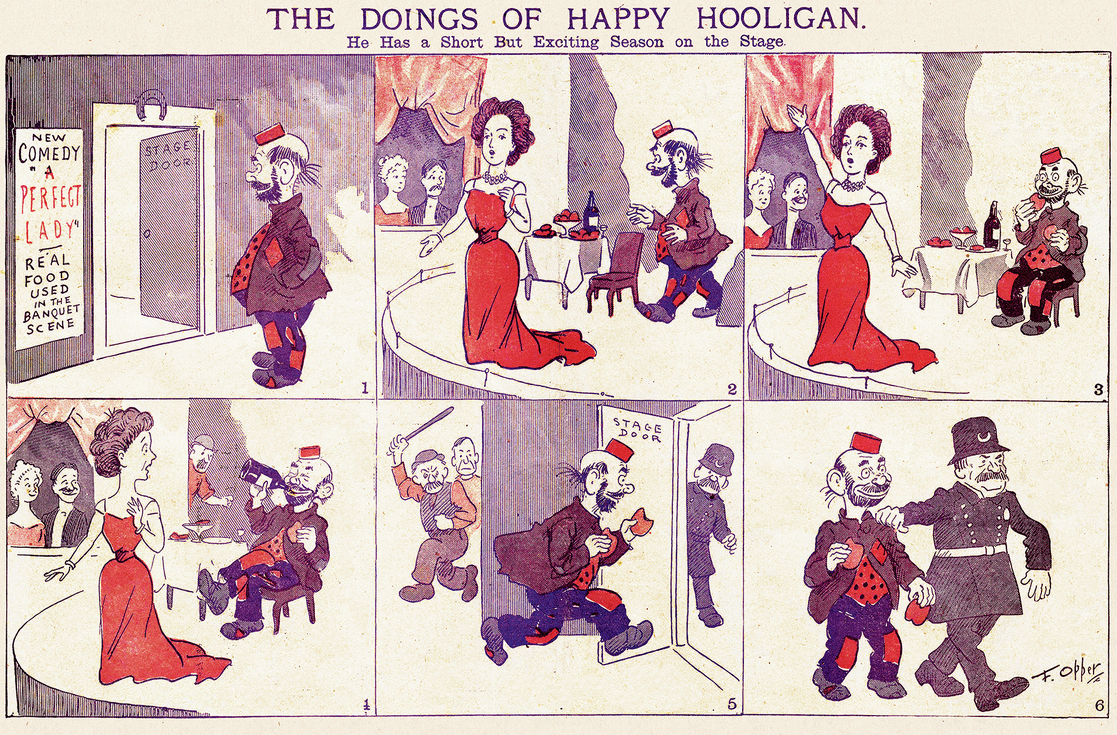
Characters like Happy Hooligan, created by Frederick Burr Opper and syndicated from 1900 onward, became some of the most widely read comic features in the country. Hooligan was not a cruel portrayal by the standards of his time, but he was unmistakably built from Irish stereotypes. His peaked hat, his battered tin can on his head, his well-meaning incompetence, and his inevitable bad luck drew on a character type that audiences would have recognized from decades of stage comedy and illustrated humor. He was sympathetic in a condescending way, a figure audiences could laugh at without feeling guilty, because the laughs were framed as gentle.
Visual Language and Its Consequences
The visual conventions that carried Irish stereotypes across decades of newspaper publishing were not subtle. The jutting jaw, the heavy brow, the reddened nose, the clay pipe, the shillelagh, the shabby clothing, all of these were elements cartoonists deployed with minimal variation. They were efficient, which was part of the problem. An artist working on a weekly or daily strip had little incentive to develop nuance when a handful of visual markers would communicate character and situation instantly to the reader.
What this efficiency produced, across years and years of repetition, was a remarkably durable image. Readers who had never visited an Irish neighborhood, who had no personal contact with Irish immigrants or their families, formed impressions through these repeated visual encounters. Irish stereotypes in this context were not simply harmless jokes. They were a form of instruction, teaching readers what the Irish were supposed to look like, how they were supposed to behave, and what place they occupied in the social hierarchy.
Original Sunday comic supplements were frequently printed in color using early four-color processes, which caused rapid fading when exposed to light.
Reception and Resistance
The Irish-American community was not passive in the face of these portrayals. By the early twentieth century, Irish Americans were well-organized politically and had a significant presence in local media markets, particularly in cities like New York, Boston, and Chicago. Irish-language newspapers and Catholic publications pushed back against the more degrading elements of popular caricature, and Irish political figures occasionally used their influence to protest particularly offensive portrayals in the mainstream press.
The protests did not eliminate Irish stereotypes from the comics page, but they contributed to a gradual softening of the most overtly hostile imagery. The simian caricatures that had appeared in British satirical magazines and filtered into early American illustration became less common as the century turned. What remained was a milder set of clichés, the lovable rogue, the hot-tempered but good-hearted fighter, the devoted mother, the hard-drinking but charming ne'er-do-well. These were softer images, but they were still Irish stereotypes in the sense that they reduced a diverse community to a short list of recognized traits.
Syndication and National Spread
The syndication of newspaper comics was the mechanism that carried these images across the country. A strip that originated in a New York paper might within a few years be running in hundreds of papers across every region of the United States. This national distribution gave newspaper comics an influence on public perception that local media could not match. Irish stereotypes that might have remained regional curiosities instead became national visual conventions, recognized from Maine to California.
The syndicates themselves had commercial reasons to favor familiar formulas. A strip that relied on widely recognized character types was easier to sell to editors who needed to predict how their readership would respond. Irish stereotypes were part of the inventory of reliable comic material that syndicates offered to client papers, and their persistence was partly a function of this commercial logic.
Changing Standards and the Long Decline
By the mid-twentieth century, the most exaggerated forms of ethnic caricature had become less acceptable in mainstream newspaper comics. The reasons were multiple: the political consequences of Nazi racial imagery in Europe had made American editors more sensitive to visual dehumanization, the Irish-American community had achieved substantial social and political integration, and shifting cultural standards among the newspaper-reading public pushed editors toward less overtly offensive content.
This did not mean that Irish stereotypes disappeared overnight. They persisted in legacy strips that continued to run long after their original creators had retired or died, and they surfaced in seasonal features, Saint Patrick's Day comics, and advertising art that ran alongside the editorial content. The decline was real but gradual, and remnants of the old visual vocabulary remained visible well into the latter decades of the century.
What the Record Shows
Looking at the full run of newspaper strip history, from the 1890s through the postwar decades, the treatment of Irish characters illustrates something important about how popular media transmits cultural attitudes. Irish stereotypes were not the creation of malicious individuals working in isolation. They were products of inherited traditions, commercial pressures, audience expectations, and editorial inertia. Individual cartoonists may have worked with affection toward the characters they drew, but affection expressed through caricature is still caricature.
The newspaper comics page was a space where American society worked out its understanding of who belonged and who didn't, who was respectable and who was comic material. Irish immigrants and their descendants spent decades as comic material in that space, and the images produced during those decades were not forgotten quickly. They left traces in popular memory that outlasted the strips themselves, which is the nature of imagery repeated often enough and widely enough to feel normal.
The study of Irish stereotypes in newspaper comics is not an exercise in retrospective condemnation of individual artists or editors. It is a way of understanding how media shapes perception over time, how inherited images gain authority through repetition, and how a community's public identity can be filtered through a lens it did not choose and could not fully control.
Collecting Newspaper Strips Featuring Irish Characters
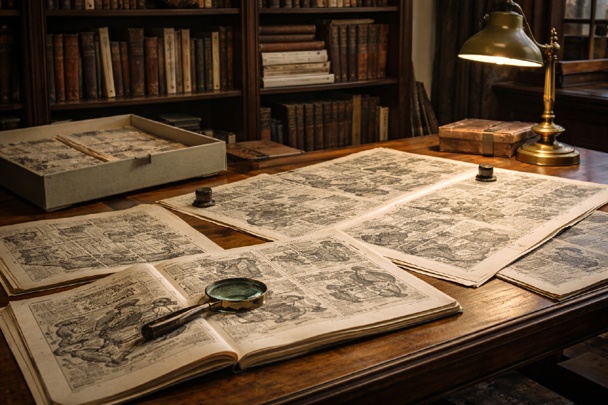
For collectors and historians, newspaper strips that feature Irish stereotypes occupy a complicated but significant corner of the original art and ephemera market. Sunday pages and daily strips from the peak years of ethnic caricature, roughly 1895 through the 1930s, are among the most historically revealing printed artifacts of their era. Strips featuring characters like Happy Hooligan turn up at auction, in estate collections, and through specialty dealers who focus on early American newspaper comics. The condition of newsprint from this period varies considerably, and collectors generally prize clean, unfolded examples with strong color registration on the Sunday pages.
Original art from strips that traded in Irish stereotypes carries particular documentary value. Cartoonists working in ink on illustration board left behind original panels and pages that show the drafting conventions and editorial corrections that never made it to print. When these originals surface, they often reveal how deliberately the visual shorthand was constructed, which pen strokes defined the jutting jaw, which details the editor flagged or approved. For a collector focused on media history rather than nostalgic appreciation, this material offers a direct look at how caricature was produced as a commercial product.
Reprints, anthologies, and bound newspaper archives provide more accessible entry points for readers who want to examine these strips without the expense or fragility concerns of original newsprint. Several university library collections have digitized substantial runs of early syndicated comics, and these archives are searchable and free to consult. Anyone serious about understanding Irish stereotypes as a sustained visual pattern in print culture will find that primary source review, whether physical or digital, is more instructive than secondhand summary.
Bound newspaper volumes stored in public libraries were sometimes trimmed during binding, removing outer margins that contained artist signatures or publication details.
What to Look for When Examining These Strips
Approaching these strips with a critical eye means knowing what to look for beyond the surface humor. The most informative examples of Irish stereotypes in newspaper comics are not always the most extreme. Subtle repetition across dozens of strips, the same physical traits, the same behavioral patterns, the same narrative outcomes, often tells more about cultural assumptions than a single overtly hostile image does.
Collectors and researchers examining strip runs from major syndicates should note how Irish characters are positioned relative to other ethnic figures in the same panels or storylines. The visual hierarchy, who is drawn with dignity and who is drawn as comic relief, reflects editorial and commercial assumptions that the jokes alone do not fully expose. Dating the strips accurately also matters. A strip from 1902 and one from 1928 may look similar on the surface but reflect very different social and political contexts for Irish Americans, and reading them without that context produces incomplete conclusions.
For those building a focused collection around print culture and ethnic representation, Irish stereotypes in newspaper comics represent one of the better-documented threads available. The volume of surviving material is substantial, the syndication records are reasonably well preserved in newspaper archives, and the critical literature on early comics history has grown steadily since the 1990s. That combination of primary material and secondary scholarship makes this a more navigable area of research than many comparable topics in American media history.
Further Reading & Resources
📖 Read: 11 things you should never say when you're in Ireland
🔍 Explore: 10 Stereotypes All Irish People Hate