Martin Balsam Biography: Brilliant Oscar Winner Behind Classic Films
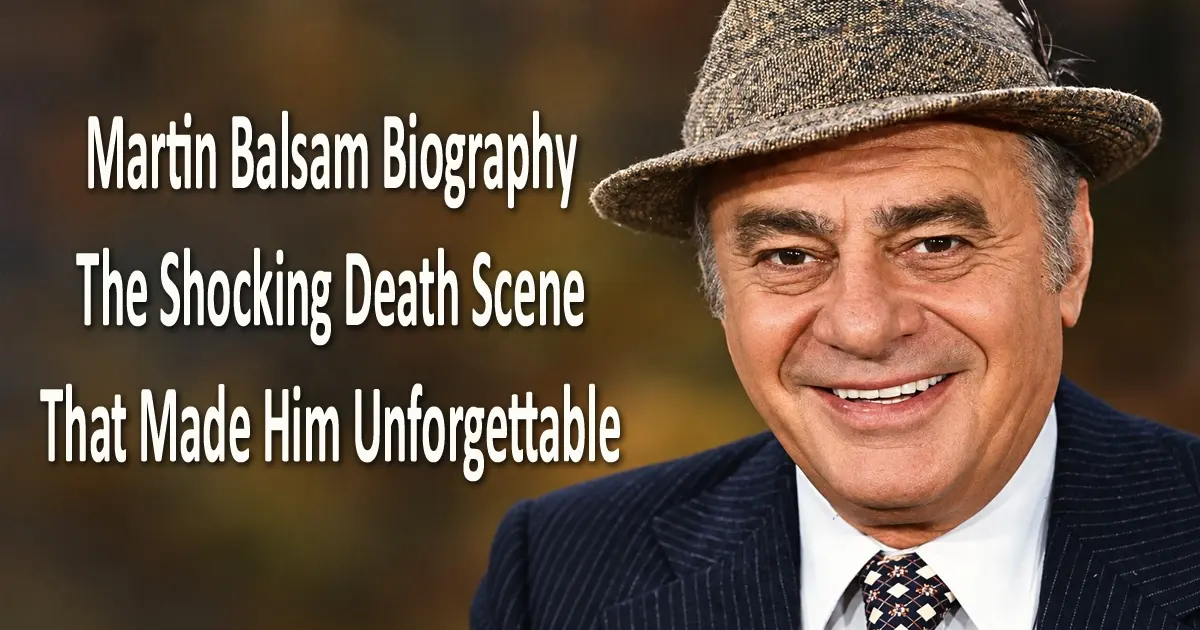
Martin Balsam occupies a distinctive place in American film history as one of the most respected and recognizable character actors of the twentieth century. Over a career that lasted half a century, he moved between Broadway, live television, Hollywood studio pictures, and European cinema, building a body of work defined by reliability, intelligence, and an unshowy realism that made audiences believe in every character he played.
Martin Balsam was an American character actor from the Bronx whose career spanned Broadway, live television, Hollywood, and European cinema for half a century. He is best remembered as detective Milton Arbogast in Alfred Hitchcock's Psycho, Juror #1 in 12 Angry Men, agent O. J. Berman in Breakfast at Tiffany's, and Mr. Green in The Taking of Pelham One Two Three. Television audiences also knew him as Murray Klein, Archie Bunker's business partner on Archie Bunker's Place.
Balsam rarely played the leading man, but he was often the actor who made a film work. Whether cast as a detective, a businessman, a military officer, a talent agent, or an ordinary man caught in extraordinary circumstances, he brought a grounded humanity that audiences instantly recognized, even when they could not recall his name. His Academy Award and Tony Award confirmed his standing among the finest actors of his generation.
A product of New York's postwar theater scene and one of the early members of the Actors Studio, Balsam represented a generation of performers who helped bring psychological realism to American acting. His career offers a window into the changing landscape of entertainment, from the golden age of live television to the gritty crime films of the 1970s.
Martin Balsam was the original voice of HAL 9000. When Stanley Kubrick was making 2001: A Space Odyssey, Balsam recorded the lines for the film's calm, murderous computer. Kubrick ultimately replaced him with Canadian actor Douglas Rain, reportedly feeling Balsam's warm, expressive delivery made the machine sound too human. One of the most famous voices in film history might have belonged to the everyman from the Bronx.
👶 Early Life
Summary: Born in the Bronx to Russian Jewish parents, Martin Balsam discovered acting in his high school drama club and trained under Erwin Piscator before making his professional debut in 1941.
Martin Henry Balsam was born on November 4, 1919, in the Bronx borough of New York City. He was the first child of Albert Balsam, a Russian Jewish immigrant who manufactured women's sportswear, and Lillian Weinstein Balsam, a New York native whose parents had also emigrated from Russia. He grew up in a working Jewish household in the Bronx, a world of crowded apartment buildings and close-knit neighborhoods that would later inform the everyday authenticity of many of his performances.
Balsam attended DeWitt Clinton High School, one of New York's largest public high schools, where he joined the drama club and discovered his interest in performing. His earliest stage experience came in an amateur production in 1935, in which he played a villain. The experience convinced him that acting was more than a passing hobby.
After high school, Balsam worked at a series of ordinary jobs while continuing to pursue acting. He enrolled at the Dramatic Workshop of The New School in Manhattan, where he studied under the German director Erwin Piscator. A pioneer of political and documentary theater who had fled Nazi Germany, Piscator emphasized ensemble work and socially engaged drama, and his workshop trained a remarkable generation of American performers.
Balsam made his professional stage debut in August 1941 in a production of Ferenc Molnár's The Play's the Thing in Locust Valley, Long Island. Later that year, he made his first Broadway appearance in Ghost for Sale. His promising start was interrupted almost immediately by the American entry into World War II.
Explore the Biographies of Iconic Celebrities
🎖️ World War II Service
Balsam entered military service in 1941 and served with the United States Army Air Forces until 1945. During his service, he rose to the rank of sergeant and worked as a radio operator aboard a B-24 bomber in the China-Burma-India Theater of Operations, one of the most difficult and least publicized theaters of the war.
Crews in the China-Burma-India Theater faced dangerous flying conditions, long supply lines, and remote bases far from home. The experience gave Balsam a firsthand understanding of military life that later proved useful in the many officers and servicemen he portrayed on screen.
When the war ended, Balsam returned to New York determined to resume his acting career. Like many returning veterans, he took whatever work he could find while auditioning and studying, gradually rebuilding the momentum he had lost during his years in uniform.
After returning home from World War II, Balsam worked as an usher at Radio City Music Hall while he waited for his acting career to take off.
🎭 Stage Career and the Actors Studio
Balsam's postwar career was closely tied to the theater, which remained his first love throughout his life. From 1947 to 1949, he was a resident member of the Town Hall Players, a summer stock company that allowed him to perform a wide range of roles in rapid succession.
🎓 An Early Member of the Actors Studio
In 1947, Balsam was selected by Elia Kazan and Lee Strasberg to join the Actors Studio, the influential workshop that would become synonymous with method acting. Among its early members were Marlon Brando, Montgomery Clift, Julie Harris, Kim Stanley, and Eli Wallach. The Studio's emphasis on emotional truth, careful observation, and psychological detail shaped Balsam's approach for the rest of his career.
Balsam appeared in Sundown Beach (1948), a Broadway production developed through the Actors Studio and directed by Kazan. Although the play had a short run, it showcased the Studio's young ensemble and helped establish Balsam as part of a new generation of serious New York actors.
🌹 Tennessee Williams and Broadway in the 1950s
Balsam appeared in two Broadway productions of works by Tennessee Williams. In The Rose Tattoo (1951), starring Maureen Stapleton and Eli Wallach, he played a supporting role in the playwright's passionate drama about a Sicilian American widow. He returned to Williams in Camino Real (1953), an experimental fantasy directed by Kazan, in which he played several roles.
In Middle of the Night (1956), Paddy Chayefsky's drama about a middle-aged widower who falls in love with a much younger woman, Balsam played the son-in-law opposite Edward G. Robinson. He later appeared in the musical Nowhere to Go But Up (1962), a comedy about Prohibition agents, playing the real-life agent Moe Smith.
🏆 You Know I Can't Hear You When the Water's Running
The high point of Balsam's stage career came with Robert Anderson's You Know I Can't Hear You When the Water's Running, a collection of four one-act comedies about marriage, sex, and aging. The production opened on Broadway on March 13, 1967, under the direction of Alan Schneider, with a cast that included Eileen Heckart, George Grizzard, and Melinda Dillon.
Balsam played three different characters across the evening: an eager actor auditioning for a role that requires nudity, a husband resisting his wife's plan to replace their double bed with twin beds, and a father awaiting the arrival of his grown children at Christmas. The variety of the roles allowed him to display his full range, moving from broad comedy to quiet melancholy. The production ran for 756 performances, and Balsam won the 1968 Tony Award for Best Actor in a Play.
❄️ Cold Storage
Balsam returned to Broadway in Ronald Ribman's Cold Storage (1977), a dark comedy set on the rooftop terminal ward of a New York hospital. He played Joseph Parmigian, a terminally ill fruit and vegetable dealer who confronts mortality with sardonic humor and furious energy. The performance earned him a Drama Desk Award and confirmed that, a decade after his Tony victory, he remained one of the strongest stage actors in New York.
🎬 Film and TV Career
Summary: From On the Waterfront and 12 Angry Men to A Thousand Clowns, All the President's Men, and Archie Bunker's Place, Balsam became one of the most dependable character actors in film and television.
Balsam's screen career began in the earliest days of television. He appeared on The Philco Television Playhouse in 1948 and became a familiar presence on the live dramatic anthologies that defined the golden age of television, including Studio One, Playhouse 90, and The Goldbergs. Live television required actors to perform entire dramas without retakes, and Balsam's stage discipline made him a valuable performer in the demanding format.
He made his film debut in On the Waterfront (1954), directed by his Actors Studio colleague Elia Kazan. In a small, uncredited role, Balsam played an investigator looking into mob control of the city's waterfront unions. The film, starring Marlon Brando, won eight Academy Awards, including Best Picture, and placed Balsam in one of the landmark American films of the decade.
His first major film role came in 12 Angry Men (1957), Sidney Lumet's courtroom drama starring Henry Fonda. Balsam played Juror #1, the earnest and slightly overwhelmed foreman who tries to keep order as the jury debates a murder case. The film's ensemble included Lee J. Cobb, E. G. Marshall, Jack Warden, Ed Begley, and Jack Klugman, and its focus on character and dialogue suited Balsam's theatrical training perfectly. The film became one of the most celebrated dramas in American cinema.
Balsam appeared as a reporter in Time Limit (1957), a military drama directed by Karl Malden, and in Marjorie Morningstar (1958), the adaptation of Herman Wouk's novel starring Natalie Wood and Gene Kelly. He played Mac Keely in Al Capone (1959), opposite Rod Steiger in the title role, and repeated his stage association with Paddy Chayefsky's story in the film version of Middle of the Night (1959), starring Fredric March and Kim Novak.
His television work during this period included two memorable episodes of The Twilight Zone. In "The Sixteen-Millimeter Shrine" (1959), he played a Hollywood agent trying to rescue a faded star from her obsession with her old films. In "The New Exhibit" (1963), he played Martin Lombard Senescu, a devoted wax museum caretaker whose attachment to figures of notorious murderers leads to a disturbing conclusion. He also appeared on Alfred Hitchcock Presents, The Untouchables, and Father Knows Best.
The year 1960 brought the role for which Balsam would always be remembered: private detective Milton Arbogast in Alfred Hitchcock's Psycho (1960). His performance and its shocking conclusion are examined in their own section below.
Balsam followed Psycho with Breakfast at Tiffany's (1961), Blake Edwards's romantic comedy starring Audrey Hepburn and George Peppard. He played O. J. Berman, the fast-talking Hollywood agent who discovered Holly Golightly and remains convinced she is "a real phony." His comic energy provided a sharp contrast to the film's dreamy romance.
In Cape Fear (1962), directed by J. Lee Thompson, Balsam played Police Chief Mark Dutton, a sympathetic lawman who is unable to protect Gregory Peck's family from the menacing ex-convict played by Robert Mitchum. The film's tension and Mitchum's terrifying performance made it a classic of the suspense genre.
Balsam portrayed studio executive Bernard B. Norman in The Carpetbaggers (1964), Edward Dmytryk's adaptation of Harold Robbins's bestselling novel, starring George Peppard. That same year, he appeared in John Frankenheimer's political thriller Seven Days in May (1964) as Paul Girard, a loyal aide to the president who is killed while investigating a planned military coup. The film co-starred Burt Lancaster, Kirk Douglas, and Fredric March.
From 1963 to 1966, Balsam had a recurring role as Dr. Milton Orloff on the medical drama Dr. Kildare, starring Richard Chamberlain. The steady television work complemented his growing film career.
His career reached its peak in A Thousand Clowns (1965), directed by Fred Coe and adapted from Herb Gardner's Broadway comedy. Jason Robards starred as Murray Burns, an unemployed television writer who refuses to conform while raising his young nephew. Balsam played Arnold Burns, Murray's practical older brother, a successful talent agent who has accepted the compromises his brother rejects. In a pivotal scene, Arnold delivers a moving defense of ordinary responsibility, explaining that he is the kind of man who simply takes what life offers and does his best with it. The quiet dignity of the performance earned Balsam the Academy Award for Best Supporting Actor at the 38th Academy Awards in 1966.
Balsam appeared in Harlow (1965) as a studio boss and in The Bedford Incident (1965) as Lieutenant Commander Chester Potter, the ship's doctor aboard a Navy destroyer stalking a Soviet submarine, opposite Richard Widmark and Sidney Poitier. He then joined Peter Sellers in the Vittorio De Sica comedy After the Fox (1966), written by Neil Simon.
In Hombre (1967), Martin Ritt's Western starring Paul Newman, Balsam played Henry Mendez, a stagecoach driver whose passengers come under attack by outlaws. The film's examination of prejudice and moral courage reflected the more serious tone of late-1960s Westerns.
Balsam entered the 1970s with three major films released in a single year. In Mike Nichols's war satire Catch-22 (1970), adapted from Joseph Heller's novel, he played Colonel Cathcart, the ambitious and cowardly commander who keeps raising the number of missions his airmen must fly. In Tora! Tora! Tora! (1970), the American-Japanese account of the attack on Pearl Harbor, he portrayed Admiral Husband E. Kimmel, commander of the Pacific Fleet. In Arthur Penn's revisionist Western Little Big Man (1970), starring Dustin Hoffman, he played Allardyce T. Merriweather, a traveling con man who loses parts of his body over the course of the story while never losing his enthusiasm for swindling.
Balsam reunited with Sidney Lumet for The Anderson Tapes (1971), a heist thriller starring Sean Connery, in which he played an antiques dealer involved in a plan to rob an entire luxury apartment building. He also began a productive period in European cinema, starring in Damiano Damiani's Confessions of a Police Captain (1971). Balsam played Giacomo Bonavia, a Palermo police commissioner who releases a dangerous inmate in a desperate attempt to bring down a Mafia-connected developer, opposite Franco Nero. The film was one of the most widely distributed Italian crime dramas of its day, and Balsam continued to appear in Italian productions throughout the decade.
He played Joanne Woodward's husband in Summer Wishes, Winter Dreams (1973), a quiet drama about a woman confronting regret and aging, and appeared in the crime thriller The Stone Killer (1973), starring Charles Bronson.
One of Balsam's most acclaimed performances came in The Taking of Pelham One Two Three (1974), directed by Joseph Sargent. He played Harold Longman, known to his fellow criminals as Mr. Green, a former subway motorman fired from the transit system who joins a gang that hijacks a New York subway car and holds its passengers for ransom. With Walter Matthau as the transit police lieutenant and Robert Shaw as the gang's ruthless leader, the film became a classic of 1970s New York cinema. Balsam's nervous, perpetually sneezing Mr. Green provided some of its most memorable moments.
That same year, Balsam joined Lumet's all-star cast in Murder on the Orient Express (1974), the adaptation of Agatha Christie's mystery. He played Signor Bianchi, a director of the railway company and an old friend of Albert Finney's detective Hercule Poirot. The ensemble included Lauren Bacall, Ingrid Bergman, Sean Connery, Vanessa Redgrave, and John Gielgud.
In All the President's Men (1976), Alan J. Pakula's account of the Watergate investigation, Balsam portrayed Howard Simons, the managing editor of The Washington Post, who supports reporters Bob Woodward and Carl Bernstein, played by Robert Redford and Dustin Hoffman. Alongside Jason Robards as Ben Bradlee and Jack Warden as Harry Rosenfeld, Balsam helped create a convincing portrait of a newsroom under pressure.
He appeared as a stadium manager in the disaster thriller Two-Minute Warning (1976), starring Charlton Heston, and in the horror film The Sentinel (1977). He also joined the cast of Raid on Entebbe (1977), an NBC television film about the Israeli rescue of hijacked hostages in Uganda. Balsam played Daniel Cooper, one of the hostages, and received an Emmy nomination for his performance. The same year, he supported Frank Sinatra in the crime drama Contract on Cherry Street (1977).
Balsam portrayed MGM chief Louis B. Mayer in Rainbow (1978), a television film about the early life of Judy Garland. He continued working steadily in television movies during this period, including Aunt Mary (1979) with Jean Stapleton and The People vs. Jean Harris (1981) with Ellen Burstyn.
His most prominent television role came in Archie Bunker's Place (1979 to 1981), the continuation of All in the Family. Balsam played Murray Klein, a liberal Jewish businessman who becomes Archie Bunker's partner in the neighborhood tavern. The pairing of Carroll O'Connor's bigoted Archie with Balsam's patient, good-humored Murray provided both comedy and a gentle examination of prejudice and friendship. Balsam remained with the series for two seasons and returned for a guest appearance in its final season.
During the 1980s, Balsam appeared in Death Wish 3 (1985), starring Charles Bronson, as Bennett Cross, an elderly resident of a crime-ridden Brooklyn neighborhood. He played Ben Kaplan, a Holocaust survivor among the hostages on a hijacked airliner, in The Delta Force (1986), starring Chuck Norris and Lee Marvin. He also appeared in The Goodbye People (1984) and in Two Evil Eyes (1990), an anthology of Edgar Allan Poe adaptations directed by George A. Romero and Dario Argento.
In a fitting tribute to his own film history, Martin Scorsese cast Balsam in a cameo as a judge in his remake of Cape Fear (1991). Along with Gregory Peck and Robert Mitchum, Balsam was one of three actors from the original film to appear in the new version, creating a link between the two generations of the story.
Broadway columnist Earl Wilson nicknamed Martin Balsam "The Bronx Barrymore," a playful nod to both his neighborhood roots and his serious stage talent.
🔪 Psycho and the Death of Detective Arbogast
Although Balsam appeared in dozens of acclaimed films, no role followed him more closely than Milton Arbogast, the private investigator in Alfred Hitchcock's Psycho (1960). His brief but unforgettable performance became one of the most studied in film history.
🕵️ The Character
Arbogast is hired by an insurance company to recover $40,000 stolen by Marion Crane, played by Janet Leigh. After Marion vanishes, Arbogast tracks her movements to the isolated Bates Motel, where he questions its nervous young proprietor, Norman Bates, played by Anthony Perkins.
Balsam played Arbogast as patient, persistent, and quietly intelligent. His interrogation of Norman, a battle of polite questions and evasive answers, remains a masterclass in screen tension. Arbogast's methodical approach and growing suspicion make him the audience's surrogate, the one person who seems capable of discovering what has happened to Marion.
🪜 The Staircase Scene
Hitchcock had already shocked audiences by killing his leading lady less than halfway through the film. He then repeated the shock by eliminating the detective audiences expected to solve the mystery. When Arbogast enters the Bates house and climbs the staircase to question Norman's mother, a figure rushes out and stabs him. Hitchcock filmed the attack from a high overhead angle that concealed the killer's identity, then cut to Arbogast's face as he tumbles backward down the stairs.
To create the startling image of the fall, Hitchcock placed Balsam in front of a rear-projection screen showing the staircase moving away from the camera, while the actor flailed his arms to simulate losing his balance. The combination of techniques produced a disorienting effect that audiences had never seen before. The scene became one of the most analyzed sequences in Hitchcock's career.
🎞️ A Role That Defined Him
Psycho became one of the most influential films ever made, and Balsam's role ensured that his face became familiar to generations of moviegoers. Even audiences who never learned his name recognized him as the detective who climbed the stairs at the Bates house.
The performance also demonstrated a quality that defined Balsam's career. With limited screen time, he created a fully believable character whose death carried genuine weight. His ability to make a strong impression in a supporting role became the foundation of his reputation in Hollywood.
🎬 Read more about Anthony Perkins in our exclusive bio.
❤️ Personal Life
Martin Balsam's personal life was shaped by three marriages, his devotion to his children, and a deep attachment to New York City and its theater community. Despite his success in Hollywood, he remained a New Yorker at heart and preferred stage and screen work that kept him close to the city where he had grown up.
💍 Marriage to Pearl Somner
Balsam's first marriage, to actress Pearl Somner in the early 1950s, came during the period when both were building careers in the New York theater. The marriage was brief and ended in divorce after a few years.
💍 Marriage to Joyce Van Patten
Balsam's second wife was actress Joyce Van Patten, a member of a prominent show business family and the sister of actor Dick Van Patten. The couple had one daughter, Talia Balsam, before divorcing in 1962. Both parents continued to work steadily as actors, and Van Patten went on to a long career in film, television, and theater.
Talia Balsam followed her parents into acting. She built a career in film and television that included a memorable recurring role as Mona Sterling, the ex-wife of John Slattery's character, on the acclaimed drama Mad Men.
💍 Marriage to Irene Miller
In 1963, Balsam married Irene Miller. The couple had two children, Adam and Zoe. Their marriage lasted more than two decades, spanning the most successful period of Balsam's career, including his Oscar and Tony victories. The couple divorced in 1987.
🍝 A Lasting Love for Italy
Balsam's work in Italian cinema during the 1970s developed into a lifelong affection for Italy. He spent considerable time there over the years and frequently vacationed in Rome, where he enjoyed the city's culture, food, and film community.
🎭 Reputation Among His Peers
Within the industry, Balsam was known as a dependable professional who prepared carefully and treated his colleagues with respect. Although proud of his Academy Award, he kept it in perspective and continued to choose his roles carefully. He once remarked that he had to remind himself not to get carried away by success after so many years of steady work.
He often said that ordinary people identified with him, and he took pride in representing the average man on screen. That sense of connection with everyday audiences reflected both his Bronx upbringing and his belief that the best acting grew out of honest observation of real life.
Martin Balsam's final screen role was in The Silence of the Hams (1994), a spoof of Psycho and The Silence of the Lambs, in which he played a detective named Martin Balsam, a comic nod to the doomed investigator he had played for Hitchcock more than three decades earlier.
🕊️ Later Years
Summary: Balsam kept working into the 1990s and died on February 13, 1996, at age 76, while vacationing in Rome.
Balsam continued working into the 1990s, accepting film, television, and stage roles as he entered his seventies. Although his parts became smaller, he remained a welcome presence for directors who valued his experience and for audiences who had grown up watching him.
🎬 Continuing to Work
His later appearances often drew on his long history in film, allowing filmmakers to pay tribute to his career. His cameo in Scorsese's Cape Fear remake reflected the respect he commanded among a younger generation of directors who had studied his earlier work.
He also remained connected to the European film industry, where his association with Italian cinema had made him a familiar figure. His final screen appearance came in an Italian production released in 1994.
🕯️ Death in Rome
Martin Balsam died on February 13, 1996, at the age of 76, in Rome, Italy, where he had been vacationing. He was found in his room at the Ripetta Residence, a hotel near the center of the city. Initial reports suspected a heart attack, while other accounts later attributed his death to a stroke.
News of his death prompted tributes recalling his performances in Psycho, 12 Angry Men, Breakfast at Tiffany's, and A Thousand Clowns. Obituaries emphasized the remarkable range of his career and the familiarity of his face to audiences around the world.
Balsam was buried at Cedar Park Cemetery in Paramus, New Jersey. He was survived by his three children, Talia, Adam, and Zoe.
🏆 Legacy
Martin Balsam occupies a lasting place in American film history as one of the definitive character actors of his era. His legacy rests not on star billing but on a body of work so consistent and so convincing that it became woven into the fabric of American movies.
🎭 The Art of the Character Actor
Balsam's greatest contribution was his demonstration that supporting roles could be as artistically significant as leading ones. He brought the same seriousness and preparation to a two-scene appearance that other actors reserved for starring roles, and his characters consistently felt like real people with lives extending beyond the edges of the screen.
His ability to play authority figures, ordinary workers, schemers, and victims with equal conviction made him one of the most versatile actors in Hollywood. Directors relied on him to establish credibility in a scene, and audiences trusted him instinctively.
🎓 A Representative of the Actors Studio Generation
As one of the early members of the Actors Studio, Balsam belonged to the generation that transformed American acting during the postwar years. Alongside performers such as Marlon Brando, Eli Wallach, and Kim Stanley, he helped replace stylized theatrical conventions with a more naturalistic approach grounded in emotional truth.
Unlike some of his celebrated colleagues, Balsam rarely drew attention to his technique. His realism was quiet and unforced, demonstrating that method training could produce subtlety as well as intensity.
🏆 A Rare Combination of Honors
Balsam's Academy Award and Tony Award placed him among a select group of performers recognized at the highest level in both film and theater. His Emmy nomination and his recognition from international film organizations reflected the breadth of a career that crossed every major medium of his era.
These honors confirmed what audiences already knew from experience: that Balsam was an actor of exceptional skill whose contributions elevated every production he joined.
🎞️ A Face in the Classics
Few actors appeared in as many enduring American films as Balsam. On the Waterfront, 12 Angry Men, Psycho, Breakfast at Tiffany's, Cape Fear, Catch-22, The Taking of Pelham One Two Three, Murder on the Orient Express, and All the President's Men continue to be watched, studied, and celebrated by new generations of viewers.
Through these films, Balsam remains a living presence in American culture. Each new audience that discovers these classics encounters his work, often recognizing him as the familiar face that made a memorable moment possible.
🏆 Martin Balsam's Place in American History
Martin Balsam's career traced a remarkable path from a Bronx high school drama club through wartime service, the New York stage, and the golden age of television to the most celebrated films of Hollywood and Europe. His story reflects the experience of a generation of performers who built American entertainment through talent, discipline, and dedication rather than celebrity.
His legacy is ultimately one of craftsmanship, humanity, and reliability. Martin Balsam showed that an actor did not need to be a star to leave a lasting mark, and that the ordinary man, portrayed with honesty and care, could become one of the most memorable figures on the screen.