🎬 R. G. Armstrong Biography: The Sinister Sheriff Who Haunted Horror Fans
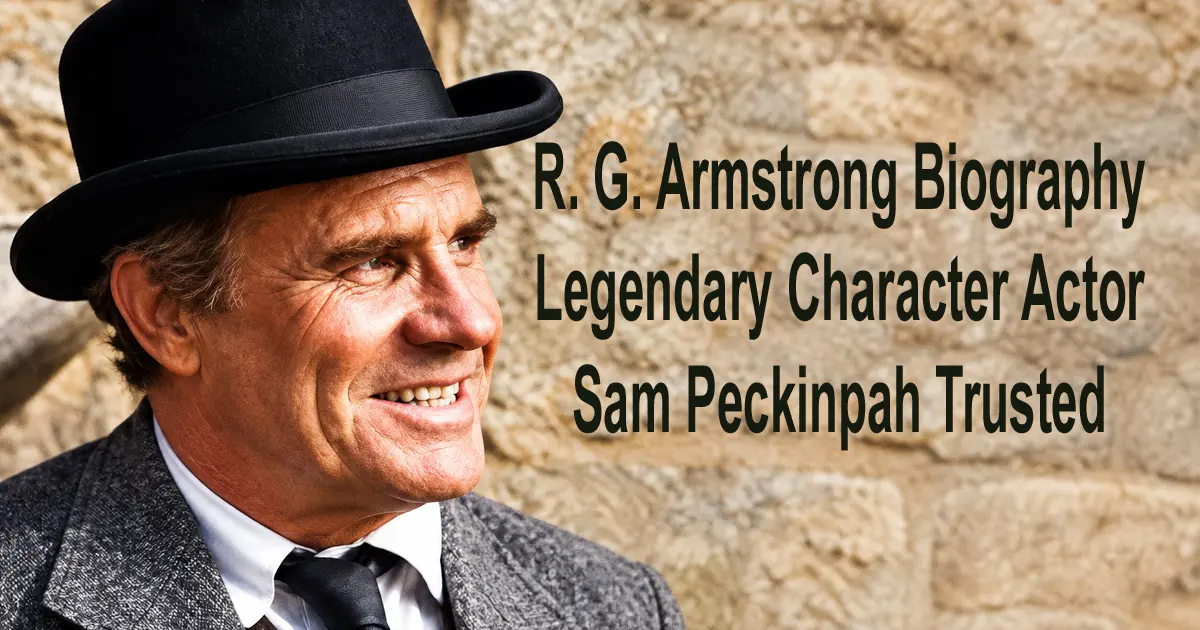
R. G. Armstrong occupies a distinctive place in American film and television history as one of the most recognizable character actors of the second half of the twentieth century. Over a career that spanned nearly five decades, he appeared in dozens of feature films and more than ninety television series, becoming a familiar face to audiences who may never have learned his name but never forgot his presence.
R. G. Armstrong (April 7, 1917, to July 27, 2012) was an American character actor and playwright from Alabama whose career spanned Broadway, television Westerns, Hollywood action films, and cult horror. Trained at the Actors Studio, he appeared in the original Broadway production of Cat on a Hot Tin Roof before becoming a favorite of director Sam Peckinpah in Ride the High Country, Major Dundee, and Pat Garrett and Billy the Kid. Horror fans remember him for Race with the Devil, The Car, Evilspeak, The Beast Within, and Children of the Corn. On television, he played the demonic Uncle Lewis Vendredi in Friday the 13th: The Series.
Tall, broad-shouldered, and possessed of a booming Southern voice, Armstrong was a natural for sheriffs, ranchers, preachers, outlaws, and military men. He could be terrifying as a Bible-thumping zealot or sympathetic as a grieving father, and directors valued his ability to bring authority and menace to even the smallest role. His work ranged from Broadway dramas by Tennessee Williams to classic Westerns, action blockbusters, and cult horror films.
Armstrong is especially remembered for his long association with director Sam Peckinpah, whose films made memorable use of his fiery intensity. His career reflects the evolution of American popular entertainment, from the live stage and the television Western to the horror and action films of the 1970s and 1980s.
The man raised by a fundamentalist family that hoped he would become a preacher made his film debut in a movie set in a nudist camp. Garden of Eden (1954) was banned by New York censors, and the fight over the film reached the state’s highest court, which ruled in 1957 that nudity alone was not obscene. R. G. Armstrong’s first screen credit helped change American censorship law.
👶 Early Life
Summary: Raised on an Alabama farm by a fundamentalist family that hoped he would preach, R. G. Armstrong discovered the stage at college and first dreamed of becoming a writer.
Robert Golden Armstrong Jr. was born on April 7, 1917, in Pleasant Grove, Alabama, and was raised on a small farm near Birmingham. His family belonged to a strict fundamentalist Christian tradition, and his mother hoped he would become a preacher. Religion was a central part of his upbringing, and the tension between his family’s beliefs and his own artistic ambitions would later shape some of his most powerful performances.
Armstrong graduated from Hueytown High School in 1935 and enrolled at Howard College, now Samford University, in Homewood, Alabama. There he developed an interest in acting and literature. Seeking a stronger theater program, he transferred to the University of North Carolina at Chapel Hill, where he earned his bachelor’s degree.
At Chapel Hill, Armstrong joined the Carolina Playmakers, the university’s influential theater company, which was known for developing new American plays rooted in regional life. His fellow students included Andy Griffith, who became a lifelong friend. The experience gave Armstrong his first serious training as a performer and introduced him to a community of writers and actors who shared his passion for the stage.
Armstrong’s original ambition was to become a writer rather than an actor. He wrote plays and poetry and hoped to build a literary career. In a 1966 interview, he recalled how hard he had struggled to become a serious writer. Although acting eventually became his profession, his love of language and storytelling remained an important part of his life.
Explore the Biographies of Iconic Celebrities
🎭 Broadway and the Actors Studio
After completing his education, Armstrong moved to New York to pursue a career in the theater. He studied at the Actors Studio under Lee Strasberg, joining a generation of performers who were transforming American acting with the psychological realism of the method.
🎓 End as a Man
In 1953, Armstrong joined many of his Actors Studio colleagues in the cast of End as a Man, Calder Willingham’s harsh drama about cruelty and corruption at a Southern military academy. The production, which featured Ben Gazzara, began off-Broadway and moved to Broadway, an unusual transfer at the time that helped demonstrate the commercial potential of the off-Broadway movement.
🐈 Cat on a Hot Tin Roof
Armstrong’s Broadway breakthrough came in the original production of Tennessee Williams’s Cat on a Hot Tin Roof, which opened at the Morosco Theatre on March 24, 1955, under the direction of Elia Kazan. He played Doctor Baugh, the family physician who knows the truth about Big Daddy’s terminal cancer. The cast included Barbara Bel Geddes as Maggie, Ben Gazzara as Brick, Burl Ives as Big Daddy, Mildred Dunnock as Big Mama, and Pat Hingle as Gooper.
When Burl Ives took a vacation from the production in late 1955, Armstrong stepped into the role of Big Daddy, the domineering Mississippi patriarch at the center of the play. Taking on one of the most commanding roles in American drama confirmed his ability to hold the stage and earned him strong notices. The production won the Pulitzer Prize for Drama.
🔥 Orpheus Descending and Other Stage Roles
Armstrong returned to Tennessee Williams in Orpheus Descending (1957), playing Sheriff Talbott, the menacing lawman of a small Southern town. The role was a forerunner of the many intimidating sheriffs he would later play on screen.
He joined the cast of William Gibson’s The Miracle Worker as a replacement in the role of Captain Keller, the stern father of Helen Keller, during the play’s acclaimed Broadway run. In 1960, he played the chief of police in The Long Dream, a stage adaptation of Richard Wright’s novel about racial injustice in Mississippi.
🎬 Film and TV Career
Summary: From television Westerns and El Dorado to Predator and Dick Tracy, Armstrong built a five-decade screen career as one of Hollywood’s most dependable character actors.
Armstrong made his first film appearance in Garden of Eden (1954), but he remained primarily a stage actor during the mid-1950s. He also had small uncredited parts in Elia Kazan’s Baby Doll (1956), another Tennessee Williams story, and in Kazan’s A Face in the Crowd (1957).
In 1958, Armstrong moved to Hollywood and quickly found steady work. He appeared in Henry Hathaway’s Western From Hell to Texas (1958) as Hunter Boyd, a powerful rancher seeking revenge against a young cowboy played by Don Murray. He followed it with No Name on the Bullet (1959), starring Audie Murphy as a hired killer whose arrival throws a frontier town into panic. Armstrong played Asa Canfield, one of the frightened townsmen.
He reprised his stage role from Orpheus Descending in The Fugitive Kind (1960), Sidney Lumet’s film adaptation of the play. As Sheriff Jordan Talbott, he appeared alongside Marlon Brando, Anna Magnani, and Joanne Woodward in a story of passion and violence in a small Southern town.
📺 The Golden Age of the Television Western
Television provided much of Armstrong’s work during the late 1950s and 1960s. He appeared on nearly every popular Western series of the era, including Gunsmoke, Bonanza, Rawhide, Have Gun Will Travel, The Rifleman, Maverick, Wagon Train, Laramie, Cheyenne, Zane Grey Theatre, and The High Chaparral. He was frequently cast as a tough sheriff, a stern father, or a powerful landowner, roles that suited his imposing physical presence.
His television work extended well beyond Westerns. He appeared on The Fugitive, The FBI, Alfred Hitchcock Presents, The Twilight Zone, The Time Tunnel, and The Invaders, among many others. He became a series regular on T.H.E. Cat (1966 to 1967), an NBC adventure series starring Robert Loggia as a former cat burglar turned professional bodyguard, in which Armstrong played a police captain.
🤠 Howard Hawks and El Dorado
One of Armstrong’s most memorable Western roles came in El Dorado (1966), Howard Hawks’s classic starring John Wayne and Robert Mitchum. Armstrong played Kevin MacDonald, a rancher whose young son is shot and who becomes caught in a range war with a ruthless rival. His sympathetic performance showed that he could play warmth and grief as convincingly as menace.
🥊 The Great White Hope and the Early 1970s
In Martin Ritt’s The Great White Hope (1970), adapted from Howard Sackler’s play about a Black heavyweight champion modeled on Jack Johnson, Armstrong played Cap’n Dan, one of the promoters determined to find a white fighter capable of defeating the champion. The film starred James Earl Jones and Jane Alexander.
He played outlaw Clell Miller in The Great Northfield Minnesota Raid (1972), Philip Kaufman’s revisionist account of the James Younger Gang starring Cliff Robertson and Robert Duvall. In the Italian Western My Name Is Nobody (1973), starring Henry Fonda and Terence Hill, he played Honest John, a comically dishonest outlaw.
Armstrong appeared with Burt Reynolds in the moonshine action film White Lightning (1973) and with Jan-Michael Vincent in the trucking drama White Line Fever (1975). In Bob Rafelson’s Stay Hungry (1976), he appeared alongside Jeff Bridges, Sally Field, and Arnold Schwarzenegger in a story set in the world of Alabama bodybuilding.
🎥 Warren Beatty’s Films
Armstrong became a favorite of Warren Beatty, who cast him in three films he directed or co-directed. He appeared in Heaven Can Wait (1978), Beatty’s fantasy comedy about a football player who dies before his time, and in Reds (1981), Beatty’s epic about journalist John Reed and the Russian Revolution.
In Dick Tracy (1990), Armstrong played Pruneface, one of the grotesque gangsters from Chester Gould’s comic strip. Buried under heavy prosthetic makeup, he joined an ensemble that included Beatty, Madonna, Al Pacino, and Dustin Hoffman. The film’s makeup work won the Academy Award.
🎞️ The 1980s
Armstrong remained in steady demand throughout the 1980s. He appeared in Where the Buffalo Roam (1980), starring Bill Murray as Hunter S. Thompson; The Pursuit of D. B. Cooper (1981), with Treat Williams and Robert Duvall; Raggedy Man (1981), starring Sissy Spacek; and Wim Wenders’s detective drama Hammett (1982).
He co-starred with Tom Selleck and Sam Elliott in the television Western The Shadow Riders (1982) and played a Texas Ranger captain in Lone Wolf McQuade (1983), an action film starring Chuck Norris. He also appeared with Willie Nelson in Red Headed Stranger (1986) and with Robin Williams and Kurt Russell in the comedy The Best of Times (1986).
One of his most widely seen roles came in Predator (1987), John McTiernan’s science fiction action film. Armstrong played General Phillips, the officer who sends Arnold Schwarzenegger‘s elite commando team into the Central American jungle on a mission that turns into a fight for survival against an alien hunter. The film became one of the most popular action movies of the decade.
His television work in the 1980s included appearances on The Dukes of Hazzard, Dynasty, Trapper John, M.D., Matlock, and Quantum Leap. He later appeared on Walker, Texas Ranger, L.A. Law, and Cybill.
🤠 Sam Peckinpah’s Fire and Brimstone
Armstrong’s most celebrated professional relationship was with director Sam Peckinpah, whose violent, morally complex Westerns redefined the genre during the 1960s and 1970s. The two men met in 1960 while working on The Westerner, the short-lived television series Peckinpah created. Armstrong had already appeared in the pilot episode of The Rifleman, which Peckinpah wrote.
Peckinpah recognized the inner conflict Armstrong carried from his strict religious upbringing and used it to striking effect. In Peckinpah’s films, Armstrong frequently played unbalanced fundamentalist Christians, men who quoted Scripture while carrying a shotgun. These characters combined righteousness and menace in a way that reflected Peckinpah’s fascination with violence, morality, and hypocrisy on the American frontier.
⛰️ Ride the High Country
In Ride the High Country (1962), Peckinpah’s elegiac Western starring Joel McCrea and Randolph Scott as aging lawmen, Armstrong played Joshua Knudsen, a harsh and fanatically religious farmer. His daughter, played by Mariette Hartley, runs away to escape his control and marry a miner, setting the story in motion. Armstrong’s portrayal of a father whose piety has hardened into tyranny gave the film much of its emotional tension. The film is widely regarded as one of the finest Westerns of its era.
⚔️ Major Dundee
Armstrong played the Reverend Dahlstrom in Major Dundee (1965), Peckinpah’s ambitious Civil War era cavalry epic starring Charlton Heston and Richard Harris. As a preacher who joins an expedition pursuing Apache raiders into Mexico, Armstrong embodied the uneasy mixture of faith and violence that ran through Peckinpah’s work.
🏜️ The Ballad of Cable Hogue
Armstrong showed a gentler side in The Ballad of Cable Hogue (1970), Peckinpah’s comic and melancholy fable starring Jason Robards as a prospector who discovers water in the desert and builds a stagecoach stop. Playing a more likable character than in his other Peckinpah films, Armstrong demonstrated the range that made him so valuable to the director.
🔫 Pat Garrett and Billy the Kid
His most famous Peckinpah role came in Pat Garrett and Billy the Kid (1973). Armstrong played Deputy Bob Ollinger, a sadistic, Bible-quoting jailer who torments Billy the Kid, played by Kris Kristofferson, while Billy awaits execution. During Billy’s escape, Ollinger is killed with his own shotgun in one of the film’s most memorable scenes. The cast included James Coburn as Pat Garrett and Bob Dylan, who also composed the film’s score.
🎬 A Lasting Collaboration
Armstrong remained one of the actors most closely associated with Peckinpah’s work. In later years, he participated in documentaries examining the director’s career, including Passion & Poetry: The Ballad of Sam Peckinpah (2005), sharing memories of a filmmaker whose turbulent genius shaped some of the defining Westerns in American cinema.
R. G. Armstrong guest starred on The Andy Griffith Show, the sitcom led by his old college friend and fellow Carolina Playmakers alumnus, Andy Griffith.
👻 Horror Films and Supernatural Television
Summary: Armstrong became a cult horror favorite through Race with the Devil, The Car, Evilspeak, Children of the Corn, and his demonic role in Friday the 13th: The Series.
Although Armstrong was best known for Westerns, he built a remarkable second reputation in horror and supernatural entertainment. His imposing size, commanding voice, and talent for barely suppressed menace made him a natural choice for sinister authority figures, doomed townsfolk, and characters with dark secrets. For many younger viewers, these roles became their introduction to his work.
🌑 The Twilight Zone: Nothing in the Dark
Armstrong appeared in “Nothing in the Dark” (1962), one of the most admired episodes of The Twilight Zone. Gladys Cooper starred as an elderly woman who has hidden in her apartment for years out of fear of Death, and a young Robert Redford played a wounded police officer she takes in. Armstrong played the building contractor who arrives to demolish the condemned building, forcing the woman to confront the outside world. The episode’s quiet treatment of mortality made it one of the series’ most poignant stories.
🚐 Race with the Devil
In Race with the Devil (1975), directed by Jack Starrett, Armstrong played Sheriff Taylor in one of the most effective horror films of the decade. Peter Fonda and Warren Oates starred as friends on a recreational vehicle vacation in rural Texas with their wives, played by Loretta Swit and Lara Parker. After witnessing a human sacrifice performed by a Satanic cult, the couples report the crime to the local sheriff, only to discover that the cult’s reach extends throughout the countryside.
Armstrong’s sheriff appears to be a skeptical but ordinary small-town lawman, and the gradual realization that he is part of the cult gave the film one of its most unsettling turns. The combination of road movie, chase thriller, and occult horror made Race with the Devil a lasting cult favorite.
🚗 The Car
Armstrong appeared in The Car (1977), directed by Elliot Silverstein, a supernatural thriller about a driverless black sedan that terrorizes a small Utah town, killing residents seemingly at random. James Brolin starred as the sheriff who realizes the vehicle may be demonic. Armstrong played Amos Clements, a belligerent local resident whose hostility adds to the town’s tension. Often compared to Jaws and Steven Spielberg‘s Duel, the film developed a devoted following among horror fans.
🐕 Devil Dog: The Hound of Hell
In the CBS television film Devil Dog: The Hound of Hell (1978), Armstrong played Dunworth in a story about a suburban family whose new puppy was bred by a Satanic cult. Starring Richard Crenna and Yvette Mimieux, the film follows the family’s descent into evil as the dog exerts a demonic influence over the household.
💻 Evilspeak
Armstrong appeared in Evilspeak (1981), a horror film starring Clint Howard as Stanley Coopersmith, a bullied cadet at a military academy who discovers the writings of a medieval Satanist and uses a computer to perform black magic rituals. Armstrong played Sarge, a gruff member of the academy staff. The film’s combination of early computer technology and occult horror, along with its violent climax, made it notorious and later earned it a cult reputation.
🦗 The Beast Within
In The Beast Within (1982), directed by Philippe Mora, Armstrong played Doc Schoonmaker, a small-town Mississippi physician. The story follows a young man, conceived when his mother was attacked by a mysterious creature, who begins transforming into a monster as he reaches adulthood. Ronny Cox and Bibi Besch played his parents. The film is remembered for its elaborate transformation effects and its Southern Gothic atmosphere.
🌽 Children of the Corn
One of Armstrong’s best-known horror roles came in Children of the Corn (1984), directed by Fritz Kiersch and adapted from a short story by Stephen King. Peter Horton and Linda Hamilton starred as a young couple who stumble into Gatlin, Nebraska, a farming town where the children have murdered the adults in the name of a mysterious deity that lives in the cornfields.
Armstrong played Diehl, a crusty old gas station owner on the edge of town who has survived by trading with the children while warning travelers away. His character’s fate demonstrated the danger lurking in the fields and established the film’s atmosphere of rural dread. Children of the Corn became one of the most successful Stephen King adaptations of the decade and launched a long-running horror franchise.
📦 Friday the 13th: The Series
Armstrong created one of his most memorable villains in Friday the 13th: The Series (1987 to 1990), a syndicated horror anthology unrelated to the slasher films that shared its name. He played Lewis Vendredi, an antiques dealer who made a pact with the Devil, selling cursed objects in exchange for wealth and long life. When Vendredi tried to break the bargain, he was dragged into Hell, and his niece and nephew inherited the shop along with the responsibility of recovering every cursed item he had sold.
Although Vendredi died in the opening episode, Armstrong returned several times as the character’s demonic spirit, attempting to escape from Hell and torment his relatives. For a generation of horror fans, Uncle Lewis became Armstrong’s signature role.
🔮 Warlock: The Armageddon
Armstrong appeared in Warlock: The Armageddon (1993), directed by Anthony Hickox, a sequel in which Julian Sands returned as an immortal sorcerer seeking magical runestones to bring about the end of the world. Armstrong played Franks, a member of a secret order of druids that trains two young people to stop the Warlock. The film continued his tradition of lending gravity to fantastical material.
🕯️ Millennium and Purgatory
Armstrong had a recurring role during the second season of Millennium, Chris Carter’s dark thriller series starring Lance Henriksen as a profiler with the ability to see into the minds of killers. Armstrong played a reclusive visionary known only as the Old Man, a mysterious figure connected to the shadowy Millennium Group.
His final significant film role came in Purgatory (1999), a supernatural Western made for television. The film told the story of a band of outlaws who ride into a peaceful town that turns out to be a resting place for the souls of famous gunfighters awaiting entry into Heaven. Armstrong played the Coachman, who guides travelers to the mysterious town. Starring Sam Shepard and Eric Roberts, the film brought together the two genres that had defined his career: the Western and the supernatural.
The demonic antiques dealer R. G. Armstrong played in Friday the 13th: The Series was named Lewis Vendredi, and vendredi is the French word for Friday.
❤️ Personal Life
Summary: Married three times and the father of five children, Armstrong was a thoughtful, literary man whose gentle nature contrasted with his menacing screen image.
R. G. Armstrong was known as Bob to his friends. Despite the intimidating characters he played on screen, colleagues remembered him as thoughtful, literate, and warm, with a lifelong interest in writing and ideas.
💍 Marriages
Armstrong was married three times. His first wife was Ann Neale, whom he married in 1952. The couple had four children, three daughters and a son, before divorcing in 1972. He then married Susan Guthrie, and the couple divorced in 1976. His third wife was Mary Craven, to whom he remained married until her death in 2003.
👨👧👦 Children and Family
Armstrong’s children from his first marriage were daughters Robbie, Laurie, and Daryl and a son, Wynn. He also had a daughter, Betty, from an earlier relationship. At the time of his death, he had five grandchildren.
✍️ A Writer at Heart
Throughout his acting career, Armstrong continued to think of himself as a writer. He wrote plays and poetry, and his literary interests reflected his training at the University of North Carolina and his early hope of building a career in letters. His friends often noted the contrast between his rugged screen image and his reflective, intellectual nature.
⛪ Faith and Conflict
Armstrong’s upbringing in a fundamentalist Christian household left a lasting mark on both his life and his work. The tension between the faith of his family and his own artistic path gave him a deep understanding of religious fervor, which he channeled into his portrayals of preachers, zealots, and stern fathers. Directors such as Peckinpah recognized that his performances drew on something personal and authentic.
Armstrong appeared in a 1978 television adaptation of H. G. Wells’s The Time Machine, adding classic science fiction to a résumé already filled with Westerns and horror.
🕊️ Later Years and Death
Summary: Armstrong worked into his eighties, shared memories of Peckinpah in documentaries, and died of natural causes at age 95 in 2012.
Armstrong continued working into his eighties, accepting roles in films and television that drew on his decades of experience. His final screen credits came at the beginning of the twenty-first century, bringing to a close a career that had begun on Broadway in the early 1950s.
🎙️ Remembering Peckinpah
In retirement, Armstrong contributed interviews to documentaries about Sam Peckinpah and the Westerns they had made together. His recollections offered valuable insight into one of Hollywood’s most complicated directors and helped preserve the history of a remarkable period in American filmmaking.
🕯️ Death
R. G. Armstrong died of natural causes on July 27, 2012, at his home in Studio City, California. He was 95 years old. His death was confirmed by his daughter Robbie Armstrong-Dunham.
Tributes recalled his work with Peckinpah, his countless appearances in television Westerns, and roles in films such as El Dorado, Predator, Dick Tracy, and Children of the Corn. Obituaries emphasized the remarkable breadth of a career that touched nearly every corner of American screen entertainment.
🏆 Legacy
R. G. Armstrong occupies a lasting place among the great character actors of American film and television. His legacy rests on a body of work so extensive and so varied that he became part of the visual memory of several generations of viewers.
🤠 A Defining Face of the Western
Armstrong’s contributions to the Western genre were enormous. Through his appearances on virtually every major television Western of the 1950s and 1960s, and through films such as Ride the High Country, Major Dundee, El Dorado, and Pat Garrett and Billy the Kid, he helped shape the look and feel of the American frontier on screen.
His work with Sam Peckinpah remains especially significant. The fire-and-brimstone characters he created for the director became some of the most vivid figures in Peckinpah’s films, embodying the director’s view of the West as a place where faith, violence, and hypocrisy were deeply intertwined.
👻 A Cult Favorite in Horror
Armstrong’s horror and supernatural roles earned him a devoted following among genre fans. Films such as Race with the Devil, The Car, Evilspeak, The Beast Within, and Children of the Corn continue to be rediscovered by new audiences, and his portrayal of Lewis Vendredi in Friday the 13th: The Series remains a favorite among fans of 1980s horror television.
His ability to bring credibility to fantastic material helped elevate these productions. Whether playing a cult member hiding behind a badge or a doomed gas station owner on the edge of a haunted cornfield, he made audiences believe in the danger.
🎭 The Craft of the Character Actor
Like many great character actors, Armstrong rarely received top billing, yet he consistently made the films and television episodes around him stronger. His training on Broadway and at the Actors Studio gave even his smallest roles depth and conviction. He could dominate a scene with a single line or convey a lifetime of experience with a look.
His career demonstrates the essential role character actors play in American entertainment. Stars may carry the story, but performers like Armstrong create the world in which that story takes place.
🏆 R. G. Armstrong’s Place in American Entertainment
R. G. Armstrong‘s journey from a small Alabama farm to the stages of Broadway and the sets of Hollywood reflects the experience of a generation of performers who built American popular culture through hard work and versatility. His career spanned the original productions of Tennessee Williams, the golden age of the television Western, the revisionist cinema of the 1970s, and the action and horror films of the 1980s.
His legacy is ultimately one of range, intensity, and endurance. R. G. Armstrong gave American audiences sheriffs to fear, fathers to pity, preachers to dread, and villains to remember, leaving a body of work that continues to surprise and unsettle viewers decades after it was made.
🗣️ Why He Still Matters
R. G. Armstrong still matters because the films he helped make keep finding new audiences. Western fans revisit Ride the High Country and Pat Garrett and Billy the Kid, action fans quote Predator, and horror fans keep rediscovering Race with the Devil and Children of the Corn, and in every one of them, Armstrong is the presence that makes the danger feel real. He represents a vanishing breed of character actor whose face audiences knew instantly, and whose craft gave countless stories their weight. Every time a new viewer meets one of his sheriffs or zealots, his work proves it still has the power to unsettle.