Robert A. Burns Tourist Trap and the Nightmare Built from Nothing
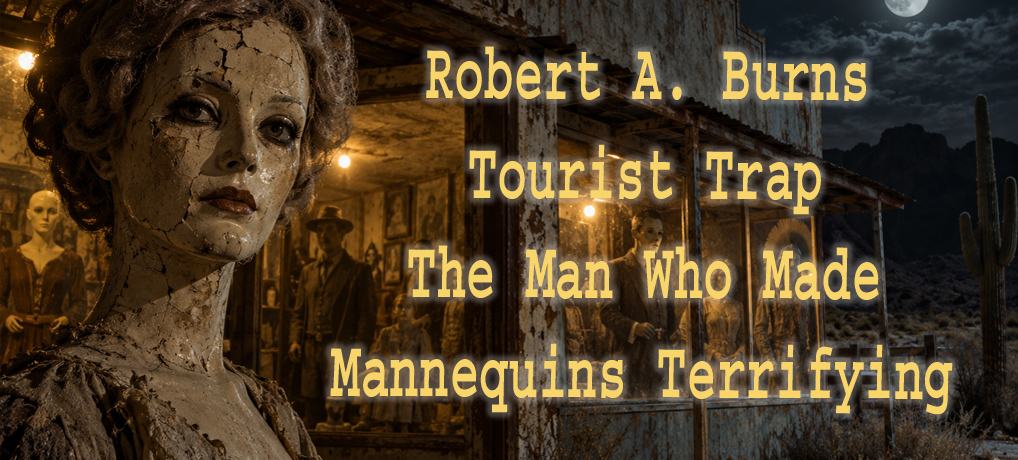
Somewhere along a road that nobody uses anymore, there is a museum that should not still be open. The buildings are weathered. The signs are hand-painted. The exhibits are dusty and mismatched and frozen in expressions that are almost human but not quite right. Nobody has visited in years. The new highway bypassed this place a long time ago, and the man who runs it has been left alone with his collection ever since.
That is the world that Tourist Trap asks you to step into. It is a 1979 horror film directed by David Schmoeller, starring Chuck Connors as Mr. Slausen, the lonely owner of a failed roadside attraction called Slausen's Lost Oasis. A group of young travelers stumbles onto the property after car trouble, and what happens next is one of the stranger horror experiences the decade produced.
The film works because of what is in the rooms. The mannequins. The masks. The worn furniture and unfinished figures and mismatched displays that fill Slausen's museum with a history nobody asked for and a presence that never quite lets go. That physical world was built by one man. His name was Robert A. Burns, and Tourist Trap stands as one of the finest examples of what a production designer can do when given a story that demands a world rather than a set.
What Is Tourist Trap About?
The film opens on Woody, a young man whose car has broken down on a deserted stretch of road. He finds what appears to be an abandoned gas station and goes inside to look for help. What he finds instead is a room full of mannequins and something that moves when it should not. The sequence that follows, with objects flying through the air and a door slamming shut, announces immediately that Tourist Trap is not going to behave like a conventional slasher film.
His friends eventually find their way to Slausen's Lost Oasis, a roadside museum that was once a going concern and is now populated entirely by wax figures, mannequins, and the sad memorabilia of a business that the world drove past and forgot. Mr. Slausen, played by Chuck Connors with a warmth that keeps shifting into something harder to name, welcomes them with a shotgun on his shoulder and a story about the highway that took his customers away. He seems kind. He seems harmless. He seems like exactly the kind of man you would want to find when your car has broken down in the middle of nowhere.
The film mixes slasher horror with supernatural elements, specifically a character who appears to possess telekinetic abilities, and wraps both around the wax-museum tradition that goes back to Mystery of the Wax Museum in 1933 and House of Wax in 1953. Its killer wears smooth, pale masks that connect him visually to the mannequins surrounding him. Its victims are isolated in a place that feels forgotten. And its horror is less about blood, of which there is very little, than about atmosphere, helplessness, and the deeply unsettling business of being in a room where the faces watching you are not quite right.
The major identity twist at the film's center is worth discovering without assistance. What can be said is that Schmoeller and co-writer J. Larry Carroll built their screenplay from Schmoeller's University of Texas thesis film, The Spider Will Kill You, and that the telekinetic elements were added at the suggestion of producer Charles Band, who also distributed the film through his association with Compass International Pictures, the same company that had recently released Halloween.
Slausen’s Lost Oasis: A Roadside Attraction Left Behind
Before the interstate highway system reshaped American travel, the roads of this country were lined with privately owned businesses competing for the attention of passing motorists. Reptile farms. Wax museums. Mystery spots. Curiosity shops. Giant fiberglass animals. Hand-painted signs promising wonders a quarter mile ahead. These attractions were built in an era when road trips moved at a different pace and drivers were willing to pull over for something unusual.
The Federal-Aid Highway Act of 1956, signed by President Eisenhower, set in motion the construction of the interstate system that would eventually bypass thousands of these businesses. A motel or museum that had sat directly on a busy two-lane highway could suddenly find itself a mile from the new high-speed road, reachable only by a confusing frontage road that most drivers never took. The impulse stops disappeared because drivers stayed on the faster lanes. The businesses that depended on curiosity and spontaneity found that the interstates were designed specifically to eliminate both.
Mr. Slausen explains this situation to his visitors with a bitterness that sits just below his hospitality. The new highway diverted traffic away from his museum. His business collapsed. He stayed anyway, tending to his collection in a place that the modern world had simply decided to forget. That detail gives the film a believable history that most horror movies never bother to establish. Slausen's Lost Oasis does not feel like a set. It feels like a real place that something went wrong inside of, over many years, in ways that were mostly quiet and mostly invisible to anyone passing on the road outside.
The Real America Behind the Horror
The roadside America that Tourist Trap elegizes was a genuine and specific culture. Families on summer vacations stopped at attractions that would strike modern travelers as eccentric at minimum. Wax museums featuring historical figures in various states of dramatic pose. Mystery spots where balls appeared to roll uphill and water seemed to flow sideways due to carefully managed optical illusions. Reptile farms where children pressed their faces against glass and stared at things that stared back. Souvenir shops selling turquoise jewelry, painted rocks, and postcards of giant fiberglass roadrunners.
These businesses were often family-owned and intensely personal. The people who built them had invested their lives in the belief that passing motorists would stop, and that stopping would be worth the detour. Many of them were right for a time. Then the interstates arrived, and the mathematics of traffic changed in ways that the individual roadside operator could not negotiate with.
What Tourist Trap understands, and what gives it a dimension that most horror films of its era lack, is that this decline had a human face. Mr. Slausen is not simply a horror movie villain waiting in a museum. He is a man whose life's work was made irrelevant by a road-building project. His bitterness is earned. His attachment to his collection is comprehensible. His museum is full of things that mattered to someone and now matter only to him. That context does not excuse what happens inside Slausen's Lost Oasis. It makes it sadder and stranger and ultimately more frightening.
The film turns nostalgia for American road trips, for the summer vacations and station wagons and roadside curiosities of the mid-century, into something deeply uncomfortable. The family-friendly promise of a roadside attraction becomes the premise of a nightmare. The open road, which American culture has always associated with freedom and possibility, leads here to a place that is inescapable.
Robert A. Burns Before Tourist Trap

Robert A. Burns was born on May 27, 1944, in Odessa, Texas. He earned a Bachelor of Fine Arts degree from the University of Texas at Austin, where he edited the campus humor magazine The Texas Ranger and developed the visual sensibility and love of found objects that would define his film work. He had careers in commercial art, advertising, and journalism before moving into film, and that background in practical visual communication shaped how he approached every set he designed.
He met director Tobe Hooper at a party in Austin and began working with him on small projects. That relationship led to his work as art director and casting director on The Texas Chain Saw Massacre in 1974. It was a $140,000 film shot in Texas summer heat, with a cast and crew that were operating under conditions of physical stress. Burns's contribution to that film has been recognized as one of the primary reasons it retains its power more than fifty years after its release.
The Sawyer family farmhouse in The Texas Chain Saw Massacre is one of the most disturbing interior spaces in the history of horror cinema, and Burns built it from scavenged and discarded materials. Bones assembled into mobiles and wall hangings. Animal parts incorporated into furniture. A dinner table constructed from human remains. Every object in that house suggests years of accumulated private ritual. Nothing looks purchased or placed for effect. Everything looks found, used, and integrated into a way of life that has its own terrible internal logic. The house does not feel like a set. It feels like evidence.
He brought that same approach to Wes Craven's The Hills Have Eyes in 1977. The desert landscape and scavenged living arrangements of the film's antagonist family have their own visual vocabulary, distinct from the Sawyer house but built from the same principle. Burns was not recreating horror movie sets. He was imagining the material lives of people whose existence had taken a particular direction over many years, and then building the physical traces of those lives from the outside in.
By the time he arrived at Tourist Trap in 1978, Burns had developed a reputation in the low-budget horror world as someone who could transform cheap or discarded materials into environments that felt inhabited. Director David Schmoeller later credited Burns with being essential not only to the look of the film but to the majority of its physical effects. Schmoeller described his contribution as the work of someone who understood that atmosphere came from the right objects given the right history, not from expensive equipment or elaborate construction.
Building the World of Tourist Trap
Tourist Trap was filmed in twenty-four days on a budget of $350,000, shot at locations in Malibu, Agua Dulce, Griffith Park, and Rampart Sound Studios in Los Angeles. Those constraints were not obstacles for Burns. They were conditions he had been working within for his entire career, and his approach to Slausen's Lost Oasis reflects a practical intelligence about what limited resources actually require.
Burns scrounged up a variety of mannequins to populate the museum, seeking out figures that were mismatched, worn, and at different stages of deterioration rather than selecting identical display pieces. The result is a collection that feels accumulated rather than arranged. Some figures are relatively intact. Others have cracked surfaces, missing features, or expressions that suggest damage rather than design. Some are dressed in period clothing that looks as though it has been on the figure for decades. Others are partially completed, as if the maker lost interest or ran out of materials before finishing the face.
This variety is essential to why the museum is so disturbing. A room full of identical mannequins would read as a manufacturing environment. A room full of varied mannequins, each with its own particular degree of completion and decay, reads as a collection. Someone chose these. Someone arranged them. Someone has been living among them. The museum reveals its occupant before the occupant reveals himself, and what it reveals is not quite right in ways that are difficult to articulate precisely.
The mismatched furniture, the hand-painted signs, the worn display cases and exhibit labels all contribute to the same effect. Every room in Slausen's museum has a history. That history is private and strange and belongs entirely to whoever has been tending this place alone since the highway took away the customers. Burns built an environment that tells a story through objects rather than through dialogue, and that story is already disturbing before anything overtly horrifying occurs.
How the Mannequins Became Monsters
The uncanny valley is a term borrowed from robotics to describe the discomfort that human beings feel when confronted with something that is almost human but not quite right. A robot or doll or wax figure that falls into this zone triggers a response that is more disturbing than either a clearly non-human object or a fully convincing human replica. Tourist Trap lives entirely in this space, and Burns understood how to build it from the ground up.
The mannequins throughout the film are almost human. They have faces, expressions, hair, clothing. They occupy space in the same rooms as the living characters, at the same scale, in the same light. Nothing about them announces itself as obviously theatrical or artificial. But their expressions are fixed. Their eyes do not track. Their smiles do not respond to what is happening around them. They are present in a way that store window mannequins are not, because they have been arranged with care and lived with for years, and that care has given them a weight that ordinary display figures do not carry.
Burns avoided making every figure look identical, which is the decision that matters most. Groups of similar objects become patterns. Groups of varied objects become populations. A room full of mannequins that each have their own particular face and condition and degree of completion feels occupied in a way that a matched set never could. The viewer is not looking at props. The viewer is looking at something that resembles a community, which is precisely the wrong thing to find in an empty building at the end of a road nobody uses.
The cracked surfaces, the wigs, the painted eyes, the missing features, and the stiff smiles all contribute to an environment that is recognizable and wrong simultaneously. The mannequins appear to watch the living characters. They appear to laugh. They appear to wait. They never actually do any of those things on their own, which makes the moments when they appear to move all the more effective, because the viewer has already been primed to feel that something in this room is not entirely still.
Tourist Trap Retro Big Box Collection
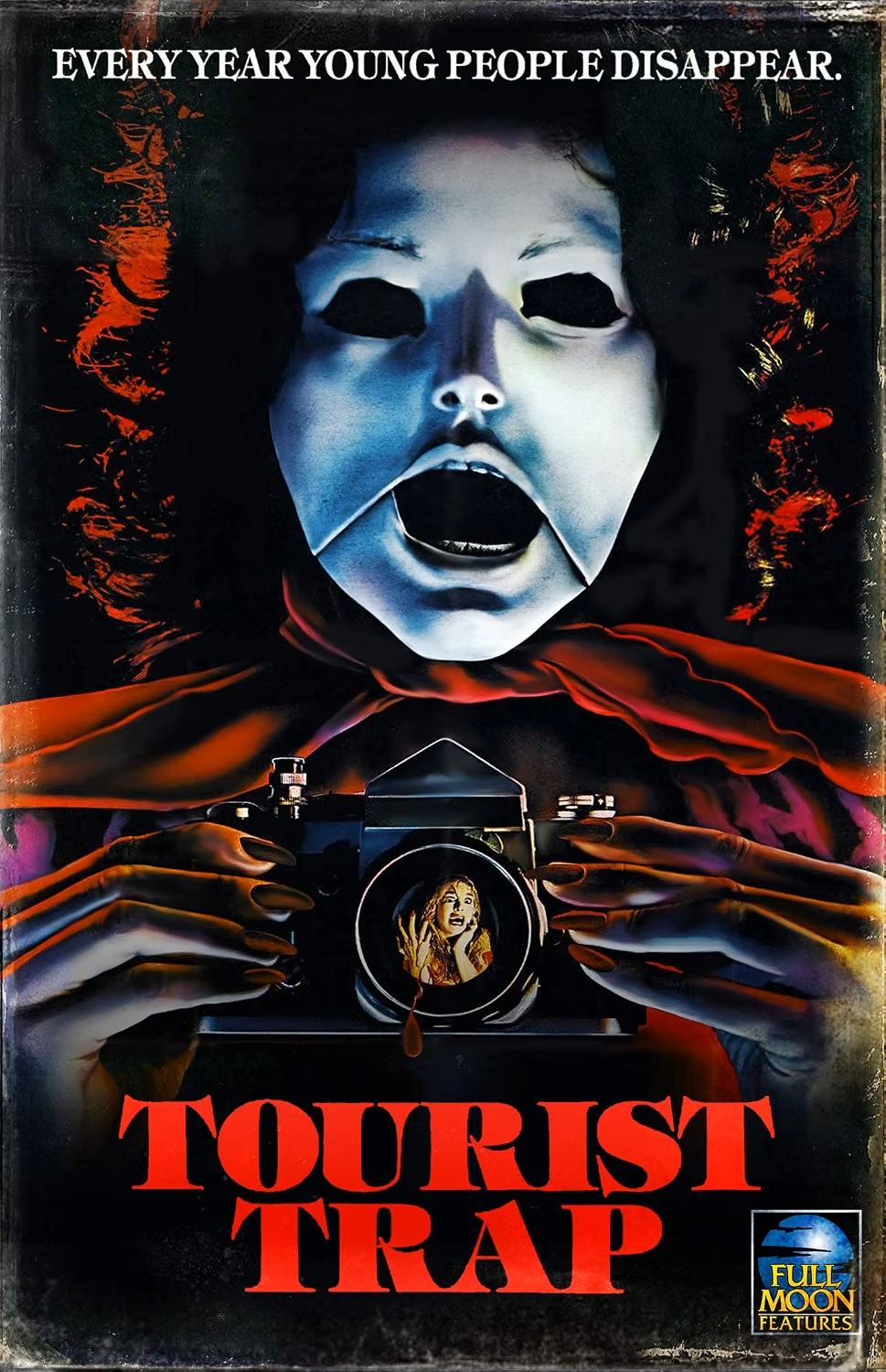
Product Description:
If you've just finished reading about Tourist Trap, there's no better way to experience this cult horror classic than with the Retro Big Box Collection. Featuring Chuck Connors as the mysterious Mr. Slausen and Tanya Roberts in one of her earliest film roles, this unforgettable blend of haunted attractions, sinister mannequins, and psychological terror remains one of the most unsettling horror films of the late 1970s. This collector's edition is packed with bonus features that horror fans will appreciate.
Key Features:
• Deluxe Retro Big Box collector's edition of Tourist Trap
• Starring Chuck Connors and Tanya Roberts
• Includes an interview with director David Schmoeller
• Features rare theatrical trailers and an audio commentary by the director
• A must-have for cult horror fans and physical media collectors
Why This Works:
Tourist Trap has earned a loyal following thanks to its eerie atmosphere, unforgettable mannequin effects, and disturbing story. If you're fascinated by the film's production, especially the remarkable work of production designer Robert A. Burns, this collector's edition is an excellent companion to your article. The bonus features offer additional insight into one of the most unique horror movies ever made, making it an outstanding addition to any horror collection.
Buy on Amazon
The Blank Masks of Tourist Trap
The killer's masks in Tourist Trap are among the most distinctive in the horror genre, and their effectiveness is built on exactly the same principle as the mannequins surrounding them. They are simple. They are pale. They express very little. And they are more disturbing for what they withhold than for anything they show.
A complicated monster mask announces its own artificiality. The viewer can see the latex, the paint, the mechanical elements. The construction is part of the spectacle. A smooth, pale mask that covers the entire face and registers only the most basic human features operates differently. It tells the viewer that there is a face underneath, and that the face has been deliberately hidden. The blankness is not the absence of expression. It is the replacement of expression with something that refuses to be read.
The masks in Tourist Trap connect the killer visually to the mannequins that surround him. He belongs in this collection. He is part of it. The boundary between the living and the displayed, between the person and the figure, is precisely what the film is interested in collapsing, and the masks are one of the primary tools Burns used to accomplish that collapse. A viewer who has spent ninety minutes in a room full of almost-human faces will not see a pale smooth mask as something clearly alien. They will see it as something that fits, and that recognition is more frightening than surprise.
Practical Effects Inside the Museum
Many of the film's most memorable effects were achieved physically during filming, which is part of why they retain their weight. There is a specific quality to an effect that exists in actual space, in front of an actual camera, with actual actors reacting to it in real time. Tourist Trap has that quality throughout, and Burns was responsible for building and executing many of the physical elements that created it.
The film's opening sequence, in which objects appear to fly across a room and hurl themselves against the walls, was accomplished through an ingenious piece of set construction. The room was built at a ninety-degree rotation from its apparent orientation. What appears on screen to be a wall was actually the floor. What appears to be a cabinet was anchored to the ceiling. Objects were thrown horizontally by crew members and fell naturally due to gravity, creating the impression, once the footage was rotated back to its apparent upright orientation, of objects being hurled with impossible force across vertical space. The effect looks strange because its physics are wrong, which is exactly what the sequence required.
Other effects were accomplished with wires, which in the hands of skilled operators and with careful editing and camera positioning can create illusions that digital effects often cannot match, specifically the impression that something is being moved by a force rather than a mechanism. The physical weight of a wire-suspended object, the way it swings and settles, reads differently to the eye than the motion of a digitally moved object, and Burns understood how to use that difference.
The staged knife impact was accomplished through the use of concealed protection hidden behind an actor's hair, a simple and effective solution to a problem that more expensive productions have sometimes solved less convincingly. The plaster-mask sequence was performed physically, with wet material applied gradually to an actor's face in close-up, and the slow, tactile construction of that effect is a significant part of why it remains disturbing. There is no digital element to reassure the viewer that what they are watching did not actually happen. It was in a room. A camera recorded it. An actor endured it.
The Plaster-Mask Scene
This section contains a minor spoiler for a specific scene in the film, though it does not reveal the film's central twist or ending.
At one point in Tourist Trap, a character is restrained and a wet material is applied gradually across her face while she remains conscious. The scene does not depend on blood or violence. It depends on helplessness and the viewer's immediate physical understanding of what is happening to the character. The sensation of material being applied over a breathing face is one that every viewer understands without being told. The close-ups of the character's eyes, still moving above the material as it rises toward her nose, communicate a specific terror that is almost entirely physical in its operation.
What makes the scene exceptional, beyond its practical construction, is what it represents within the film's logic. The act of making a mannequin, of covering a face and fixing its features into a permanent expression, has been transformed into a method of murder. The museum's collection and the killer's technique are revealed as the same process. Burns's mannequins, which have been filling the background of every scene since the film began, suddenly carry a different and heavier meaning.
A brief safety note is appropriate here. The application of plaster, papier-mache, latex, or any craft material over a person's face, and particularly over the nose or mouth, presents a physical risk and should never be attempted as a recreation or DIY project. The scene was filmed under controlled professional conditions with full attention to the actor's safety throughout.
Chuck Connors as Mr. Slausen
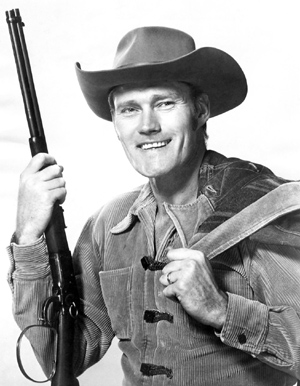
Chuck Connors was fifty-six years old when Tourist Trap was filmed, and he brought to the role of Mr. Slausen a specific kind of cultural weight that the film uses with considerable intelligence. Connors had spent the late 1950s and early 1960s as Lucas McCain in The Rifleman, a television western in which he played a widowed frontier father raising his son with a combination of physical capability and moral clarity. He was one of the most recognizable television presences of his generation, associated in the public imagination with dependability, strength, and a particular variety of American masculine integrity.
That association is exactly what Tourist Trap recruits when it casts him as Slausen. A man who looks like Chuck Connors, carrying a shotgun and wearing work clothes on a lonely property, reads initially as protective rather than threatening. His warmth toward the young visitors appears genuine. His explanation of the highway's effect on his business creates sympathy. His suggestion that they stay close to him while he looks for their friends seems like reasonable advice from a reasonable man.
Connors was not simply coasting on familiarity. He actively sought out the role, reportedly stating that he wanted to be the Boris Karloff of the 1980s. His performance moves between warmth and bitterness and humor and menace with a naturalness that makes the transitions more unsettling than they would be if the darkness were more consistently present. A Slausen who was always threatening would simply be a threat. A Slausen who is kind in some moments and wrong in others creates a more complicated and more frightening situation, because the viewer cannot fully trust their own reading of the character from scene to scene.
Pino Donaggio and the Sound of the Mannequins
The story of how Pino Donaggio came to score Tourist Trap is one of those production details that seems almost impossible in retrospect. Donaggio was in Los Angeles working on Joe Dante's Piranha when Schmoeller, serving as a Spanish language interpreter between Dante and the Italian composer who did not speak English, simply asked Donaggio at the end of a spotting session whether he would be interested in scoring Tourist Trap. Donaggio agreed. Producer Charles Band, who had spent part of his childhood in Italy and spoke fluent Italian, negotiated the arrangement. The budget rose from $300,000 to $350,000 to cover Donaggio's fee and the cost of recording the full orchestral score in Rome.
At the time, Donaggio had already scored Don't Look Now for Nicolas Roeg in 1973 and Carrie for Brian De Palma in 1976. His credentials were exceptional for a film of this size and budget. Producer Irwin Yablans reportedly hated the score Donaggio delivered, having wanted something closer to the synthesizer-based Halloween soundtrack. What Donaggio provided instead was a fully orchestrated score that begins with a wry, almost circus-like quality and then moves through melancholy, playfulness, tension, and outright terror as the film requires.
The score is essential to how the mannequins function as a horror element. Laughter, mechanical sounds, voices, and sudden musical stabs animate the displays in the viewer's imagination even when nothing on screen is moving. Sound creates the impression of movement in the peripheral vision of the mind, and Donaggio understood how to use that principle. The scratchy harps, the staccato strings, the eerie vocal effects, and the precisely timed musical cues give the museum a soundscape that makes it feel populated and active in ways that the production design alone could not fully achieve. The two elements together, Burns's physical world and Donaggio's score, create something that neither could have accomplished without the other.
How Tourist Trap Blends Several Kinds of Horror
Part of what made Tourist Trap difficult to market in 1979, and part of what makes it distinctive today, is that it does not fit comfortably into any single horror category. Its surface resembles the stranded-traveler slasher format that The Texas Chain Saw Massacre had established five years earlier and that was being replicated across the genre with increasing frequency. But Tourist Trap adds elements that the standard slasher format does not accommodate.
The telekinetic powers that the killer appears to possess introduce a supernatural dimension that the slasher format excludes. The mannequins connect the film to the wax-museum horror tradition, a genre with its own history and its own particular variety of dread. The roadside isolation, the failed attraction, and the bitterness of a man whose life's work was made irrelevant by a highway give the film a social and emotional context that most slashers do not pursue. And director Schmoeller, who had studied theater in Mexico under Alejandro Jodorowsky and film under Luis Buñuel, brought a surrealist sensibility to the material that occasionally pushes the film in directions that are strange rather than conventionally frightening.
Stephen King recognized this quality. In his 1981 book Danse Macabre, a survey of horror in literature and film, King praised Tourist Trap as an obscure classic, singling out its atmosphere and its willingness to operate outside genre convention. That endorsement did not immediately rescue the film from obscurity, but it placed it in a conversation it deserved to be part of.
The Film’s Surprising PG Rating
Tourist Trap received a PG rating from the Motion Picture Association of America, a designation that surprised virtually everyone involved in the production. The film contains scenes of violence, sustained psychological horror, the plaster-mask suffocation sequence, and imagery that most audiences of any era would consider disturbing. Director Schmoeller himself has expressed surprise at the rating in subsequent interviews.
The rating is explicable in the context of what the film does not contain. There is very little blood. The violence is often more suggested than shown. The horror operates primarily through atmosphere, helplessness, and the steady accumulation of wrong details rather than through explicit gore. The MPAA's rating system in 1979 was calibrated primarily around sexual content and explicit violence, and Tourist Trap managed to be frightening while remaining within boundaries that the system registered as appropriate for a general audience.
The PG rating had practical consequences. It allowed the film to reach television audiences more easily than an R-rated picture would have. Repeated screenings on cable television in the 1980s introduced Tourist Trap to viewers who had missed its initial theatrical release, and many of those viewers were younger than they might have been if the film had carried a more restrictive rating. The cult following the film eventually developed was built in part from audiences who encountered it on cable as teenagers and found it far more disturbing than its rating had suggested they should.
Why Tourist Trap Was Overlooked
Tourist Trap opened in March 1979, during a period when the American horror market was absorbing the aftermath of Halloween and preparing for the slasher wave that Friday the 13th would launch the following year. Audiences and distributors were developing a template for what a successful horror film looked like, and Tourist Trap did not fit that template cleanly. Its telekinesis made it something other than a straightforward slasher. Its mannequins made it something other than a supernatural horror film. Its roadside setting and its strange emotional register made it something other than either.
It grossed four million dollars against its $350,000 budget, which represents a profitable return but not the kind of success that generates sequels or sustained studio attention. It did not produce a franchise. Its distributor was Compass International Pictures, which lacked the marketing reach of the major studios. The film was made on a tight schedule by a first-time director working with a production designer who was himself still building his reputation.
What saved it was time and the gradual expansion of home video. VHS allowed viewers to seek out films that had been missed or misunderstood on their initial release. Cable television brought it to audiences across the country without the filter of theatrical distribution. DVD and later digital restorations gave it a clarity and accessibility that its theatrical run had never provided. Each new format found a new audience, and each new audience contributed to a cult following that has continued to grow.
Robert A. Burns’s Recognizable Style
Comparing the work of Robert A. Burns across Tourist Trap, The Texas Chain Saw Massacre, and The Hills Have Eyes reveals a consistent set of principles operating within three very different visual environments. The films do not look identical. The Sawyer farmhouse, the desert camp of the Hills Have Eyes family, and Slausen's Lost Oasis are distinct places with distinct personalities. But they share a quality of having been built from the inside out rather than the outside in.
In each case, Burns began with an imagined occupant and worked backward to the objects that person would have accumulated, modified, and arranged over years. The bones and animal parts of the Sawyer house tell the story of a family whose relationship to the world around them has become purely predatory and whose domestic rituals incorporate that predation into every surface.
The scavenged materials and desert-adapted living arrangements of The Hills Have Eyes family tell the story of people who have built a life from whatever the desert provided and whatever passing travelers left behind. Slausen's Lost Oasis tells the story of a man who stayed when everyone else left, who has been tending a collection in isolation for years, and whose loneliness has taken a direction that the objects around him quietly suggest before he says a word.
Burns died on May 31, 2004, in Seguin, Texas, four days after his sixtieth birthday. He had worked on more than a dozen films across his career, including The Howling for Joe Dante in 1981 and Re-Animator for Stuart Gordon in 1985. He is the subject of a 2020 documentary called Rondo and Bob, directed by Joe O'Connell, which follows Burns's decades-long search for information about Rondo Hatton, a former sports reporter whose acromegaly transformed his features and led to a brief acting career. The documentary gives a portrait of Burns as a man of curiosity and warmth whose relationship to the strange and the forgotten went far beyond his professional work.
A Dark Record of Vanishing Roadside America
There is an irony at the center of Tourist Trap that the film itself seems aware of. Slausen's Lost Oasis is a roadside attraction that nobody visits. The highway bypassed it. The customers stopped coming. The exhibits that were meant to entertain passing travelers have been waiting in the dark for years, accumulating dust and a private history that nobody was supposed to see.
The film changed that. Tourist Trap is now the reason that Slausen's Lost Oasis has an audience. The museum that was designed to catch the eye of motorists and invite them to stop has finally succeeded, through the medium of a horror film, in doing exactly that. Viewers who would never have known this place existed have spent ninety minutes inside it. They have examined its exhibits and its mannequins and its hand-painted signs more closely than any tourist ever would have. The attraction's failure became, through a specific kind of movie-making, its most successful season.
That is the kind of Forgotten Americana that Tourist Trap preserves. Not just the physical details of a roadside museum, the worn surfaces and mismatched figures and fading signage, but the emotional reality of a place that believed in its own relevance and was proven wrong by forces it could not control. The highway did not care about Slausen's Lost Oasis. The interstate system was not designed with small attractions in mind. The decision that destroyed this particular fictional business was made by people who never knew it existed.
That story, of a place built with care and left behind by progress, is one of the defining American narratives of the twentieth century. Tourist Trap tells it through the specific and uncomfortable medium of horror, which turns out to be exactly the right genre for the job.
Why Tourist Trap Still Works
The location feels used and inhabited in ways that designed sets rarely do, because Burns built it from objects with histories rather than from objects selected for appearance.
The mannequins occupy the same physical space as the actors, which gives every scene a weight that digital backgrounds and composited environments cannot reproduce. When an actor looks at a mannequin, they are looking at something that is actually there, and that reality communicates itself through the performance.
The masks have clear and readable shapes that work at any distance and in any light. Their simplicity is their strength.
Chuck Connors gives the strange story a human center that the film would not survive without. His familiarity makes the strangeness more strange. His warmth makes the horror more horrifying.
The practical effects retain their physical weight because they were physically constructed. The rotated room, the wire work, the plaster application: all of these were real, and the camera recorded their reality.
And Robert A. Burns's production design makes Slausen's Lost Oasis feel larger than anything shown on screen. Every room implies rooms beyond it. Every object implies a story behind it. The museum seems to extend in every direction beyond the edges of the frame, and that sense of a world that exceeds the camera's view is what finally distinguishes an unsettling film from one that is merely frightening.
Final Thoughts
There is a particular quality to places that were built for one purpose and ended up serving another entirely. Slausen's Lost Oasis was built to entertain. It ended up as something else. Robert A. Burns understood that transformation and built it into every surface of the museum he designed.
His work on Tourist Trap deserves recognition alongside his work on The Texas Chain Saw Massacre, which has received considerably more attention from film historians and horror enthusiasts alike. Both films demonstrate the same principle: that the physical environment of a horror film is not decoration but argument, that the objects in a room tell the story of the people who put them there, and that a production designer who understands this can build a nightmare from almost nothing.
Tourist Trap deserves more than its current status as a cult oddity seen by horror completists and recommended in footnotes. It is a handmade horror film built inside the ruins of American roadside travel, designed by a man who knew how to give discarded objects a history and a presence, scored by a composer who understood how to make an empty room sound populated, and anchored by a performance from an actor who made the familiar strange and the strange familiar.
It has been waiting at the end of that road for more than forty years. It is worth the detour.
Tourist Trap Retro Big Box Collection
Product Description:
If you've just finished reading about Tourist Trap, there's no better way to experience this cult horror classic than with the Retro Big Box Collection. Featuring Chuck Connors as the mysterious Mr. Slausen and Tanya Roberts in one of her earliest film roles, this unforgettable blend of haunted attractions, sinister mannequins, and psychological terror remains one of the most unsettling horror films of the late 1970s. This collector's edition is packed with bonus features that horror fans will appreciate.
Key Features:
• Deluxe Retro Big Box collector's edition of Tourist Trap
• Starring Chuck Connors and Tanya Roberts
• Includes an interview with director David Schmoeller
• Features rare theatrical trailers and an audio commentary by the director
• A must-have for cult horror fans and physical media collectors
Why This Works:
Tourist Trap has earned a loyal following thanks to its eerie atmosphere, unforgettable mannequin effects, and disturbing story. If you're fascinated by the film's production, especially the remarkable work of production designer Robert A. Burns, this collector's edition is an excellent companion to your article. The bonus features offer additional insight into one of the most unique horror movies ever made, making it an outstanding addition to any horror collection.
Buy on Amazon
Further Reading and Viewing
For readers who want to explore the film and its context further, several reliable resources are worth seeking out. The American Film Institute maintains a catalog entry for Tourist Trap that provides production information and context within American film history. Full Moon Features, which holds the restored version of the film, offers it through their streaming platform at fullmoonfeatures.com.
Director David Schmoeller has given several detailed interviews about the production, including an extensive conversation published at Daily Grindhouse that covers the hiring of Donaggio, the working relationship with Charles Band, and his recollections of Burns's contributions to the film. The documentary Rondo and Bob, directed by Joe O'Connell and available on streaming platforms, provides the most complete portrait of Robert A. Burns as a person and an artist that currently exists.
For the broader history of American roadside attractions and their decline, the archives at Roadside America represent one of the most comprehensive ongoing records of these vanishing pieces of Americana.